

Taking more vitamins doesn't automatically improve libido, erections, stamina, or testosterone. That promise is the product of aggressive supplement marketing, not a reliable reading of clinical evidence. For most men, the useful question isn't “Which vitamin boosts performance?” It's “Which nutritional deficiency could be contributing to the problem, and can testing confirm it?”
That distinction matters. A nutrient can support hormone production, sperm development, vascular function, or cellular energy when the body lacks enough of it. Once nutritional status is adequate, adding more may produce little sexual benefit and can create unnecessary risks. The evidence for vitamins commonly marketed for sexual health supports targeted correction, not a universal performance upgrade.
Table of Contents
- The Deficiency Reality Behind Sexual Wellness
- Evaluating the Vitamin D and Testosterone Connection
- Zinc and B Vitamins for Androgen Support
- Supplement Ingredients That Might Backfire
- Choosing the Right Supplement Forms and Doses
- Integrating Vitamins with Lifestyle and Blood Flow
- When to Stop Supplementing and See a Clinician
The Deficiency Reality Behind Sexual Wellness
Sexual function depends on several systems working together. Hormone production, blood-vessel health, nerve signaling, energy availability, psychological wellbeing, and reproductive biology all matter. A deficiency can interfere with one or more of these systems, but a supplement can't compensate for every cause of erectile dysfunction or low desire.
The most important distinction is between repletion and enhancement. Repletion brings an inadequate nutrient level back into a healthier range. Enhancement attempts to push an already adequate system beyond its normal function. Research on male sexual health is much more supportive of the first scenario.
A man with insufficient vitamin D, poor zinc intake, or an absorption problem may have a plausible nutritional contributor to address. A man whose relevant nutrient levels are already adequate shouldn't assume a multivitamin will improve his sex life just because the label includes vitamin D, zinc, or B vitamins.
Why multivitamins often disappoint
Multivitamins are designed to cover broad nutritional needs, not to diagnose or treat a specific sexual-health problem. They may be useful when diet is limited or a clinician identifies a nutritional gap, but their presence in a daily routine doesn't prove that the body needs more of every ingredient.
The broader evidence is especially sobering for antioxidant vitamins. A systematic review found no significant effect from vitamins A, C, and E on sexual function, while evidence for vitamin D and vitamin B3 was limited to only a small number of studies. The systematic review of vitamins and sexual function therefore points toward a deficiency-first strategy rather than indiscriminate supplementation.
Practical rule: A symptom is a reason to investigate, not proof that a particular vitamin is missing.
Low libido or erection changes can also reflect cardiovascular disease, diabetes, medication effects, depression, anxiety, sleep disruption, or clinically low testosterone. Nutritional correction may support recovery when deficiency is part of the picture, but it shouldn't delay evaluation for those conditions.
A better starting point
Begin with diet, symptoms, medications, medical history, and appropriate laboratory testing. Restrictive eating patterns, malabsorption, and limited exposure to vitamin-D sources can make a deficiency more plausible. Testing is still more informative than guessing.
The practical conclusion is narrow but useful: supplements for men's sexual health make the most sense when they correct a documented or strongly suspected deficiency. They are not fundamentally useless. They are merely being asked to do more than the evidence supports when marketers present them as universal libido or erection enhancers.
Evaluating the Vitamin D and Testosterone Connection
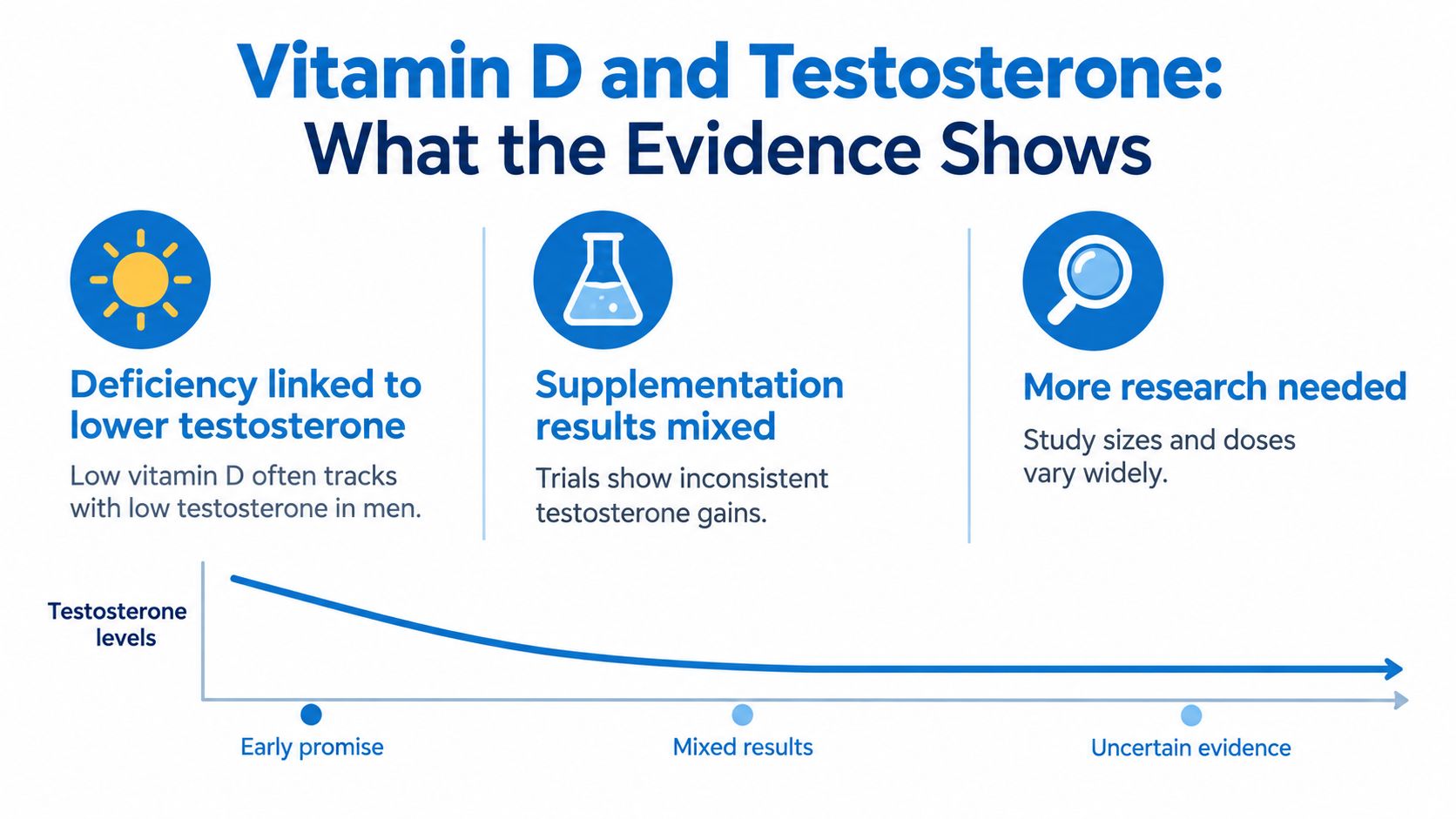
Vitamin D is the most extensively studied vitamin in male sexual health, but it's also one of the easiest to oversell. Observational research often links lower blood levels with lower testosterone or poorer erectile function. Randomized trials, which are better suited to testing whether supplementation causes improvement, have produced a far less consistent picture.
A 2018 cross-sectional study found that higher 25-hydroxyvitamin D, or 25(OH)D, was significantly associated with higher testosterone and better erectile-function scores. That result supports a biological relationship, but it can't prove that low vitamin D caused the sexual symptoms. Men with lower vitamin D may also have poorer general health, less activity, or other conditions that affect erectile function.
A later meta-analysis reached a more cautious conclusion, finding that the overall relationship between vitamin D and erectile-dysfunction risk wasn't strong. More recent research has continued to observe worse erectile outcomes among men with low vitamin D. One 2025 review reported that a 10 ng/mL decrease in 25(OH)D was associated with a 12% increase in erectile-dysfunction prevalence, while men with more severe or arteriogenic ED tended to have lower levels than men with milder ED. These findings are described in the research on vitamin D, testosterone, and erectile function.
The threshold question
The pattern appears to be more relevant in deficient men than in the general population. Some evidence links serum 25(OH)D levels above roughly 30 to 35 ng/mL, or 75 to 87.5 nmol/L, with better endothelial and sexual-health markers. One study also reported a cut-off around 15.05 ng/mL for distinguishing arteriogenic from non-arteriogenic ED. These thresholds shouldn't be treated as universal treatment targets, because laboratory interpretation depends on context and the study population.
The more defensible interpretation is that very low vitamin D may identify a health state associated with poorer vascular or hormonal function. Correcting that deficiency can be reasonable. Taking vitamin D at high levels without knowing your starting status is a different proposition.
What supplementation trials actually show
A three-year randomized trial in older men found ED prevalence of 58.8% in the vitamin D group and 59.0% in the placebo group, with a prevalence ratio of 1.00, 95% CI 0.97 to 1.03, and no subgroup benefit. The randomized evidence summarized in PubMed is important because it separates association from causation. Low vitamin D may accompany poorer health without supplementation alone reversing established erectile dysfunction.
A separate 2017 study in middle-aged men with vitamin-D deficiency reported that 12 months of high-dose treatment improved testosterone and erectile-function outcomes. The contrast between these studies suggests that baseline status matters. Supplementation may be more useful for a deficient subgroup than for older men treated without a demonstrated deficiency.
A 2024 meta-analysis of 17 randomized controlled trials involving 1,774 men reported that vitamin D supplementation may raise total testosterone overall. The signal was strongest in trials using more than 4,000 IU daily for longer than 12 weeks, although other randomized evidence still finds no consistent effect across all men. The meta-analysis of vitamin D and testosterone supports a dose- and context-dependent relationship, not a universal testosterone boost.
Vitamin D is a plausible deficiency-correction tool. It isn't a dependable standalone treatment for erectile dysfunction.
Zinc and B Vitamins for Androgen Support
Zinc deserves separate attention because it's a mineral with a direct role in male reproductive biology. It contributes to spermatogenesis and supports serum testosterone, so inadequate intake can affect fertility potential as well as sexual function. The benefit is most plausible when zinc intake or absorption is low.
Review evidence links low seminal zinc with poorer sperm quality and identifies poor zinc nutrition as a significant risk factor for idiopathic male infertility. That doesn't mean every man with low libido should take zinc. It means men with restrictive diets, malabsorption, limited food variety, or confirmed deficiency have a clearer reason to investigate zinc status than men seeking a general performance edge. The review of zinc and male reproductive health supports repletion in the right clinical context.
Who should think about zinc first
A man who avoids many zinc-containing foods may have a different risk profile from someone eating a varied diet. Absorption problems can matter as much as intake. Chronic gastrointestinal disease, certain restrictive diets, and other medical factors can make a targeted assessment more useful than buying a broad “testosterone support” blend.
Zinc's role also illustrates the limit of supplementation. If deficiency is impairing sperm development or androgen status, restoring adequacy may remove a bottleneck. If zinc status is already sufficient, more isn't automatically better, and excessive mineral intake can interfere with the balance of other nutrients.
A sensible approach is to review dietary intake and medical history with a clinician, then use testing where appropriate. Don't interpret a product's high zinc content as evidence that it will improve erections or libido.
What the B-vitamin evidence says
B vitamins are often marketed around energy, nerve function, and blood flow. Those biological roles make them relevant to sexual health in principle, but the direct clinical evidence is limited. The systematic review cited earlier found limited evidence for vitamin B3, based on only a small number of studies, rather than strong proof that B vitamins improve sexual function in nutritionally replete men.
That makes B vitamins most defensible when a deficiency or absorption problem is present. A man with poor dietary intake or a condition that interferes with nutrient absorption may need focused medical advice. A man with normal nutrition shouldn't assume that adding a B-complex product will raise testosterone or improve performance.
For product-specific research, you can review the Thorne Zinc Picolinate information, but the decision to supplement should still follow the deficiency question. The threshold for action is inadequate status, not the desire for an extra hormonal effect.
Supplement Ingredients That Might Backfire
The safest supplement strategy isn't necessarily the one with the longest ingredient list. Proprietary “vitality” formulas often combine vitamins, trace elements, stimulants, herbs, and joint-support compounds. A consumer may see several familiar ingredients and assume that the combination is harmless. That assumption has weak foundations.
A 2026 study reported that vitamins and trace elements showed no protective effect against erectile dysfunction. It also found associations between supplementation with glucosamine, chondroitin, chromium, and selenium and increased ED risk. The 2026 study on supplement ingredients and erectile dysfunction doesn't establish that those ingredients directly caused ED, but it does challenge the idea that every “men's health” ingredient is automatically beneficial.
Association isn't proof, but it changes the buying decision
The study's finding is observational, so it can't prove causation. Men who take glucosamine, chondroitin, chromium, or selenium may differ from nonusers in age, health status, medication use, or reasons for taking supplements. Those differences could influence erectile outcomes.
Still, the result matters because it gives consumers a reason to scrutinize unnecessary ingredients. If a product includes selenium or chromium without a specific nutritional rationale, the ingredient isn't automatically justified by its presence on the label. A formula designed to support sexual health should have a clear purpose for each active component.
Read the entire label: A familiar ingredient can still be unnecessary, poorly dosed, or inappropriate alongside your medications.
Why blends deserve skepticism
Proprietary blends make it difficult to evaluate individual amounts. They can also encourage stacking, where a man takes a multivitamin, a testosterone product, a pre-workout, and a sexual-enhancement capsule without realizing that several products contain overlapping nutrients or stimulants.
That creates two problems. First, you can't tell which ingredient is responsible for a benefit or side effect. Second, you may continue taking an unnecessary product because the blend's marketing implies that more ingredients mean better results.
A single-ingredient product is easier to evaluate when a clinician has identified a specific need. It also makes it easier to stop, adjust, or monitor the intervention. This is particularly important for men taking medication for blood pressure, diabetes, mood disorders, or cardiovascular disease.
The contrarian conclusion is practical: don't ask only what a supplement contains. Ask what each ingredient is doing, whether you need it, and whether evidence supports its inclusion. A shorter label can be a safer and more rational choice than a crowded formula.
Choosing the Right Supplement Forms and Doses
Once a legitimate nutritional gap has been identified, product selection becomes a quality-control exercise. The form matters sometimes, but it's less important than using an appropriate dose, avoiding unnecessary combinations, and choosing a product with transparent labeling.
Chelated minerals are often marketed as easier to absorb, but a consumer shouldn't treat a particular chemical form as a guarantee of better sexual-health results. The relevant question is whether the product provides a clearly stated amount of the active nutrient and fits your medical needs.
Vitamin D products also vary by form, including D2 and D3. The evidence in this article doesn't establish that one form produces superior sexual outcomes, so choose based on clinician guidance, product transparency, and your individual situation rather than a performance claim.
A label-reading checklist
- Identify the active amount. Avoid labels that hide individual ingredient quantities inside a proprietary blend.
- Check duplicate ingredients. Compare every product you take, including multivitamins and sports formulas.
- Look for quality verification. Third-party testing can provide additional information about identity and purity, but certification doesn't prove that a product treats ED.
- Review excipients. Check capsules, sweeteners, colors, allergens, and other inactive ingredients if they matter to you.
- Match the form to your routine. Capsules, veggie capsules, gummies, and liquid products can all improve adherence when their labels are clear.
- Ask about interactions. A pharmacist or clinician can assess the product alongside prescriptions and medical conditions.
Nutrient absorption and form guide
| Nutrient | Preferred form | Absorption note |
|---|---|---|
| Vitamin D | A clearly labeled vitamin D product | Absorption and dosing should be interpreted alongside measured 25(OH)D status |
| Zinc | A transparent single-ingredient mineral | Intake, absorption, and deficiency status matter more than enhancement claims |
| B vitamins | A clearly labeled B-complex or individual vitamin | Target the specific nutritional gap rather than assuming the whole complex is needed |
Don't choose a supplement because its dose looks impressive. A larger amount may increase cost and risk without improving sexual function. The best product is the one that addresses a defined need, states its contents plainly, and can be monitored.
Integrating Vitamins with Lifestyle and Blood Flow
A vitamin doesn't operate independently of the body systems involved in sexual function. Erectile health depends heavily on vascular performance, while testosterone and libido are influenced by sleep, energy balance, stress, illness, and physical activity. Correcting a deficiency may remove one obstacle, but it won't replace the daily behaviors that support circulation and recovery.
Think of supplementation as a supporting intervention. If vitamin D is low, correcting it may be sensible. If zinc intake is inadequate, improving food sources or using targeted repletion may help. Neither step addresses poor sleep, inactivity, medication effects, anxiety, or vascular disease on its own.
Build the foundation before adding a capsule
A practical routine starts with regular meals built around nutrient-dense foods, consistent physical activity, sufficient sleep, and a plan for managing chronic stress. These habits support general health and make it easier to determine whether a supplement is contributing anything meaningful.
Exercise also provides a useful diagnostic perspective. If erections, energy, or libido change alongside worsening fitness, sleep, or stress, a vitamin may not be the primary lever. If symptoms persist despite healthier routines, medical assessment becomes more important, not less.
The useful combination is not “more supplements.” It's targeted repletion plus habits that support vascular and hormonal function.
Use one change at a time when possible. If you begin several products simultaneously, you won't know which ingredient helped or caused an adverse effect. Record the product, dose, start date, symptoms, and any relevant laboratory results, then review the pattern with a healthcare professional.
For readers considering products marketed around nitric oxide or performance, the Old School Vintage Burst Nitric Oxide Muscle Pump review may provide product-specific context, but it shouldn't replace an assessment of persistent erectile symptoms.
This video offers additional visual context for the relationship between exercise, recovery, and wellness:
The central insight is that micronutrients are most useful when they support a broader plan. A targeted supplement may correct a biochemical shortfall, while sleep, activity, stress management, and cardiovascular care address the conditions that allow sexual function to improve.
When to Stop Supplementing and See a Clinician
Persistent sexual symptoms deserve a medical explanation, particularly when they're new, worsening, or unrelated to any obvious dietary change. Sudden erectile dysfunction, a major libido decline, ongoing fatigue, or a substantial change in morning erections shouldn't be handled only with supplements.
A clinician can review medications, mental health, sleep, cardiovascular risk, metabolic health, and hormone symptoms. Depending on the situation, evaluation may include blood tests for glucose regulation, lipid and cardiovascular markers, vitamin status, and testosterone. The exact panel should be guided by symptoms and medical history rather than a generic internet checklist.
Stop self-experimenting when
- Symptoms begin suddenly: New erectile changes may require prompt assessment.
- Fatigue persists: Ongoing exhaustion can reflect medical, hormonal, sleep-related, or psychological causes.
- Libido drops sharply: A pronounced change deserves more than a new multivitamin.
- Products cause reactions: Stop the suspected supplement and seek advice for significant or persistent symptoms.
- You take prescription medication: Ask a pharmacist or clinician before adding a blend, especially one containing multiple active ingredients.
- Symptoms continue after correcting a deficiency: A nutritional explanation may be incomplete.
Urologists can assess erectile and reproductive concerns. Endocrinologists can help evaluate suspected hormone disorders. Primary-care clinicians can coordinate broader testing and address cardiovascular or metabolic contributors.
The practical boundary is clear: supplements may correct deficiencies, but they can't diagnose arteriogenic disease, diabetes, medication effects, or clinical hypogonadism. If sexual function remains impaired, move from product experimentation to clinical evaluation.
CalVitamin offers vitamins, minerals, herbal formulas, proteins, probiotics, and sexual-wellness products in formats including capsules, veggie capsules, liquid shots, and gummies. Use CalVitamin to compare clearly labeled options, then choose targeted supplementation based on your nutritional needs and clinical advice rather than performance marketing.






