
Magnesium glycinate isn't automatically the better-absorbed choice. That popular recommendation confuses a useful practical advantage, gentler digestion, with a bioavailability advantage that hasn't been established for every formulation. The difference between magnesium citrate and magnesium glycinate is better understood through measured magnesium responses, elemental dose, and whether their effects on your bowel help or hinder consistent use.
Table of Contents
- Why These Two Magnesium Salts Get Confused
- Citrate and Glycinate Side by Side
- Which Form Raises Magnesium in Studies
- Elemental Magnesium on the Label
- How Each Form Treats the Gut
- Which Form Fits the Goal
Why These Two Magnesium Salts Get Confused
Both products supply magnesium, but they attach it to different partners. Magnesium citrate is the water-soluble salt of citric acid. Magnesium glycinate, often sold as bisglycinate, is an amino-acid chelate that binds magnesium to glycine.
The word chelated describes that chemical arrangement. It doesn't, by itself, establish that a finished supplement delivers more magnesium into circulation than citrate.
Chemical identity isn't a clinical ranking
A systematic review published in 2025 describes citrate and glycinate as generally well absorbed, while emphasizing that study design, dose, formulation, and individual tolerance influence the results. That's a more defensible starting point than ranking every glycinate supplement above every citrate supplement.
The distinction matters because a bottle's chemical name tells you less than its marketing suggests. A manufacturer can accurately describe a product as a chelate without having demonstrated superior absorption against another finished product.
Practical rule: Treat chelation as a description of the ingredient, not proof that it wins a human comparison.
Three checks matter more than premium wording
Use separate questions to evaluate a supplement rather than trying to answer everything with the word absorption.
- Measured response: Did a human comparison show a change in magnesium readings, and what exactly did the investigators measure?
- Elemental dose: How much actual magnesium does the serving supply, rather than how much the entire magnesium compound weighs?
- Digestive tolerance: Can you take the intended serving consistently without unwanted bowel effects?
These checks can lead to different winners. A product can produce a stronger circulating-magnesium signal yet be less practical for someone who develops loose stools. Another can be easier to take regularly without having demonstrated superior absorption.
The useful distinction is therefore not basic versus premium. It's evidence for magnesium delivery versus suitability for your routine. Neither salt wins every comparison for every adult, and the exact product deserves more scrutiny than the category name.
Citrate and Glycinate Side by Side
| Criterion | Magnesium citrate | Magnesium glycinate |
|---|---|---|
| Chemical form | Water-soluble salt of citric acid | Amino-acid chelate, often sold as bisglycinate |
| Elemental magnesium by compound weight | Higher elemental share in the compared formulations; verify the finished label | Lower elemental share in the compared bisglycinate formulation; composition affects the amount |
| Evidence for raising magnesium | Stronger direct human signals in the comparisons discussed below | No basis for assuming every glycinate product produces a greater circulating-magnesium response |
| Gut effect | Osmotic; loose stools, cramping, or diarrhea become a greater concern as the dose rises | Generally better tolerated, although not guaranteed to be symptom-free |
| Lowest tracked price per equivalent elemental dose | Compare the cost of actual magnesium, not compound weight | Don't assume chelation makes the equivalent dose more expensive |
| Best everyday fit | Repletion when a softer stool would also be useful | Daily repletion when a laxative effect would undermine adherence |
Magnesium citrate versus magnesium glycinate at a glance
Read across a row, not down a column looking for the most favorable descriptions. The chemical-form row identifies the ingredient. The evidence row addresses measured outcomes. The gut row addresses your likely experience. Those are related questions, but they aren't interchangeable.
For example, a person who wants to improve magnesium intake and already struggles with urgency should give digestive tolerance considerable weight. A person whose stools are persistently firm might view citrate's bowel effect differently. Neither decision requires pretending that the preferred form is universally more absorbable.
Compare the serving you'll actually take
The most useful comparison happens at the labeled elemental amount per serving. Bottle size, capsule size, and a large compound-weight claim don't establish equivalence.
A supplement requiring a larger serving might still be the more practical purchase if it supplies the intended elemental amount in a tolerable format. Conversely, a compact capsule isn't useful if the actual magnesium amount is unclear.
- Start with the Supplement Facts panel: Identify the magnesium amount and the serving size together.
- Read the ingredient description: Confirm whether the product contains citrate, bisglycinate, or a mixture.
- Assess practicality: Consider capsule count, powder measurement, and whether the serving fits your routine.
The table is a selection aid, not a claim that citrate treats one set of medical conditions while glycinate treats another. Both deliver the same mineral. The meaningful purchasing differences concern delivery, concentration, tolerability, and value at an equivalent elemental amount.
Which Form Raises Magnesium in Studies
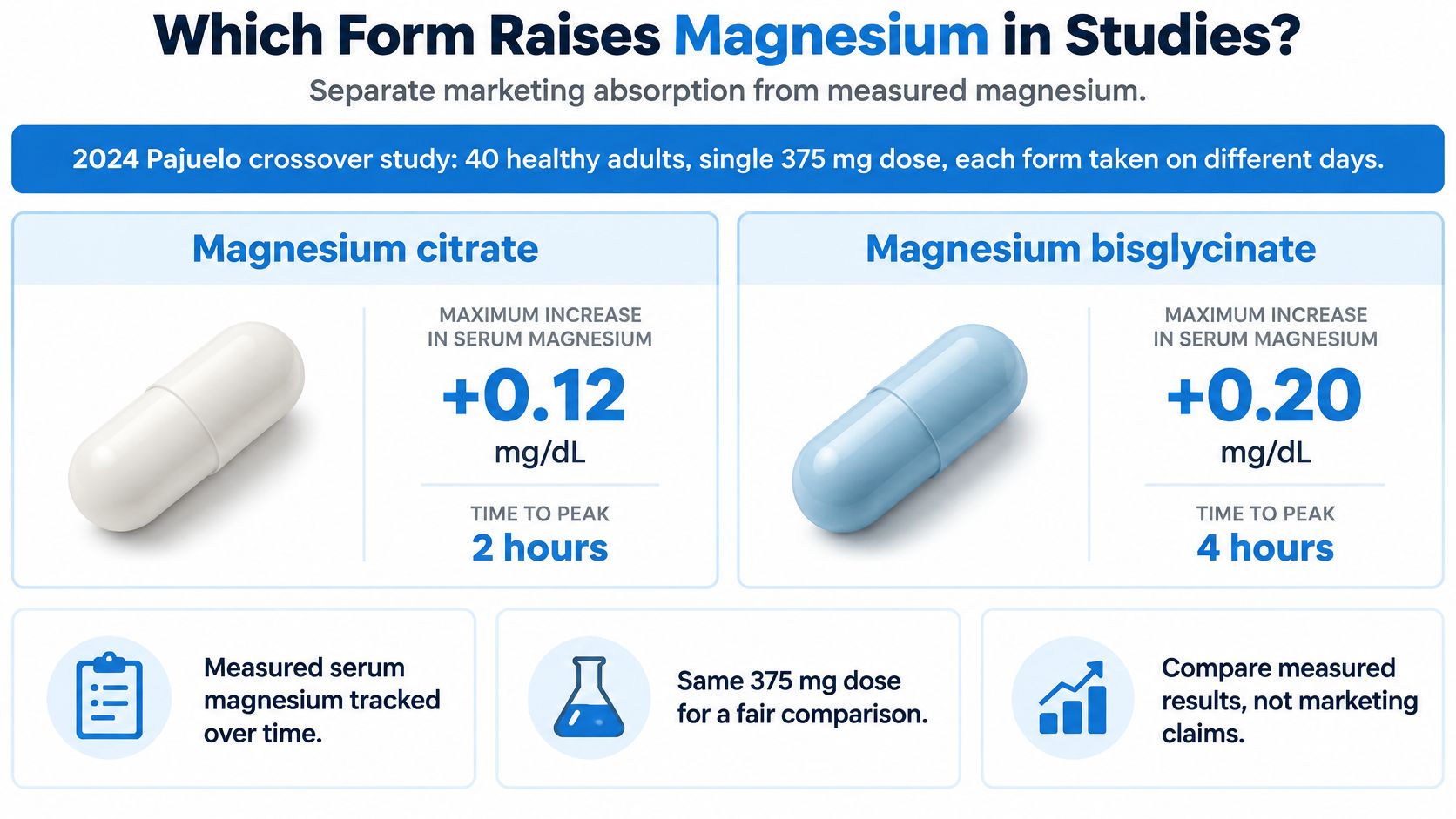
In the account of the 2024 Pajuelo crossover study published by The WonderDrop, 40 healthy adults consumed a single 375 mg dose of citrate and bisglycinate on separate occasions; plasma magnesium increased significantly at 4 hours after citrate, whereas bisglycinate didn't produce a statistically significant increase during the measured period.
That finding directly challenges the assumption that a glycine-bound form must produce the stronger blood-magnesium response. It doesn't establish that bisglycinate delivers no magnesium, or that every citrate supplement will outperform every bisglycinate product.
The visual comparison below highlights the reported study design. The measured outcome described in the study account is plasma magnesium, which should not be casually relabeled as a measure of absorption.
What the human comparisons actually establish
Human results for citrate versus glycinate
| Study | Who and dose | What changed |
|---|---|---|
| Longer double-blind trial | Healthy adults received elemental-matched citrate, a glycinate-family amino-acid chelate, or oxide daily | Citrate produced the highest mean serum readings after acute and ongoing supplementation and the highest final salivary reading; both organic forms outperformed oxide |
| Pajuelo crossover | Healthy adults took citrate and bisglycinate on separate occasions | Citrate produced a significant plasma increase; bisglycinate didn't reach significance within the measured window |
| Timed plasma sampling | Adults underwent repeated blood sampling after several magnesium formulations | Sampling at selected times cannot establish that a formulation with no significant increase had zero absorption |
The timed design deserves particular attention. Elemental Dose's account of the clinical crossover describes 40 adults sampled at 0, 1, 4, and 6 hours, with oxide and a microencapsulated formulation also included.
Those measurements provide snapshots, not continuous observation of magnesium moving through the body. A statistically nonsignificant result within that window isn't equivalent to proof of no absorption.
A stronger signal isn't a universal verdict
The longer trial adds evidence beyond a short post-dose observation, but its amino-acid chelate also requires careful interpretation. A result involving a glycinate-family chelate shouldn't automatically be assigned to every supplement labeled bisglycinate.
Keep these limits together:
- Formulation: Finished products may differ beyond the name of their magnesium salt.
- Dose matching: An equal compound weight doesn't necessarily mean an equal elemental-magnesium amount.
- Baseline status: Results in healthy participants don't establish the response in every clinical population.
- Chelate composition: The precise amino-acid complex matters when applying a finding to a retail product.
A significant magnesium rise supports that formulation under those test conditions. It doesn't prove a universal advantage for every person or every outcome.
The defensible conclusion is narrower than either marketing extreme: citrate has stronger direct evidence for raising circulating magnesium in these comparisons. Glycinate shouldn't be promoted as more bioavailable without evidence on the relevant formulation. Equally, these studies don't establish that citrate produces better sleep, fewer symptoms, or better long-term health outcomes.
Elemental Magnesium on the Label
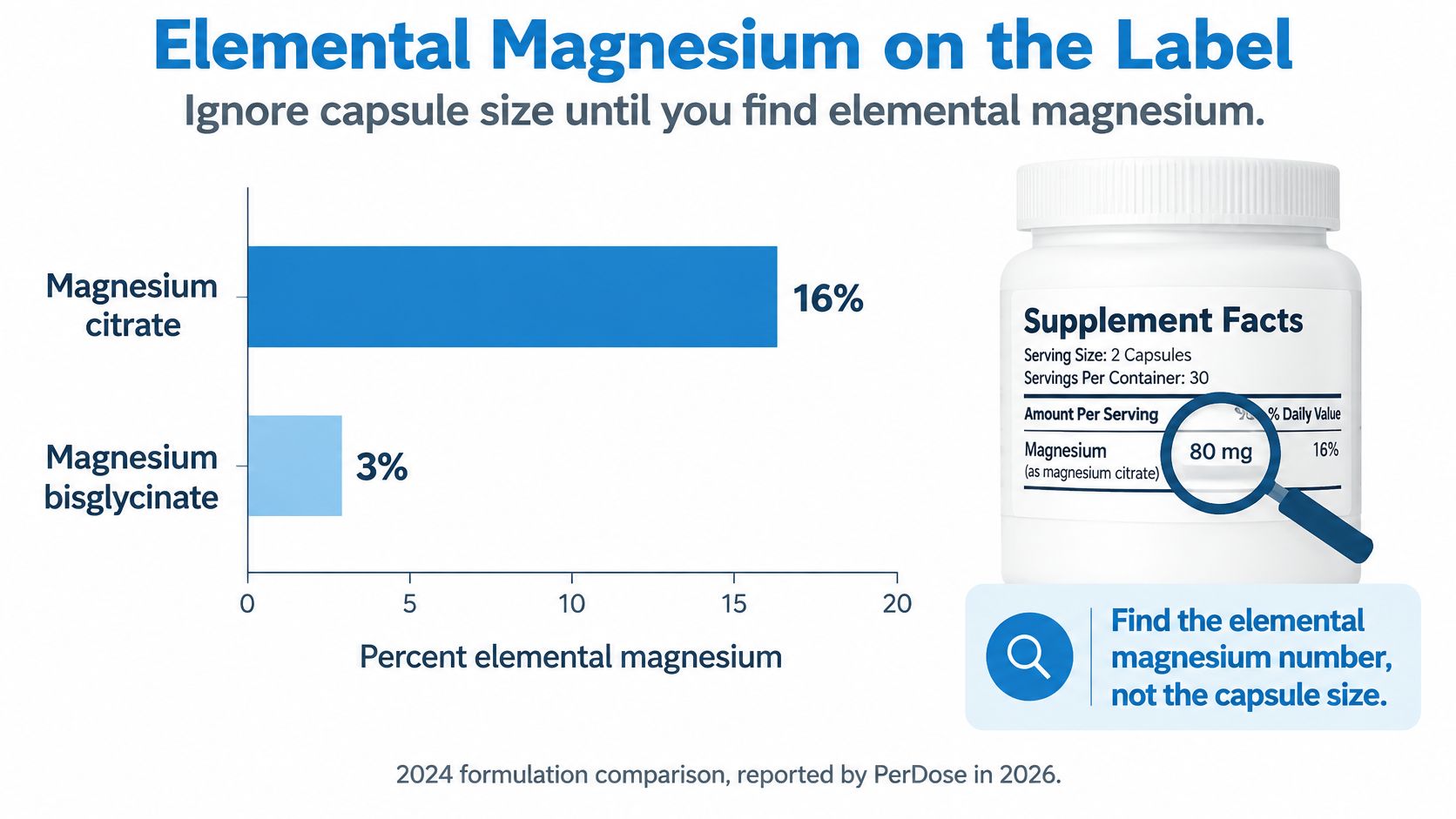
Consider a hypothetical label that lists the weight of the magnesium compound rather than actual magnesium. Using the formulation percentages published by PerDose in 2026 from a 2024 comparison, citrate contained approximately 16% elemental magnesium, compared with 11.7% for bisglycinate; consequently, 1,000 mg of compound would supply approximately 160 mg and 117 mg elemental magnesium, respectively.
Using those same percentages, a hypothetical 200 mg elemental target requires approximately 1,250 mg of citrate compound or 1,710 mg of bisglycinate compound. These are arithmetic illustrations, not recommended doses or substitutes for the finished product's label.
This visual separates the amount of the mineral from the amount of its carrier compound.
Don't convert a number that's already elemental
Many Supplement Facts panels already state the actual magnesium amount, followed by the source in parentheses. If the panel identifies magnesium supplied as bisglycinate, don't automatically reduce that listed magnesium amount by the compound's elemental percentage. You could end up calculating the same adjustment twice.
The opposite mistake is accepting a prominent front-label compound amount as though it were all magnesium. Read the front and back together, and resolve any ambiguity before choosing a serving.
For a serving-focused example, our guide to magnesium glycinate labeled at 200 mg provides useful context for distinguishing the ingredient name from the amount being claimed.
Use a label check before choosing a dose
- Identify the actual magnesium amount. Look for elemental magnesium or an unambiguous magnesium entry in Supplement Facts.
- Match it to the serving size. Establish whether the stated amount requires the full listed serving rather than an individual capsule.
- Compare like with like. Match elemental milligrams across products, then consider the exact salt and other ingredients.
Don't assume an unlabeled study dose is elemental, either. If a study summary gives a magnesium dose without clarifying the basis, retain that uncertainty rather than converting it as though the compound and elemental weights were interchangeable.
The accompanying video offers another way to review the comparison.
A higher elemental percentage means more magnesium per gram of that compound, not a higher absorbed percentage. Concentration and bioavailability answer different questions. The label establishes what you swallow; a properly designed human comparison helps assess what happens afterward.
How Each Form Treats the Gut
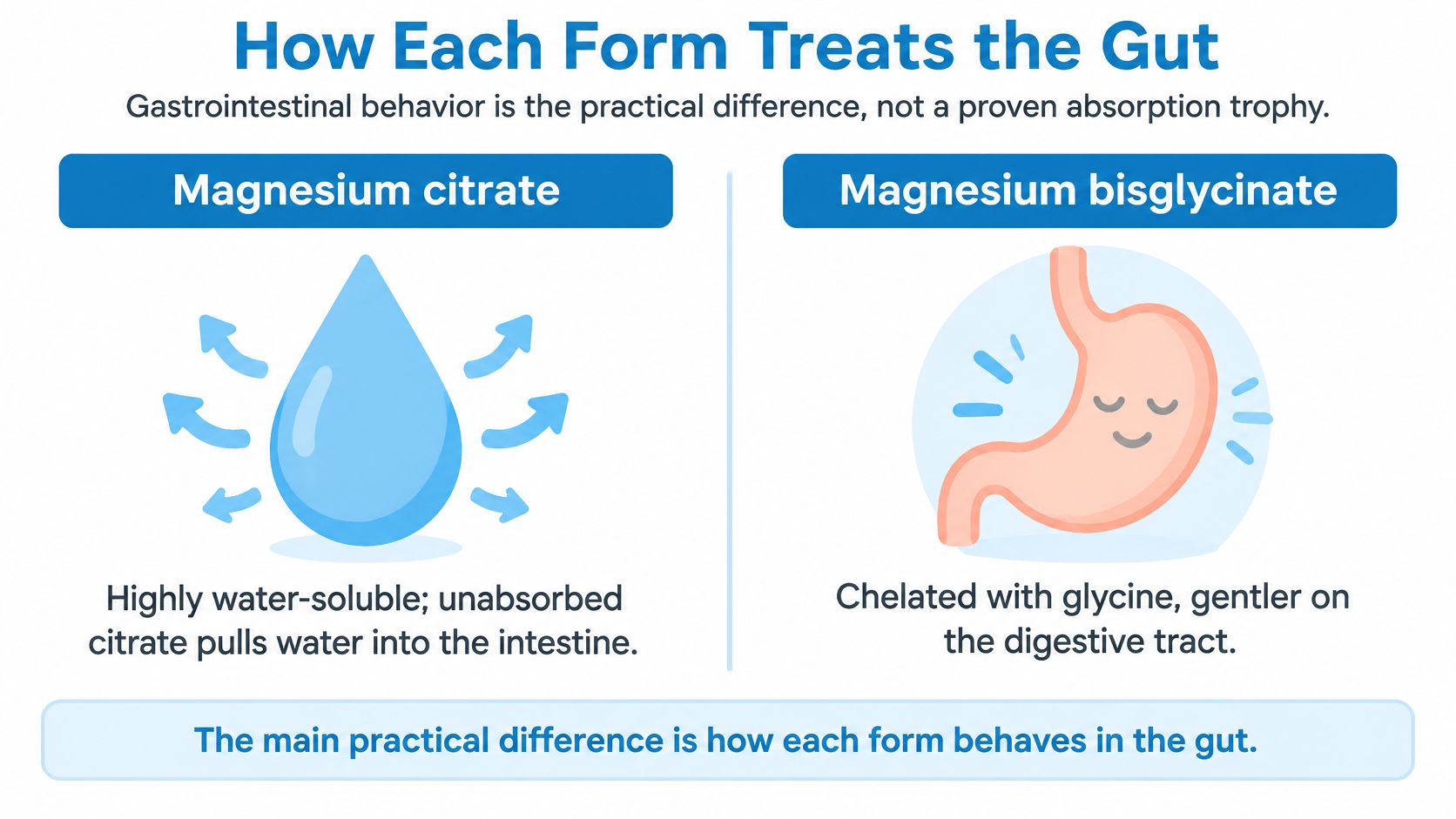
Magnesium citrate's unabsorbed fraction can exert an osmotic effect, drawing water into the intestine. That helps explain why a serving can supply magnesium while also changing stool consistency.
The Infusd overview of glycinate tolerability describes citrate as highly water-soluble and more likely to produce loose stools, cramping, or diarrhea at higher supplemental doses; it also reports that a 2024 randomized crossover found increased bowel movements with citrate but not bisglycinate under its single-dose protocol.
The infographic illustrates the practical digestive distinction, although a gentler average profile isn't a guarantee for an individual.
A useful effect can become the reason you stop
For someone with occasional hard stools, a bowel-softening effect can be welcome. For someone who already has urgency, that same response can make supplementation difficult to sustain.
This is why tolerability belongs in the effectiveness discussion. If a person repeatedly skips a supplement because of diarrhea, favorable trial results don't rescue the routine. The relevant question becomes whether another formulation permits more consistent intake at an appropriate elemental amount.
Glycinate or bisglycinate is generally described as better tolerated, but strong head-to-head evidence remains limited. Don't translate gentler into incapable of causing symptoms, and don't interpret diarrhea as proof that a supplement is working especially well.
Tolerance check: Unwanted loose stools are a reason to reassess the serving or formulation, not a signal to keep increasing it.
Handle the serving without creating a laxative regimen
Start with the labeled elemental amount, not a scoop chosen by appearance. If citrate causes urgency, consider taking it with food or discussing a divided serving rather than taking the entire intended amount at once. Neither approach justifies increasing the total.
- Existing diarrhea: Don't add citrate because you also want more magnesium. Our guide to diarrhea relief and better gut health can help frame the digestive issue separately.
- Inflammatory bowel symptoms: Seek individualized advice rather than trying to manage ongoing symptoms by switching mineral salts.
- Several bowel-active products: Review supplements, laxatives, and other products together before adding another potentially osmotic ingredient.
An ordinary citrate supplement is not interchangeable with a colonoscopy preparation. Don't copy bowel-preparation quantities or assume a nutritional supplement is a complete constipation treatment.
The practical choice is conditional: citrate makes sense when a softer stool is desirable and the serving remains comfortable. Glycinate is often easier to fit into daily repletion when avoiding laxative effects is the priority.
Which Form Fits the Goal
Choose the form around the problem that would otherwise prevent successful use. That may be a need for bowel softening, an intolerance of loose stools, difficulty measuring powder, or uncertainty about what a serving supplies.
The stronger circulating-magnesium evidence is relevant, but it isn't a reason to ignore those constraints. The best-supported form on paper can still be the wrong delivery option for a particular routine.
When raising magnesium is the primary objective
The randomized, double-blind trial indexed in PubMed assigned 46 healthy adults to 300 mg/day of elemental magnesium for 60 days as citrate, a glycinate-family amino-acid chelate, or oxide; citrate produced the highest mean serum magnesium after acute dosing (P = 0.026) and chronic supplementation (P = 0.006), and the highest salivary magnesium at day 60 (P = 0.027).
Both organic forms outperformed oxide in that comparison. The result supports taking citrate seriously for repletion rather than dismissing it as merely a laxative, but it doesn't turn the study dose into a universal recommendation.
The goal-based choices below translate the evidence into practical decisions without claiming that either salt is a treatment for unrelated symptoms.
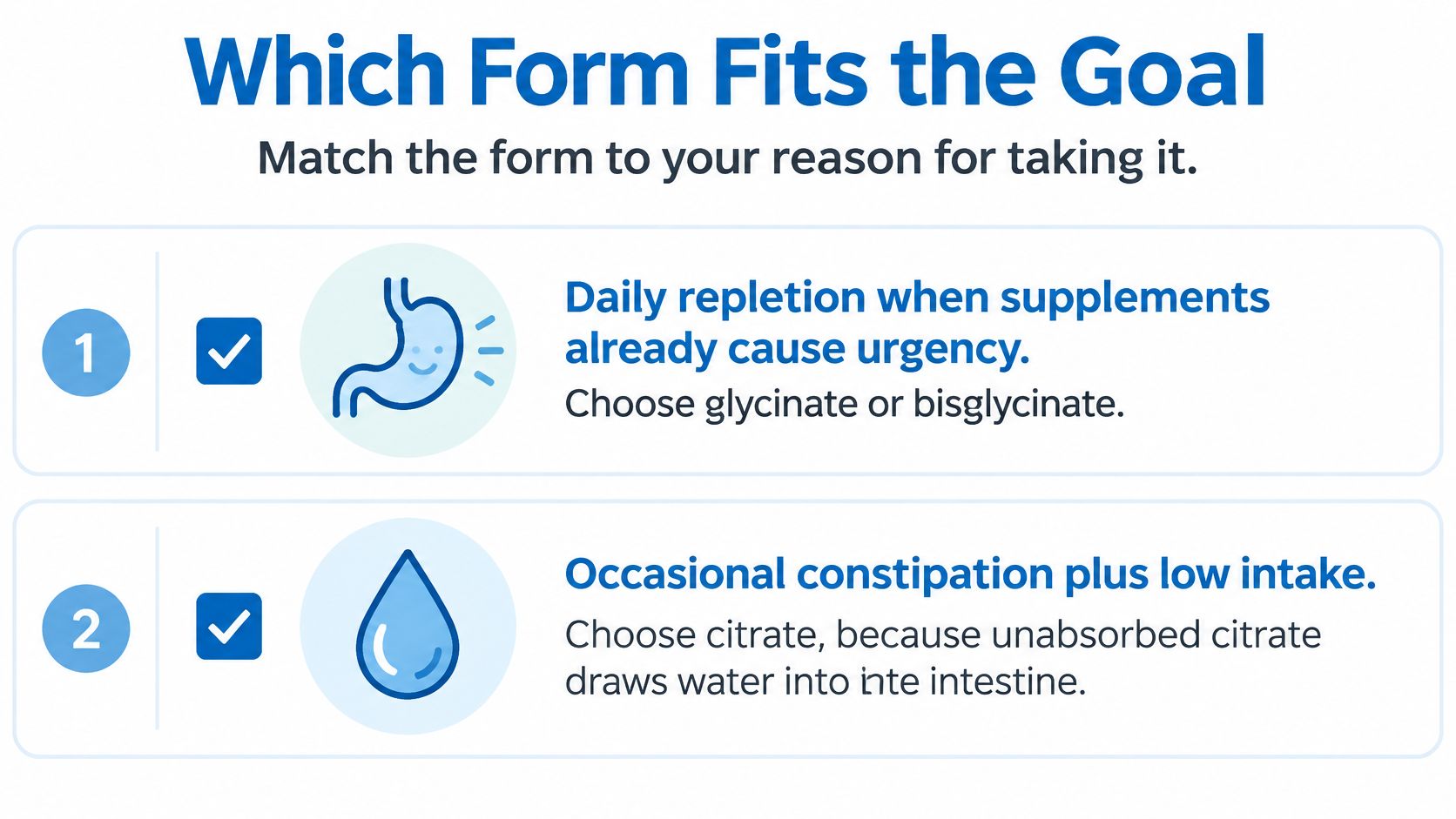
Which magnesium form fits the goal
| Goal | Lean toward | Switch if |
|---|---|---|
| Daily repletion and a sensitive stomach | Glycinate or bisglycinate | Constipation is the larger problem and stools stay too firm |
| Constipation plus low magnesium intake | Citrate | Loose stools, cramping, or skipped doses appear |
| More elemental magnesium per gram of powder | Citrate | A glycinate product already supplies the intended elemental amount conveniently |
| Evening use without a bathroom rush | Glycinate | A clinician advises a different salt; don't choose it for unproven sleep claims |
| Diarrhea or several osmotic products already in use | Glycinate, or neither until checked | Adding any supplement would complicate unresolved digestive symptoms |
| Comparing either form with magnesium oxide | Citrate or glycinate for repletion | Kidney disease or a possible drug interaction hasn't been reviewed |
Let the limiting factor decide
For daily repletion with a sensitive bowel, start by prioritizing a formulation you can tolerate. If citrate repeatedly causes skipped servings, choosing glycinate is a practical adjustment, not an admission that citrate fails to absorb.
For occasional constipation alongside low intake, citrate can serve both purposes. Persistent constipation still deserves assessment rather than repeated escalation of a supplement.
For evening use, glycinate may be the more convenient choice when avoiding urgency matters. That isn't evidence that its glycine component guarantees better sleep or less anxiety. Our magnesium glycinate benefits guide provides further context for evaluating benefit claims separately from ingredient descriptions.
Kidney disease requires clinician guidance before either salt. If you take prescription medicines, have a pharmacist review the exact product and timing rather than assuming a gentler form avoids interactions.
Use price as the tie-breaker
Delivered Dose reported in 2026 that its lowest tracked price per 200 mg elemental magnesium was $0.133 for citrate and $0.125 for glycinate. That dataset doesn't establish a permanent market-wide ranking, but it does refute the assumption that glycinate must always cost more.
Compare current costs only after establishing equivalent elemental servings and a tolerable formulation. A cheap bottle isn't good value if its serving is unclear or you won't use it.
Before checkout, confirm the elemental magnesium per serving, serving size, exact salt, and whether the capsule contains gelatin or uses a vegetarian shell. For label questions, our support line is 1-888-510-9080. Reassess your digestion after the initial servings rather than treating the first purchase as a permanent commitment.
At CalVitamin, we offer vitamins, minerals, and other wellness products alongside educational guides to help you compare supplement options. Visit our catalog with the elemental-magnesium amount and your digestive priorities in mind, and contact our support team if you need help interpreting a product label before ordering.