Most healthy adults should get 75 mg of vitamin C a day for women and 90 mg for men, with 2,000 mg a day as the adult upper limit. Pregnancy raises the adult target to 85 mg, breastfeeding raises it to 120 mg, and people who smoke need an additional 35 mg daily.
Those amounts describe total intake, not an automatic supplement prescription. The useful question isn't just “How much vitamin C should I take daily?” It's how much you already get, whether your circumstances change your needs, and whether a supplement would fill a genuine gap.
Table of Contents
- Daily Vitamin C Amounts by Age and Life Stage
- Who Needs More Than the Standard Amount
- Food Sources and Daily Totals
- Why Higher Doses Absorb Less
- Upper Limits and When High Doses Carry Risk
- Confirm Your Total Before Choosing a Dose
Daily Vitamin C Amounts by Age and Life Stage
For generally healthy adults, the National Institutes of Health vitamin C consumer guide recommends 75 mg daily for women and 90 mg for men, rising to 85 mg during adult pregnancy and 120 mg during breastfeeding. The same guide gives 80 mg for pregnant teenagers and 115 mg for breastfeeding teenagers, and identifies childhood targets including 15 mg for ages 1–3 and 45 mg for ages 9–13.
These are recommended dietary allowances, or RDAs. They're designed to meet the needs of nearly all healthy people in a particular group, rather than merely describing an average requirement.
Find the right life-stage recommendation
The lookup below separates the reference amounts available here from situations where you should obtain the complete age-specific recommendation. Don't substitute an adult dose when a child's amount isn't listed.
| Life stage | Recommended daily amount | Upper limit per day |
|---|---|---|
| Infants from birth through early infancy | Ask the pediatric clinician about feeding needs | No established limit |
| Older infants before their first birthday | Ask the pediatric clinician about feeding needs | No established limit |
| Children ages 1–3 | 15 mg | Use the pediatric age-specific limit |
| Children ages 4–8 | Obtain the age-specific pediatric recommendation | Use the pediatric age-specific limit |
| Children ages 9–13 | 45 mg | Use the pediatric age-specific limit |
| Teen boys | Obtain the age- and sex-specific recommendation | Use the adolescent limit |
| Teen girls | Obtain the age- and sex-specific recommendation | Use the adolescent limit |
| Pregnant teens | 80 mg | Use the adolescent limit |
| Breastfeeding teens | 115 mg | Use the adolescent limit |
| Adult men | 90 mg | Adult ceiling, not an intake goal |
| Adult women | 75 mg | Adult ceiling, not an intake goal |
| Pregnant adults | 85 mg | Adult ceiling, with individualized medical advice |
| Breastfeeding adults | 120 mg | Adult ceiling, with individualized medical advice |
A missing numerical entry isn't permission to estimate or use a smaller fraction of an adult supplement. Children's products, feeding needs, and age-specific limits deserve a pediatric check, especially for infants.
Understand what the daily amount means
Your intake can come from food, fortified drinks, and supplements. If meals and drinks already supply enough vitamin C, you don't automatically need a separate vitamin C product.
Also distinguish the daily recommendation from an upper limit. The recommendation is the amount to aim for nutritionally; the upper limit is a safety boundary, not a better goal.
Practical rule: Find your life-stage target before looking at supplement strengths. The largest number on the shelf doesn't tell you what your body needs.
If you're comparing products for a family, keep each person's target separate. A supplement serving intended for an adult shouldn't become the default for a teenager or younger child.
Who Needs More Than the Standard Amount
Smoking is a clear reason to adjust the usual target. The NIH health professional fact sheet recommends an additional 35 mg daily for people who smoke, producing practical targets of 125 mg for men and 110 mg for women who smoke.
Smoking increases oxidative stress and vitamin C turnover. That adjustment addresses a greater nutritional requirement; it isn't evidence that progressively larger doses provide progressively greater protection.
Different needs call for different decisions
Pregnancy and breastfeeding have their own recommendations, so use the relevant life-stage entry rather than the standard adult row. Breastfeeding also involves supplying nutrients through milk, which helps explain why the lactation recommendation is higher.
A restricted diet creates a different problem. Avoiding most fruits and vegetables may reduce what you consume without necessarily changing the amount your body requires.
- Smoking: Add the smoking adjustment to the appropriate life-stage recommendation.
- Pregnancy or breastfeeding: Use the applicable recommendation rather than adding several unrelated adult targets together.
- Limited food choices: Review what you eat, particularly if allergies, food access, or a highly restrictive eating pattern exclude produce.
- Medical conditions or recovery: Ask your clinician whether you need an individualized nutrition plan instead of choosing a larger dose yourself.
The adult recommendations are intended to maintain near-maximal vitamin C concentrations in neutrophils, a type of immune cell, while minimizing unnecessary urinary loss. They aren't intended to create drug-like effects.
That distinction matters when shopping for immune-support vitamins. A product's immune-support positioning doesn't establish that you personally need more vitamin C.
If you're recovering from illness, don't assume the right response is to increase every supplement. Tell your clinician about your usual diet, current products, symptoms, and prescriptions so the recommendation addresses your actual situation.
Food Sources and Daily Totals
Food can contribute enough vitamin C that a separate supplement isn't necessary. Start by identifying the fruits, vegetables, and fortified drinks you regularly consume, rather than beginning with a bottle.
Red bell peppers, citrus fruit, kiwifruit, strawberries, and broccoli are useful foods to consider. Their contribution depends on the portion and preparation, so treat a food tally as an estimate rather than a precise laboratory measurement.
Build a useful food inventory
Use a food-composition reference or the package label to attach a vitamin C amount to the portion you eat. For fortified juice and other packaged drinks, the label matters because formulations can differ.
| Food | Serving to record | How to establish its vitamin C contribution |
|---|---|---|
| Red bell pepper | Your portion, raw and sliced | Match the portion to a food-composition entry |
| Orange juice | The amount you drink | Check the package label, including fortification |
| Broccoli | Your cooked portion | Use a cooked-food entry, not a raw-food entry |
| Strawberries | Your portion of halves | Match the measured portion to a food-composition entry |
| Orange | The size of the fruit you eat | Choose the corresponding fruit-size entry |
| Kiwifruit | The size of the fruit you eat | Match the edible portion to the reference entry |
This approach avoids false precision. A value for raw broccoli isn't automatically the right value for cooked broccoli, and a large glass of juice isn't necessarily the serving printed on its label.
Vitamin C is sensitive to heat and prolonged storage. Include a mix of fresh and cooked produce, avoid unnecessarily long cooking, and don't assume food must always be raw to contribute.
Count what you actually consume, not what you intended to eat or what the package calls a serving.
Compare eating patterns before choosing a supplement
Consider a woman whose only regular vitamin C food is kiwifruit. Her next step is to check the size and frequency of that portion, then see whether adding another fruit or vegetable would reliably close any gap.
Compare that with someone who regularly eats an orange and strawberries. Before adding a supplement, she should total those foods along with the rest of her meals. Looking only at breakfast could miss contributions from lunch and dinner.
A man who smokes might eat red pepper, broccoli, and citrus across the day. His smoking adjustment matters, but it doesn't mean he must meet that additional need through a supplement rather than food.
For a pregnant adult who drinks fortified juice and also eats fruit and vegetables, the key question is whether a prenatal product already contributes vitamin C. Adding another product without checking can duplicate intake unnecessarily.
Include drinks and existing products
Write down your usual meals and snacks, then add fortified beverages, multivitamins, powders, gummies, and combination wellness products. Keep food intake and supplement intake in separate columns so you can see where the vitamin C comes from.
Don't let an occasional low-produce day become an automatic reason for permanent supplementation. A recurring shortfall is more useful to address, either through a realistic food change or a discussion with a dietitian or clinician.
The best tally reflects your normal routine. A carefully planned day that you rarely repeat won't tell you much about your usual needs.
Why Higher Doses Absorb Less
A larger dose doesn't produce a proportional increase in absorption. Your body regulates vitamin C uptake, so the percentage absorbed declines as intake becomes high.
The graph illustrates this diminishing absorption pattern.
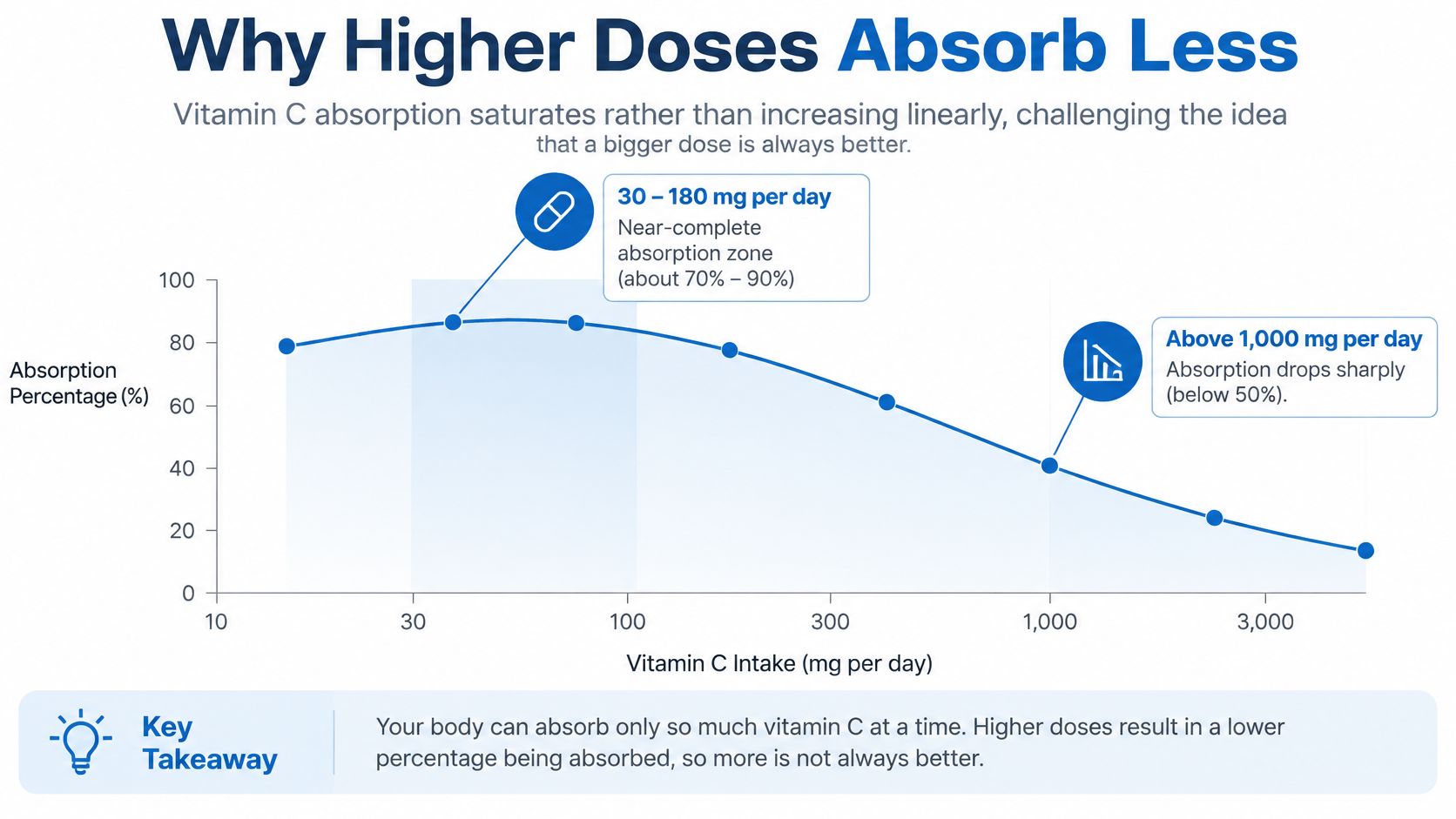
According to the NIH vitamin C absorption guidance, approximately 70–90% is absorbed at intakes of 30–180 mg daily, while absorption falls below 50% above 1,000 mg daily, with excess unmetabolized vitamin C excreted in urine.
| Daily intake | Approximate absorption |
|---|---|
| 30–180 mg per day | About 70–90% absorbed |
| Above 1,000 mg per day | Under 50% absorbed; excess unmetabolized vitamin C is excreted in urine |
Read the bands without overinterpreting them
The table describes intake ranges, not a precise absorption calculator for every product. It doesn't establish an exact percentage at every dose between the listed bands.
Also, percentage absorbed and total amount absorbed aren't the same thing. A larger dose can deliver more absorbed vitamin C overall while delivering a smaller proportion of what you swallowed. Neither result, by itself, proves a meaningful additional health benefit.
That's why matching a supplement to a dietary gap is more sensible than choosing by potency alone. You're trying to meet a nutritional need, not maximize how many milligrams enter your digestive tract.
Water-soluble doesn't mean consequence-free
Vitamin C's handling differs from that of fat-soluble nutrients, as explained in this guide to fat-soluble and water-soluble vitamins. Urinary excretion doesn't make unlimited intake useful or harmless.
Large doses can cause diarrhea and gastrointestinal discomfort. If you already meet your needs, increasing the serving may add digestive problems without a clear nutritional reason.
This video provides an additional explanation of vitamin C intake and supplementation.
The practical distinction is target versus ceiling. A nutritional target answers how much to obtain; a ceiling addresses how much habitual intake may become problematic.
Upper Limits and When High Doses Carry Risk
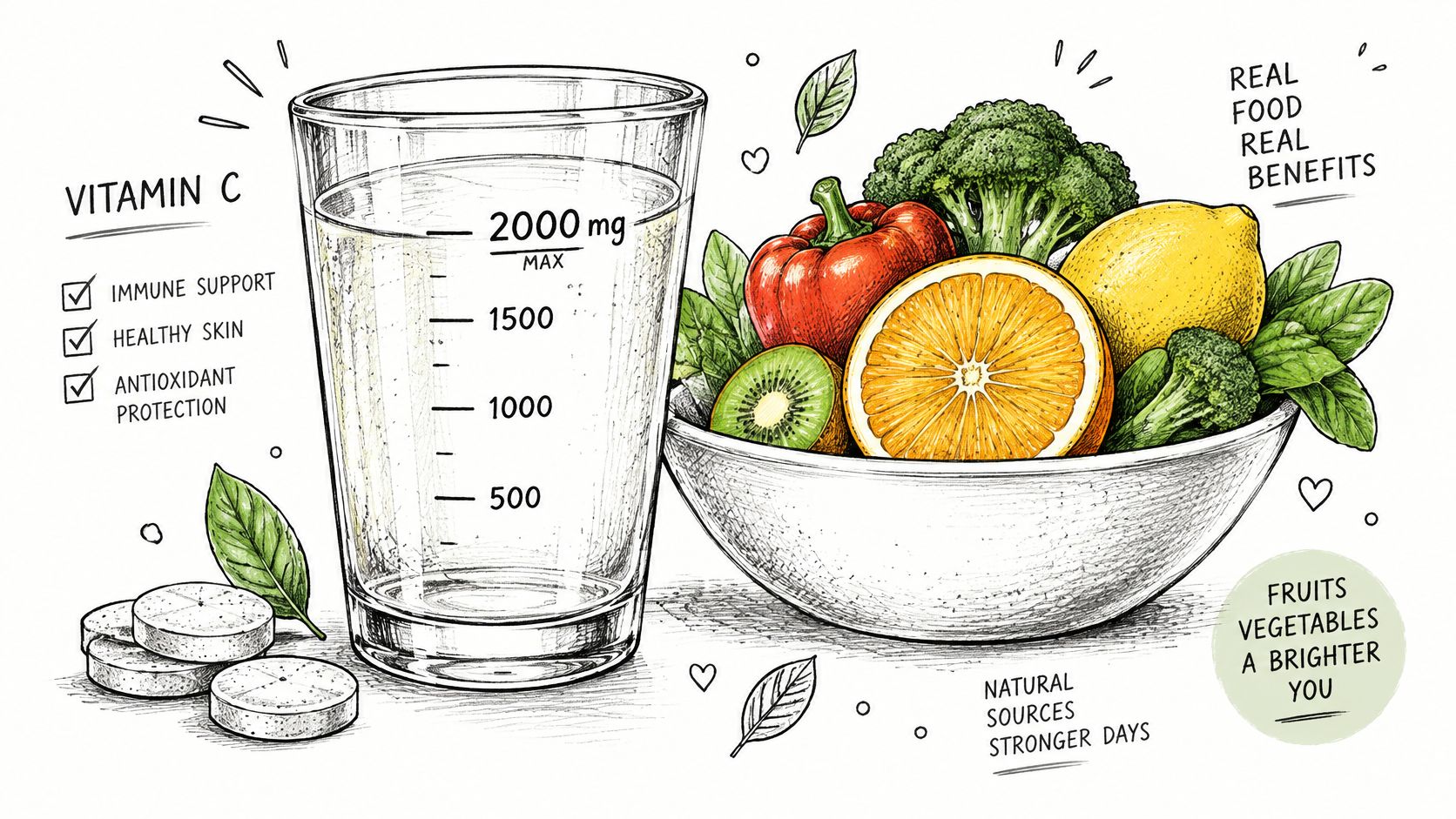
The NIH vitamin C safety guidance sets the adult tolerable upper intake level at 2,000 mg daily. That ceiling applies to the combined amount from food, beverages, and supplements, and is based largely on gastrointestinal adverse effects.
It isn't a universally safe target, and staying below it doesn't guarantee that a particular person will tolerate a product. Medical history, medications, and the reason for supplementation still matter.
This illustration reinforces the need to consider different sources together.
Kidney history changes the conversation
High-dose supplementation deserves particular caution if you've had kidney stones or have kidney disease. Some vitamin C can contribute to urinary oxalate, making kidney history relevant when deciding whether a concentrated product is appropriate.
An increase in urinary oxalate isn't the same outcome as a confirmed kidney stone. It's important not to turn a risk signal into a claim that everyone taking vitamin C will develop stones.
Equally, someone with a previous stone shouldn't assume an over-the-counter product is automatically suitable. Ask the clinician managing your kidney health before starting high-dose vitamin C.
Check treatment and medication compatibility
NIH identifies potential interactions or interference involving chemotherapy, radiation therapy, and certain cholesterol-lowering regimens. Don't add vitamin C to support cancer treatment without your oncology team's approval, and don't stop prescribed medication because you're concerned about an interaction.
Seek individualized advice before high-dose use if any of these apply:
- Previous kidney stones: Share your stone history and any existing prevention plan.
- Kidney disease: Ask whether supplementation fits your kidney function and treatment.
- Cancer treatment: Have your oncology team review the exact supplement and serving.
- Prescription medicines: Give your pharmacist or clinician the full ingredient list, including combination products.
- Pregnancy or breastfeeding: Review added supplements alongside prenatal or postnatal nutrition products.
Safety check: Bring the actual label, not just the product name. The dose and other ingredients can change the recommendation.
Ordinary dietary intake isn't the concern behind these precautions. Routine megadosing without a medical reason is a different decision from eating fruit and vegetables or correcting an identified shortfall.
If a supplement causes diarrhea or persistent stomach discomfort, don't treat those symptoms as proof that it's working. Stop and review the dose and need with a healthcare professional.
Confirm Your Total Before Choosing a Dose
Use your nutritional target to guide the purchase, rather than letting a product's strength determine your intake. The calculation should include what you already consume and what you're considering adding.
This checklist summarizes the decision.
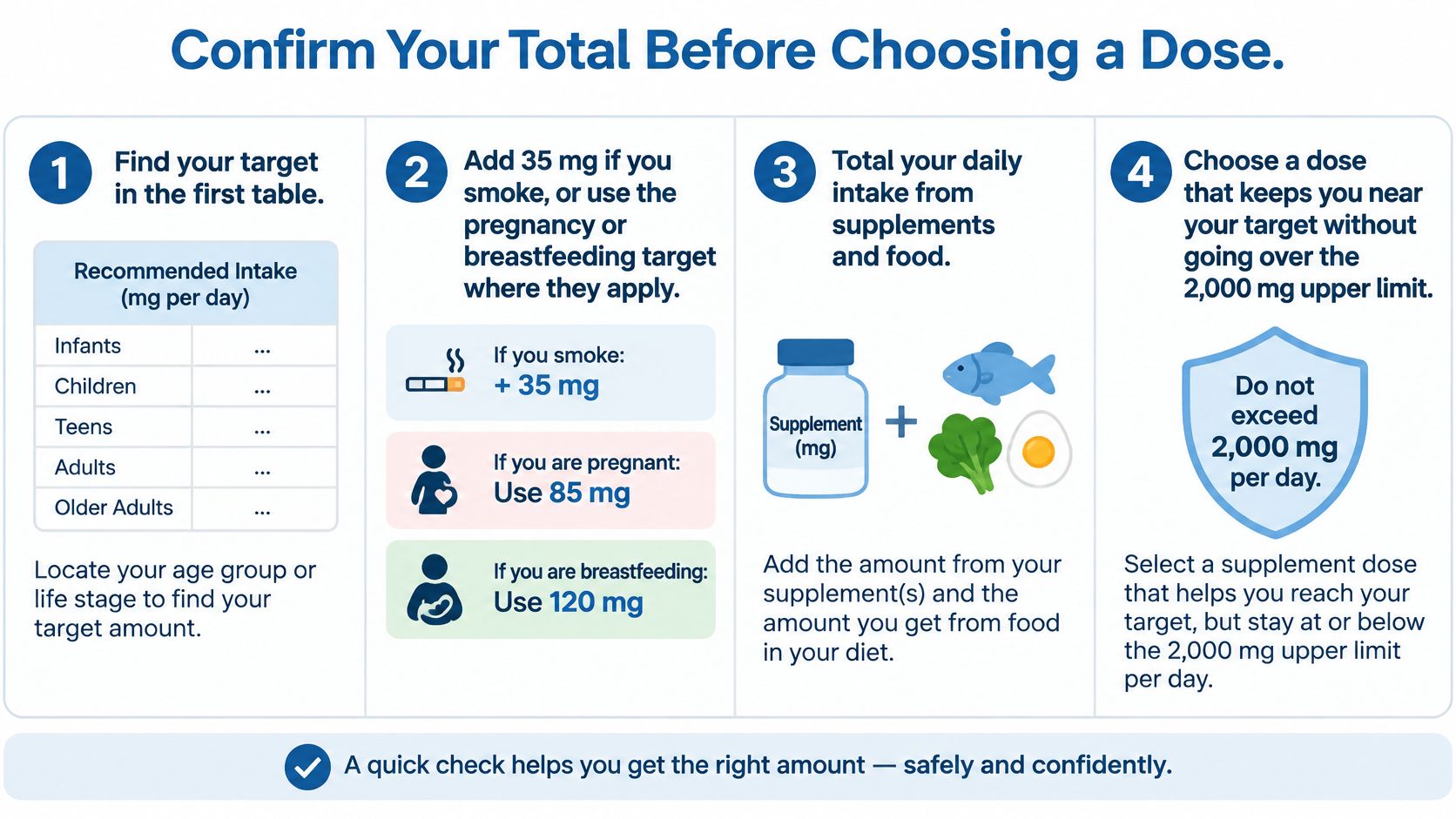
- Identify your target. Choose the recommendation for your age and life stage.
- Account for adjustments. Include smoking and any clinician-directed changes without combining unrelated life-stage targets.
- Total existing sources. Include food, fortified beverages, and every supplement that contains vitamin C.
- Evaluate the remaining gap. If there's a consistent shortfall, consider a food change or an appropriately sized supplement with professional guidance when needed.
Match the label to the gap
Compare milligrams per serving, not just the percent daily value. Our guide to reading a supplement label can help you distinguish serving size from the amount in an individual capsule or scoop.
For a concrete comparison, each 1 g scoop of Swanson Vitamin C Powder provides 1,000 mg of vitamin C as ascorbic acid, while each 3-capsule serving of Moon Juice SuperPower Immune Support contains 900 mg as CELLg8 Ascorbic Acid, or 1000% of the daily value. Those label amounts describe the products, not your personal requirement; people who are pregnant, nursing, or taking medications should consult a healthcare provider before using Swanson Vitamin C Powder.
Don't improvise tiny powder portions or alter a serving when accurate dosing isn't practical. Ask about a more suitable strength instead.
Before buying, write down your usual intake and take your current labels to a clinician or pharmacist if you have medical risks. An individualized recommendation may differ from these general nutritional starting points.
CalVitamin offers vitamin supplements and wellness products with different serving sizes and formats to compare against your nutritional needs. Visit CalVitamin to review vitamin C amounts and ingredient lists, and choose a product only after confirming whether you have a gap to fill.