"Which vitamin should I take?" is the question almost everyone asks, and it's the one that leads to the worst decisions. It invites a product name, and a product name is where this process ends, not where it starts.
A sharper version of the question sounds less satisfying at a dinner party. "Which nutrient is my body short of, and what would prove it?" That one has an answer, and the answer is usually a lab value, a diet pattern, a life stage with a written recommendation attached, or a medication list that changes how a nutrient behaves.
Answering the sharper question shrinks the shopping list quickly. Sometimes it empties it, and that's a good outcome, not a failed one.
Table of Contents
- Who Actually Needs a Vitamin Supplement
- Five Steps to Decide What to Take
- Blood Test Cutoffs for Common Deficiencies
- Checking Your Medicines Before Adding a Vitamin
- Reading Labels Without Taking Too Much
- Confirm Your Plan With a Clinician Before You Buy
Who Actually Needs a Vitamin Supplement
Do you have a specific reason to take a vitamin, or only a vague hope that one might help? The useful first move is identifying which situation you are in. Vitamin advice splits cleanly into groups with established needs and groups without them, and the groups are defined by things you can verify: a pregnancy plan, a surgery, a diagnosis, a prescription list, a diet pattern.
Find your row and you will know whether the next step is a purchase, a test, a pharmacist's review, or nothing at all.
| Situation | What changes | Reference point or next step |
|---|---|---|
| Planning pregnancy or able to become pregnant | Folic acid is recommended daily | 0.4-0.8 mg (400-800 mcg) daily |
| Pregnant, nursing or a child | Nutrient needs differ from adults | Dose set by a clinician |
| Restrictive diet (vegan, dairy-free, low variety) | B12 and other nutrients may be missed | Test before choosing a dose |
| Bariatric surgery or GI or malabsorptive disease | Absorption may be reduced | Clinician sets the regimen |
| Kidney or liver disease | Some nutrients need adjusting or accumulate | Clinician review required |
| Long-term prescription medicines | Possible drug-supplement interactions | Review the full list with a pharmacist |
| Healthy adult, varied diet, no known deficiency | Routine supplements show no clear disease-prevention benefit | Evidence insufficient per USPSTF |
| Symptoms without a test | Symptoms alone do not prove a deficiency | Order testing through a clinician |
Find your row before you shop
Notice how many rows end somewhere other than a checkout page. Three end with a clinician, two end with a test, and one ends with a pharmacist reviewing what you already take. That distribution is the shape of the evidence: need first, product second.
Pregnancy planning is the clearest case. A standing USPSTF recommendation advises daily folic acid for people planning pregnancy or able to become pregnant, while the 2022 prevention review asked a different question. In that review, the U.S. Preventive Services Task Force examined 84 randomized controlled trials and 6 cohort studies of vitamin, mineral and multivitamin supplements in generally healthy adults with no known deficiency (USPSTF vitamin supplementation recommendations).
The same review found that most of those supplements produced no clinically important protection against cardiovascular disease, cancer or death from any cause. Both findings can sit in the same conversation because they answer different questions. Folic acid before pregnancy is a targeted recommendation for a specific biological window. A daily multivitamin for a healthy 40-year-old is a general hope.
What the evidence says about the healthy adult row
The task force drew the boundary explicitly. Its general prevention recommendation does not apply to people with diagnosed or suspected deficiencies, pregnancy, childhood, chronic illness, hospitalization or other special nutritional needs. Those groups were excluded because their nutrient requirements and risks differ.
That exclusion is the practical lesson. If you belong to an excluded group, the "insufficient evidence" headline was never about you and individual guidance matters more than a store shelf. If you do not belong to any of them, the headline applies directly, and the bar for buying anything should be high.
Medicines belong in this first sort, not after checkout. A supplement can change how a prescription works, and a prescription can change how a nutrient is absorbed or cleared. The interaction check is part of deciding whether you need the product at all.
A symptom is not a row in this table. Fatigue, tingling hands or hair thinning can each have many causes, and only some of them are nutritional. Symptoms tell you to seek an evaluation, not to pick a bottle.
The rows that say "test before choosing a dose" exist for a reason. Guessing wrong in either direction costs you: too little does nothing, and too much adds risk without adding benefit.
Five Steps to Decide What to Take
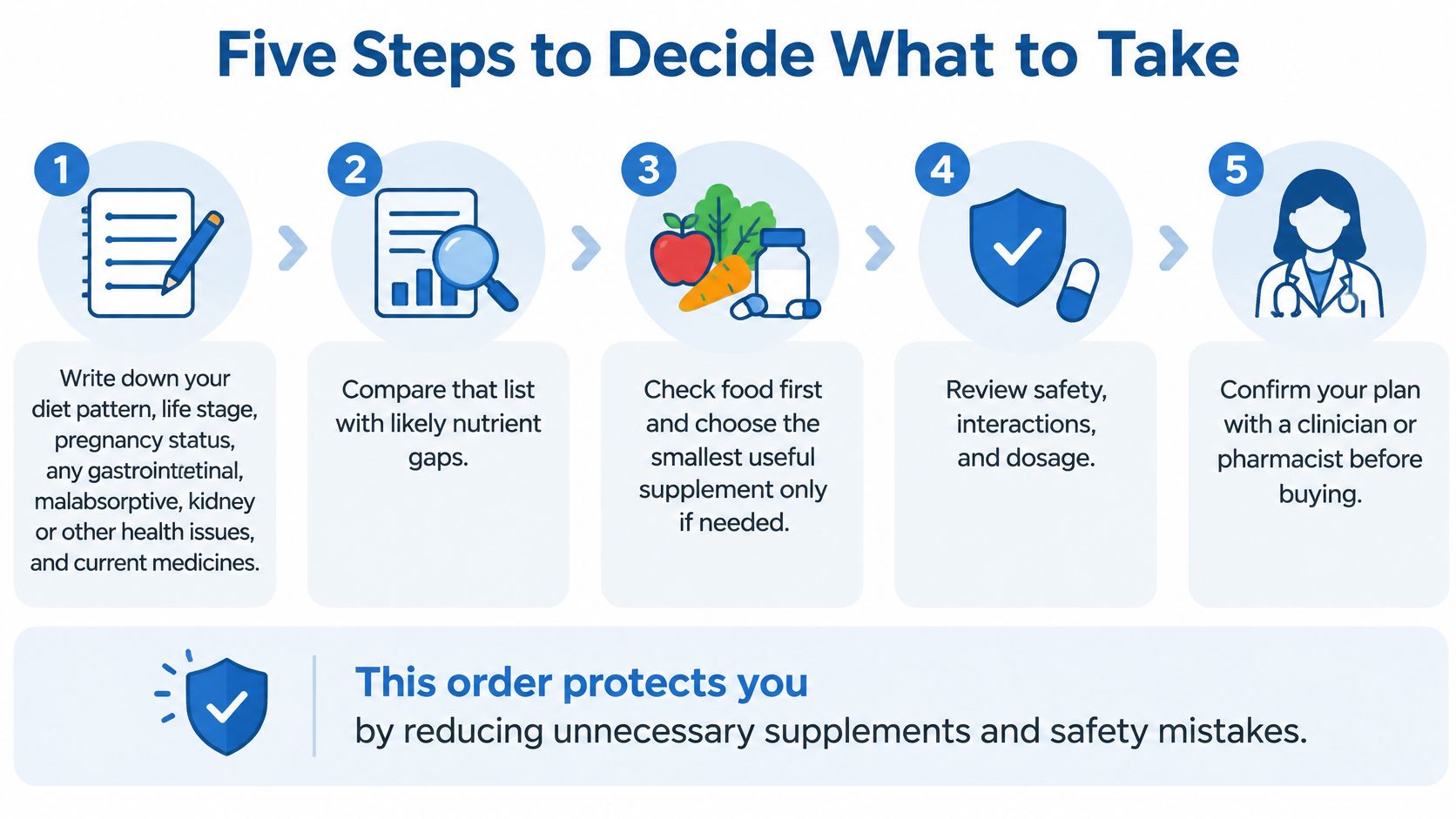
What people need here is a pathway, not another ranked list of best vitamins. Blood testing can identify real deficiencies, but a test result read without context becomes a shopping tool rather than a diagnostic one (clinical commentary on targeted supplementation). The five steps below put the context first so the test means something when it arrives.
1. Write down your context. Diet pattern, life stage, pregnancy status, any gastrointestinal or malabsorptive disease, kidney or liver condition, every prescription and over-the-counter medicine, and any past bariatric surgery. Add fortified foods and herbal products, which people routinely forget because they don't feel like "medicine." This list is what turns generic advice into advice about you.
2. Name one specific suspected deficiency. "Low B12 because I've eaten vegan for six years" is testable. "Low vitamin D because I work nights and rarely see daylight" is testable. "I want more energy" is not, because fatigue has dozens of causes and only a few are nutritional.
3. Ask for the test that matches your suspicion, not a broad panel. One targeted marker is easier to interpret, usually cheaper, and far less likely to throw up a borderline value that pushes you toward an unnecessary purchase.
4. Supplement only when the result, the clinical context or a guideline-supported indication justifies it. Carts fill up at this step. A high-dose broad formula can't be aimed at a single deficiency, and every added ingredient is another chance at a duplicated dose or an interaction.
5. Reassess after an interval your clinician sets. Repeat the lab or review the symptom, then stop, continue or adjust the dose. A supplement with no endpoint is a subscription, not a plan.
Why the order matters
Run the steps out of sequence and each one breaks. Start at step 4 and you're buying a dose nobody chose. Skip step 3 and step 5 has nothing to measure against. Skip step 5 entirely and you'll never learn whether the product did anything, so you'll keep buying it on faith.
The two places people slip are predictable.
The two failure points: step 2, where a vague symptom replaces a named suspicion, and step 4, where a broad high-dose formula replaces a matched dose.
The counterintuitive conclusion, and the one worth carrying into any product page, is that more coverage isn't better. A targeted product chosen for a documented need is usually more rational than a broad-spectrum formula taken on hope.
Food stays the default source of nutrients. Supplements are meant to fill a defined gap in a diet, not to replace the variety in it. If your diet is the problem, the most effective change often isn't in a capsule.
Blood Test Cutoffs for Common Deficiencies
When a clinician orders a test, the result comes back as a number with a threshold attached. The table below shows the deficiency cutoffs the CDC uses for five common vitamins, so you can see what "low" means before you're handed a printout.
| Vitamin | Biomarker and deficiency threshold | Interpretation note |
|---|---|---|
| Vitamin B12 | Serum B12 below 200 ng/L (148 pmol/L) | Confirm with symptoms and diet history |
| Vitamin B6 | Serum pyridoxal-5'-phosphate below 20 nmol/L | Read alongside diet and clinical context |
| Vitamin C | Serum ascorbic acid below 11.4 μmol/L | Test when intake or symptoms raise concern |
| Vitamin A | Serum retinol below 0.70 μmol/L | Interpret with clinician guidance |
| Vitamin D | Serum 25-hydroxyvitamin D below 30 nmol/L | Routine screening not advised for asymptomatic nonpregnant adults |
Reading a value against the whole picture
A number means nothing on its own. The same result can be reassuring in one person and concerning in another, depending on diet, medications, absorption, symptoms and life stage. Context is what turns a cutoff into a decision. Population statistics help with perspective, yet they can't diagnose you: national assessment data show that low vitamin levels are common in the U.S., and prevalence varies materially by age, sex and race or ethnicity.
Two practical errors follow from that.
- Ordering a broad panel instead of a targeted test. Ten borderline results create ten decisions and no clarity. One well-chosen marker answers a specific question.
- Treating a borderline value as a diagnosis. A slightly low reading in a healthy adult without symptoms isn't automatically a reason to buy a supplement. For asymptomatic, nonpregnant adults, the task force found insufficient evidence that routine vitamin D screening's benefits outweigh its harms. The fix is the context around the number: diet history, medications and symptoms, all read together.
Iron makes the matching problem concrete, because timing and absorption change what a dose delivers. Our guide to how to take iron supplements covers the practical side of that.
What to bring to the appointment
Arrive with three things and the conversation gets shorter and better. Write down your symptoms with dates, because "fatigue for six months" points somewhere different than "fatigue since last week." Note your diet pattern for a typical week, including fortified foods. Then name the specific test you want to discuss and why you suspect that nutrient.
That last part matters more than it sounds. "I'd like to check my B12 because I've been vegan for six years and I've had tingling in my feet for two months" gives a clinician something to act on. "I'd like a full vitamin panel" usually gets a careful explanation instead.
Checking Your Medicines Before Adding a Vitamin
This is the hardest part of the decision and the part consumer guides skip most often. Interaction checking isn't a footnote to the buying decision. It's a step in it, and it comes before you pay.
| Medicine or supplement | Possible effect | What to do |
|---|---|---|
| Warfarin | Vitamin K reduces its anticoagulant effect | Keep vitamin K intake steady if your clinician advises |
| Certain antibiotics | Calcium, magnesium or zinc can reduce absorption | Separate doses as your pharmacist instructs |
| Levothyroxine | Calcium, magnesium or zinc can reduce absorption | Take the thyroid medicine as prescribed and separate minerals |
| Any prescription medicine | Potential drug-supplement interaction, found in 40.1% of older supplement users in a 2025 study | Share the full list before buying |
| Two or more supplements | Potential supplement-supplement interaction, found in 10.3% in the same study | Review combined products, including multivitamins |
The scale isn't theoretical. In that 2025 study of older supplement users taking prescription medicines, 40.1% had at least one potential drug-supplement interaction and 10.3% had a potential supplement-supplement interaction, and gastrointestinal adverse effects were reported as well. Nearly half of a group doing something ordinary, buying vitamins, was carrying a risk nobody had flagged.
Why interaction checks get skipped
Supplement labels are read like food labels, which trains everyone to look at the dose and stop. A bottle doesn't announce that its calcium binds the antibiotic you take at breakfast, or that its vitamin K works against the blood thinner keeping your stroke risk down.
The timing detail trips people up too. "Take with food" and "take two hours apart from other medicines" are different instructions solving different problems, and the second one only appears when a pharmacist is looking at your whole list.
Before you buy, the list comes first. Prescriptions, over-the-counter drugs, fortified foods, multivitamins and herbal products, all on one page, all shown to a pharmacist. Nothing about that list requires a symptom or a diagnosis.
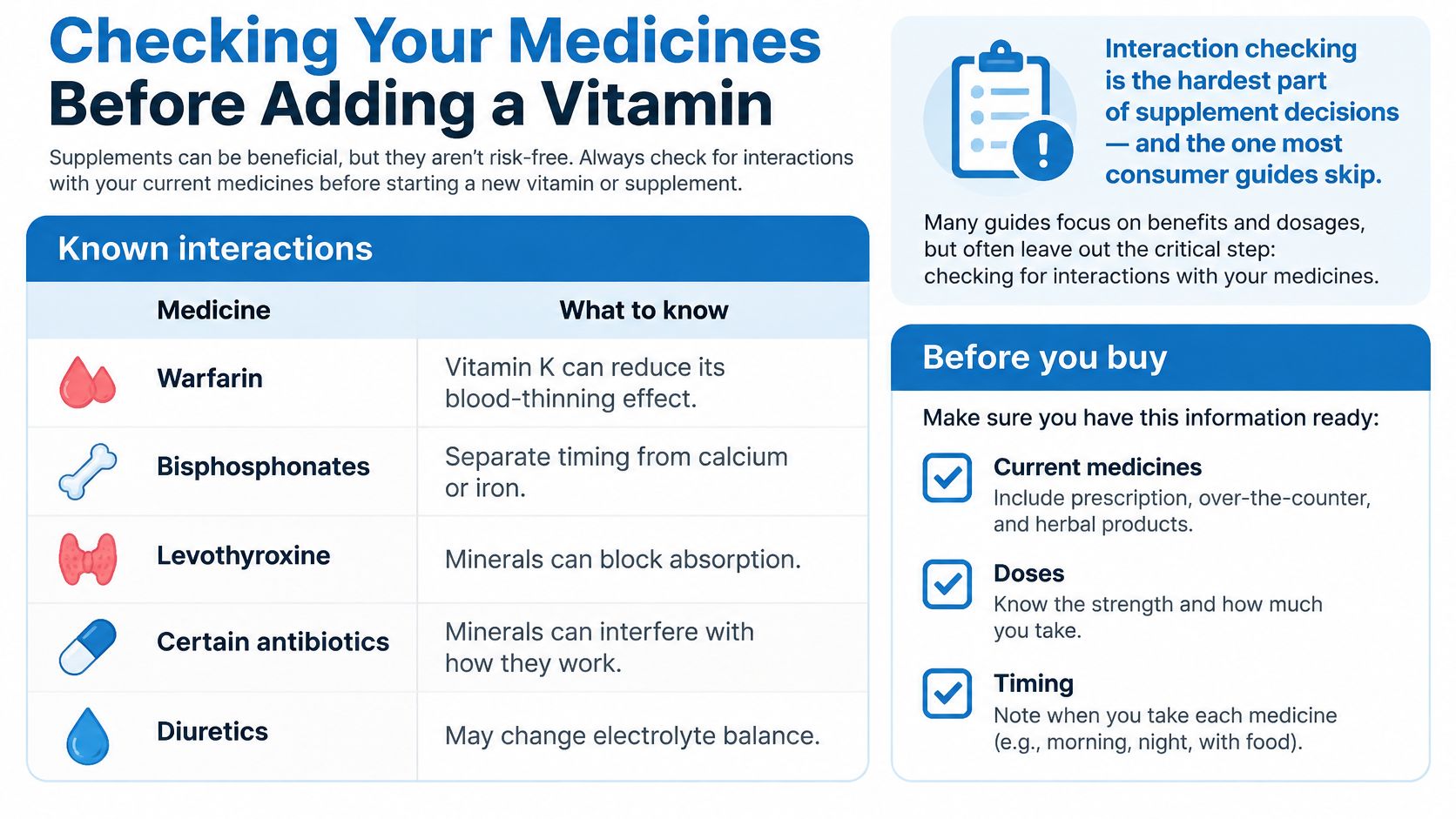
The before-you-buy checklist
Work through these in order, and stop if any answer surprises you.
- List every medicine, including anything you take occasionally for headaches, reflux or sleep.
- Add every supplement you already take, including multivitamins, protein powders with added vitamins, and herbal products.
- Check the combined list with a pharmacist. This is a short conversation, often free, and it's the step many skip.
- Ask about special situations. Surgery, pregnancy, kidney disease or a chronic illness each change the answer.
- Read the warnings and interaction prompts on the label, not just the dose on the front.
- Keep vitamin K intake consistent if you take warfarin and your clinician has advised steady intake, rather than swinging from none to a green smoothie habit.
None of this replaces professional advice. It's what you bring to that advice so it can be specific.
Reading Labels Without Taking Too Much
Once a real need is confirmed, the risk changes shape. It's no longer that you'll buy the wrong thing. It's that you'll take too much of it, or stack three products that overlap.
Start with a rule that sounds obvious and gets ignored constantly. Compare the label amount against the recommended amount for your situation, not against the biggest number on the shelf.
Checks that stop a double dose
- Read the serving size, not the front of the bottle. Two capsules is a common serving, and a "500 mg" claim on the front may describe two of them.
- Add up the total across everything you take. A broad multivitamin plus two single-nutrient products can duplicate a dose without anyone noticing.
- Ignore the daily-value percentage as a quality signal. A high percentage isn't a better product. It's a bigger dose, and for some nutrients a bigger dose is a problem.
- Note the form and whether it's taken with food. Some forms absorb differently, and some are easier on the stomach with a meal.
- Read the warning panel and interaction prompts. That section exists because the manufacturer knows things the front label doesn't say.
- Treat disease-prevention claims with suspicion. The USPSTF evidence review specifically recommends against beta-carotene and vitamin E supplements for preventing cardiovascular disease or cancer, because the evidence shows no benefit and high-dose supplementation can create risks.
That beta-carotene and vitamin E warning is worth sitting with. These are two of the most heavily marketed antioxidants in the category, and the formal position on them for disease prevention is a recommendation against.
The broader caution follows from the same source. A broad multivitamin isn't a substitute for a dietary assessment or for medical advice, and marketing that links a product to a symptom doesn't prove a deficiency exists. Our walkthrough on how to read a supplement label goes line by line through the panel if you want the detail.
The label test that matters most: could you state, in one sentence, which deficiency this product is correcting and how you know you have it? If not, the product is answering a question you haven't asked yet.
Confirm Your Plan With a Clinician Before You Buy
The single next action is a conversation, not a purchase. Book time with a clinician or a pharmacist and bring a written list, because recall is unreliable when a list runs past four or five items.
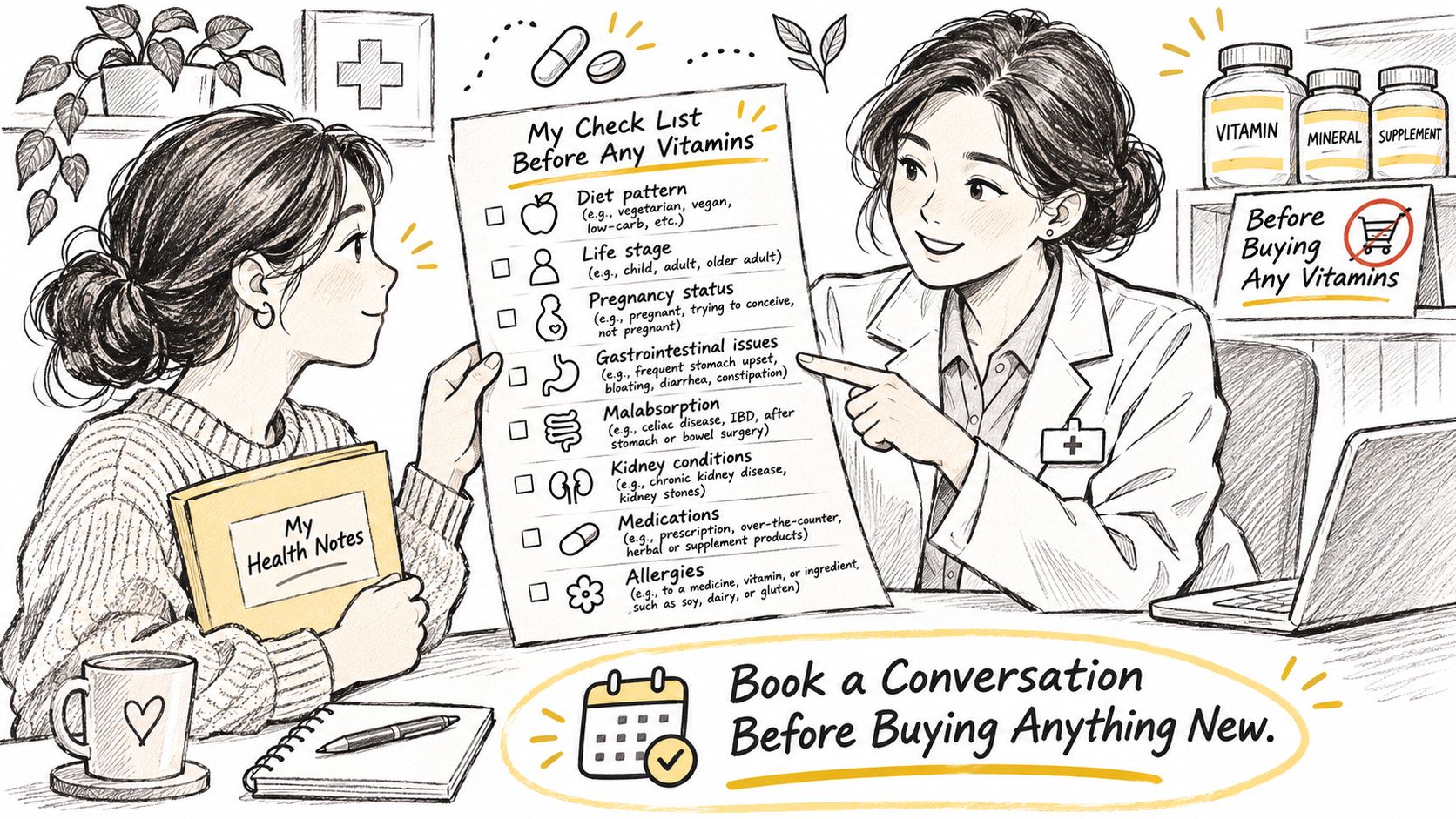
Bring your diet pattern for a typical week, your life stage including pregnancy plans, your conditions including any gastrointestinal, kidney or liver diagnosis, and every medicine and supplement you take. Add the specific deficiency or goal you want tested, and the product labels you're considering, including the supplement facts panels.
Then ask four questions.
- Is a test needed, and which one answers this question?
- What dose and duration are appropriate if it is?
- How should the product be spaced from my medicines?
- When should we recheck the result or the symptom?
Answers to those four turn a guess into a plan with a review date attached.
Buying the genuine product
Product quality varies, and a counterfeit or improperly stored bottle undercuts every careful step before it. Buy from the official CalVitamin website or from authorized supplement retailers so you get the genuine product. If a label detail is unclear, third-party testing is one signal worth understanding; our explainer on what third-party tested means covers what those certifications verify.
CalVitamin support can be reached at info@calvitamin.com or 1-888-510-9080 if you want to ask about a label, an ingredient list or a warning before ordering.
The goal was never a product chosen from a symptom or a headline. It's a supplement chosen for a documented need, checked against your medicines, and reassessed on a date you set in advance. That's how to know what vitamins to take without guessing, and it's a shorter list than many expect.
CalVitamin stocks vitamins, minerals, proteins, probiotics and herbal formulas in capsules, gummies, powders and liquids, so once you and your clinician have settled on a specific nutrient, you can find it in the form you'll take consistently. Every product page lists the dose and ingredients you'll want to check against your own medication list before ordering. Visit CalVitamin to compare options, and reach out to the support team if a label detail needs clarifying first.