97.6% of the adulterated supplements identified in an analysis of FDA warnings contained ingredients that weren't declared on the label, according to the peer-reviewed analysis published in JAMA Network Open. That finding concerns products already identified in warnings, not all supplements on sale. But it changes how to spot fake supplements: a professional-looking label isn't proof of what's inside.
Separate three questions before you buy: Is this the claimed product? Does it contain undeclared drugs or contaminants? Do its claims overpromise? A seller check helps with the first question, laboratory evidence helps with the second, and a skeptical reading of the marketing helps with the third. None answers all three.
Table of Contents
- Five-Minute Spot-Check and Label Reading
- Seals and Certifications That Prove Less Than You Think
- How to Vet a Seller Before You Pay
- Warning Signs in Claims and Drug-Like Products
- Verify Lab Proof and Botanical Identity Before You Buy
Five-Minute Spot-Check and Label Reading
Start with a short inspection of the bottle, box, and product page, then check whether the seller and manufacturer can substantiate what you see. Treat every positive signal as a filter, not a safety verdict.
Five-minute spot-check for any supplement
| Check | Green flag | Red flag |
|---|---|---|
| Supplement Facts panel | Ingredients and amounts per serving are clearly disclosed | Vague proprietary blend with no individual amounts, or no panel |
| Manufacturer details | Company name, city, and a working phone or email | Only a P.O. box with no other traceable contact, or no company information |
| Lot number and expiry | Clearly printed, durable identifiers on the bottle or box | Missing, smudged, or on a sticker that peels off easily |
| Seal and packaging | Intact tamper seal, sharp print, correct spelling | Loose seal, blurred logos, or spelling and grammar errors |
| Claims | Nutritional support language, such as supports healthy energy levels | Claims to cure or prevent disease, or deliver immediate drug-like effects |
| FDA mention | Appropriate disclaimer that statements haven't been evaluated by FDA | Claims of FDA approval for the supplement, or use of the FDA logo |
| Seller | Brand's own site or a named authorized retailer | Unknown third-party seller offering unexplained steep discounts |
| Lab proof | Lot-specific certificate of analysis naming the laboratory | No certificate, or a generic document without a lot |
Use this table to decide where to investigate, not to authenticate a bottle by appearance. I would walk away when multiple warning signs remain unresolved, and a single serious problem, such as a broken seal or an untraceable manufacturer, is enough to pause the purchase.
Practical rule: Don't let an attractive bottle cancel out a missing answer.
Read the label in order
Check ingredients and amounts per serving. Look at the Supplement Facts panel and the separate other-ingredients list. A proprietary blend may disclose a combined weight without revealing each ingredient's dose, which limits your ability to assess the formula; it doesn't, by itself, establish counterfeiting. The common mistake is accepting a long ingredient list as evidence of meaningful quantities.
Read serving size before evaluating strength. The amount displayed prominently on the front may describe a serving rather than an individual capsule. If marketing cites clinical studies, compare the studied ingredient, preparation, and daily dose with the actual formula. Don't assume research on a particular extract validates any product carrying the same plant name.
Identify the responsible company. Find the manufacturer or distributor name, location, and contact route, then search for that business independently. Compare those details with the company's own published information rather than relying only on the seller's page. A recognizable brand name can be copied, so recognition isn't verification.
Inspect the lot and expiry markings. Look for readable, durable information and photograph it before discarding the box. A removable sticker deserves investigation, but printing style alone doesn't establish authenticity. The useful question is whether the manufacturer can associate that lot with the exact product and formulation.
Match the contents and UPC. Compare the product name, dosage form, strength, net contents, and UPC with the listing you ordered from. Capsules arriving instead of gummies, or a different bottle count, require an explanation. A matching barcode helps identify the advertised item, but someone can copy it too.
Read the disclaimer without overvaluing it. A statement that FDA hasn't evaluated the claims doesn't establish effectiveness, purity, or authenticity. Nor does a disclaimer excuse disease-treatment promises elsewhere on the page. Read the front label, back label, and seller's description together.
Investigate origin and language inconsistencies. Multilingual packaging isn't evidence of fraud. However, an unexplained mismatch between origin claims, company details, and the intended market deserves a direct question before purchase. Don't treat English-only packaging as a quality credential either.
Keep a record before opening
Save the listing and photograph the front, back, seal, and lot markings when the package arrives. This gives you something concrete to send the seller if the delivered product differs from the advertised version.
For a closer explanation of serving information and label terminology, use our guide to how to read a supplement label. The aim is to understand what the label discloses, not just confirm that a panel exists.
Seals and Certifications That Prove Less Than You Think
A certification mark describes a particular program and scope. It doesn't automatically authenticate the bottle in your hand, establish that the supplement works, or guarantee that every possible contaminant was tested.
The FDA's public tainted-products materials identify more than 1,000 products marketed as dietary supplements or conventional foods containing hidden drugs or chemicals. A quality-looking presentation shouldn't override an official warning.
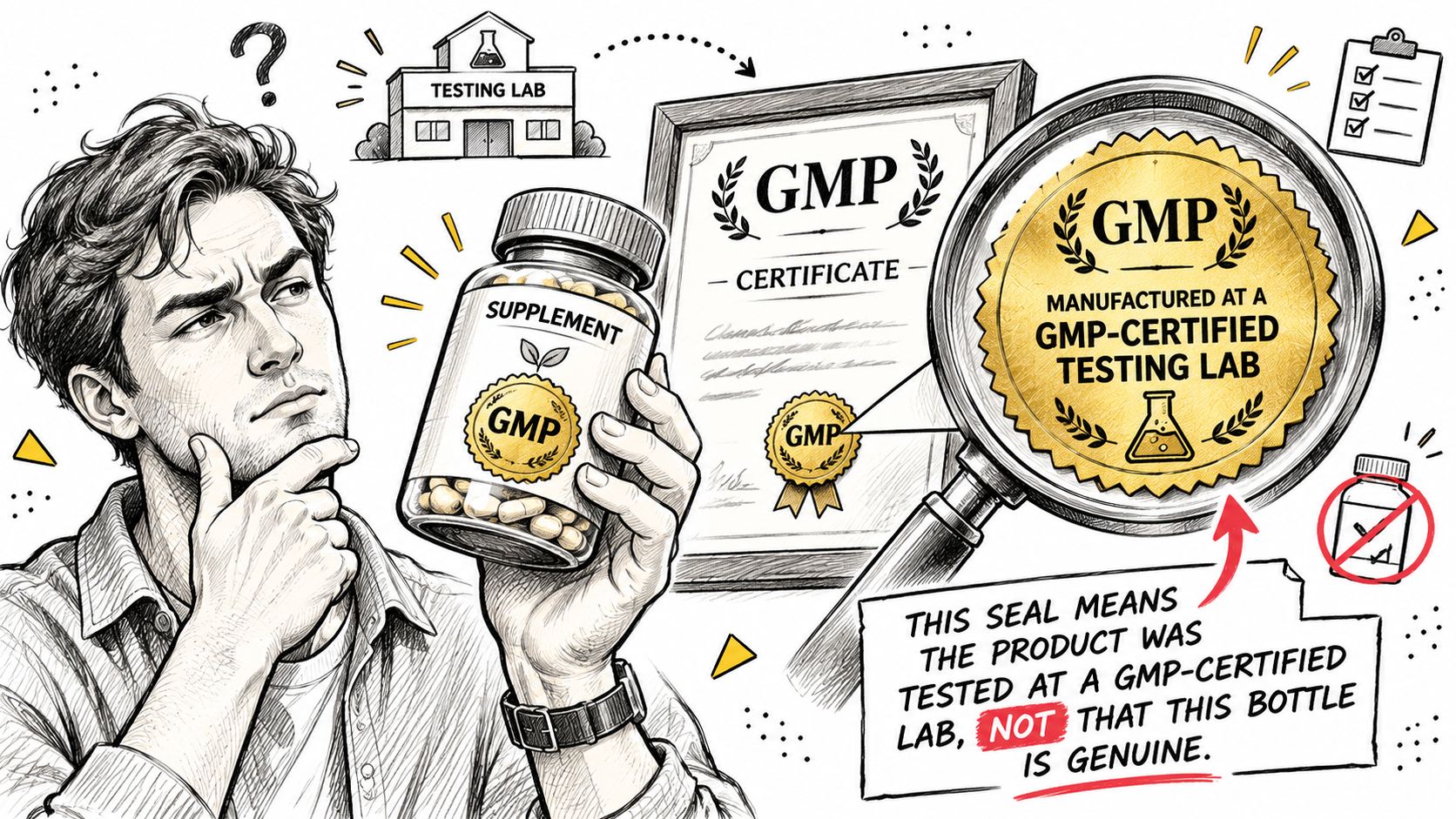
A GMP label calls for a scope check, not an automatic pass.
What each seal or claim proves and how to verify it
| Seal or claim | What it actually proves | How to verify |
|---|---|---|
| GMP certified | A legitimate certificate addresses manufacturing practices within its stated scope, not clinical effectiveness | Request the certificate and confirm the certifying body, facility, and scope |
| Third-party tested | An outside laboratory performed specified tests on submitted material, not necessarily your lot | Find the laboratory, sample description, and lot on the certificate |
| USP Verified Mark | Program verification addresses identity, strength, purity, and other program requirements | Search USP's verified product listings for the exact product |
| NSF Certified for Sport | Certification addresses the program's specified quality and banned-substance checks | Search the NSF certified products database and match the formulation |
| Informed Sport or Informed Choice | The programs address banned-substance risk, with different testing arrangements | Search the relevant program's listings and check its batch or monitoring scope |
| FDA approved | It isn't a valid general approval credential for a dietary supplement | Treat the claim as a warning sign |
| FDA-registered facility | Registration isn't approval or an endorsement of product quality | Don't accept registration as proof of product quality |
Verify the scope, not just the logo
Search through the certifier's own product listings rather than following only a seller's certificate image. Match the product name, formulation, strength, and dosage form. A certificate covering a facility or a different product doesn't establish that your purchase is covered.
Also distinguish batch testing from ongoing product monitoring. Informed Sport and Informed Choice shouldn't be treated as interchangeable promises that every bottle has undergone identical testing.
A genuine certification can still be irrelevant to the question you're asking.
If you can't verify a mark, leave it out of your buying decision. Sharp printing and a tight seal remain useful condition checks, but neither substitutes for a traceable company and a verifiable certification record.
How to Vet a Seller Before You Pay
The seller determines where your order comes from and who must answer when something doesn't match. The FDA's medication health fraud guidance warns that fraudulent health products can be sold through online marketplaces, so don't evaluate the listing without evaluating the seller.
Follow the transaction, not the storefront design
Start with the brand's own site or its named authorized retailers. Don't assume a search advertisement is the official store. Check the business identity before entering payment details, particularly when the domain or store name closely resembles a familiar brand.
Identify the actual marketplace seller. The platform name and fulfillment service don't necessarily identify the business supplying the product. Review the seller's history and ratings for consistency. A short history with an unexplained burst of activity is a reason to investigate, not standalone proof of fraud.
Test the contact route. Look for a physical business address, working phone number, and usable email address. Send a specific question about the listed product's lot documentation. A response that repeats promotional copy without addressing your question gives you little confidence in traceability.
Read the return terms before paying. Check how the seller handles damaged seals, incorrect items, and suspected authenticity problems. Clear terms won't prove chemical safety, but they tell you what recourse the seller offers if the delivery is wrong.
Compare like-for-like prices. Match bottle count, strength, formulation, and expiry information before calling something a bargain. A promotion isn't evidence of fraud. An unexplained deep discount paired with evasive sourcing answers is a different proposition.
Read complaints for details. Look for recurring descriptions of changed packaging, missing lot information, unusual contents, or adverse effects. Reviews can be manipulated, and an empty complaint search doesn't establish safety. Star totals shouldn't settle the decision.
Our guide to choosing the best online supplement store can help you compare the practical shopping details without confusing convenience with product verification.
Use the lot-number test
Ask whether the seller can connect the product it intends to ship with a traceable lot and supporting documentation. Before dispatch, it may not be able to promise a particular lot, but it should explain how you can verify the delivered item.
The decisive signal is a usable answer, not an instant reply. If nobody can explain who supplied the bottle or how to investigate its lot, choose another seller.
Warning Signs in Claims and Drug-Like Products
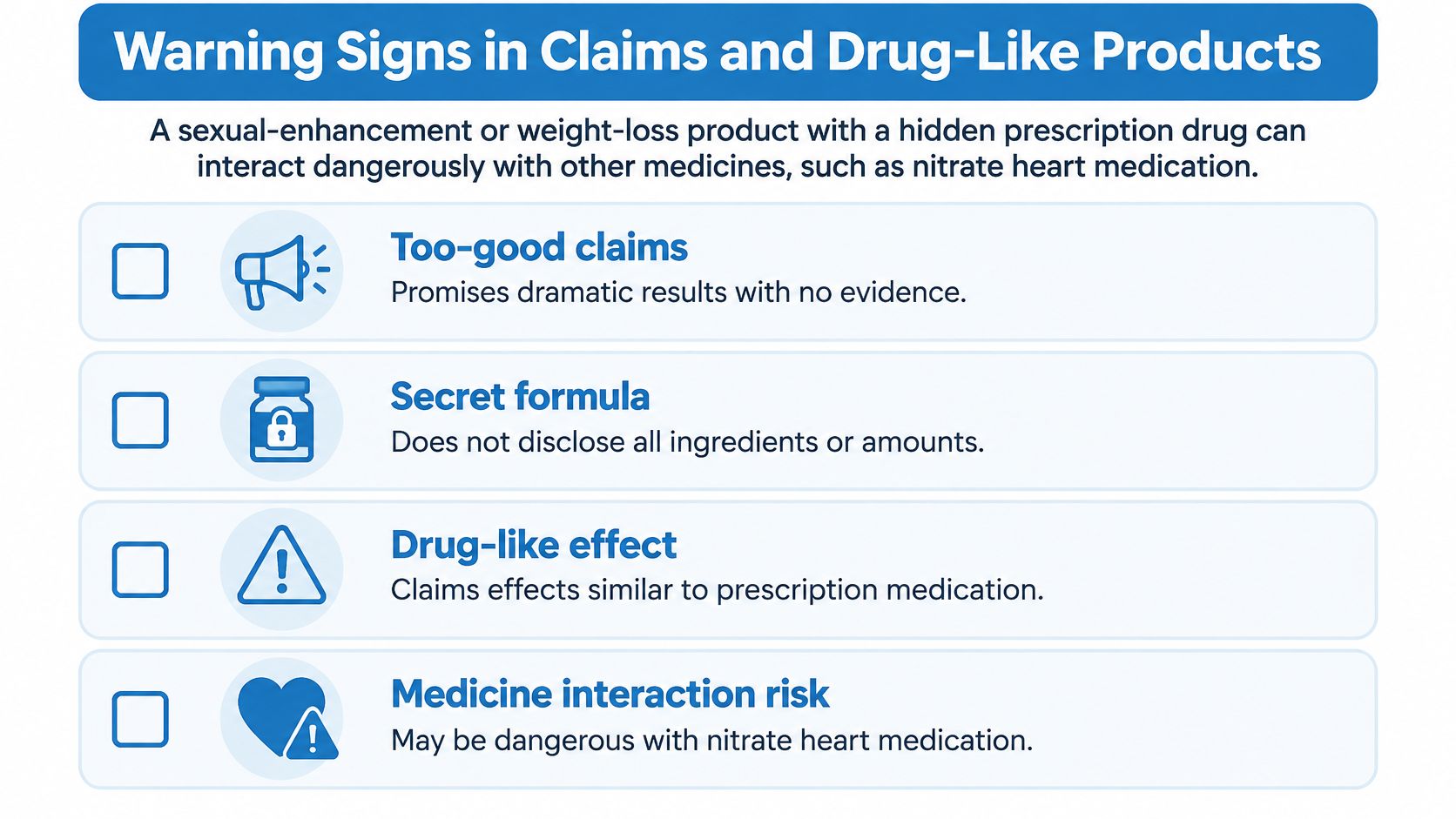
A hidden pharmaceutical ingredient changes the risk from disappointing results to an unknown drug exposure. If you take prescription medicines, don't try to judge a suspicious sexual-enhancement or weight-loss product's interaction risk from its marketing; have a pharmacist or clinician review it.
Use the following checklist to spot claims that warrant stopping the purchase.
Reject promises that outrun the evidence
- Rapid effects. Promises of immediate or unusually fast performance deserve scrutiny.
- Prescription-style instructions. Be wary when directions imitate a medicine while the seller insists the product is merely nutritional.
- Miracle language. Guaranteed cures and dramatic results aren't substitutes for evidence.
- Facility approval claims. Supposed FDA facility approval isn't a supplement-quality credential.
- Unexplained origin mismatches. Investigate inconsistent language, origin, and company information rather than judging language alone.
- Misused official branding. An FDA logo on supplement marketing isn't an authenticity seal.
Apply the strictest scrutiny to sexual-wellness, weight-loss, and bodybuilding products. Before buying, search the FDA's Tainted Products Marketed as Dietary Supplements database by both brand and product name. No matching warning means no matching warning was found, not that FDA has cleared the product.
Genuine packaging can contain the wrong botanical
Packaging checks also miss ingredient-identity problems. A review of devil's-claw supplements found that, among 20 fully analyzable products, the expected species was absent from 75%, illustrating why botanical verification requires more than an authentic-looking label.
For herbs, look for the botanical name and plant part, then assess whether the laboratory method addresses identity. DNA-based identification and chromatography answer different questions; a species result alone doesn't establish potency or freedom from contaminants.
Safety boundary: Don't take a suspect product to see whether it feels genuine.
If you've already bought one, stop using it while you seek advice, retain the packaging and receipt, and speak with a clinician about symptoms or possible exposure. Report suspected adverse events through FDA MedWatch, and seek urgent medical care for severe symptoms.
For additional context on supplement warning signs, watch the accompanying video.
Verify Lab Proof and Botanical Identity Before You Buy
A certificate of analysis, or COA, is useful only when you can connect its sample, methods, and results to the product you're considering. A polished PDF carrying a pass stamp is weak evidence if it never identifies what the laboratory examined.
Check the document itself rather than accepting a product-page badge as a substitute.
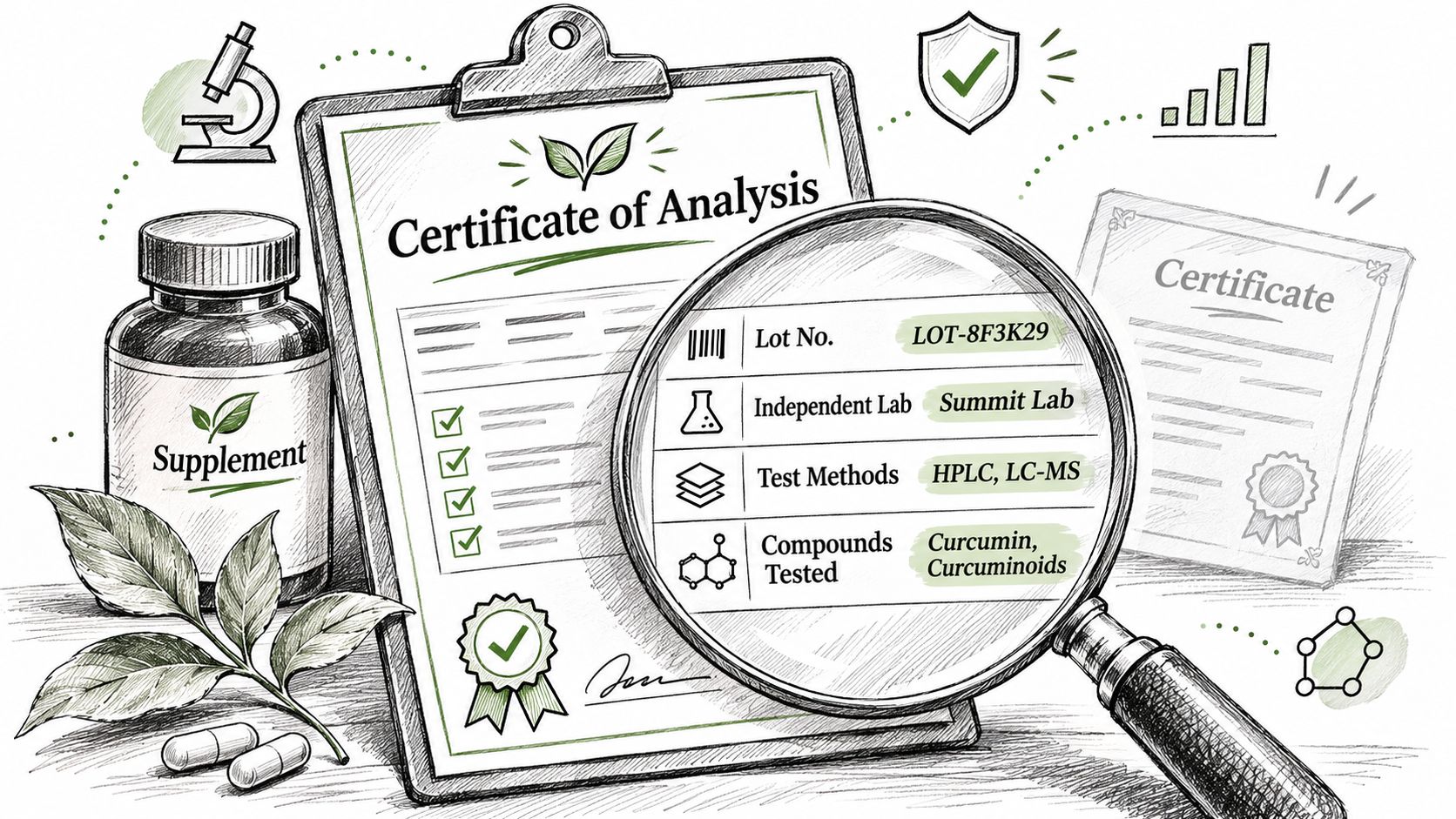
Certificate of analysis: strong versus weak proof
| Element | Strong proof | Weak proof |
|---|---|---|
| Lot | Names the lot printed on the product | Generic certificate that never names a lot |
| Laboratory | Independent laboratory named and traceable | No laboratory named, or only an internal report presented as independent verification |
| Methods | Appropriate identity and potency methods, such as chromatography or DNA-based identification | No method given |
| Analytes | Lists the compounds or contaminants tested, with results and units where relevant | Says tested without naming compounds or reporting values |
Match the test to the question
Identity testing asks whether the claimed ingredient is present. For a botanical product, the sample description should make clear which plant, plant part, and preparation the report concerns. A raw-material report doesn't automatically characterize the finished capsule after blending.
Potency testing asks how much of a specified substance is present. If the buying decision depends on an extract's active or marker compounds, look for a suitable quantitative method, such as chromatography, and readable results. A species identification doesn't answer that question.
Contaminant testing addresses the substances included in the test panel. Don't interpret a heavy-metal result as a screen for undeclared pharmaceuticals, or a microbial report as proof of botanical identity. The report's scope matters as much as its conclusion.
DNA testing also has practical limitations because processing can damage the material needed for analysis. An unsuccessful DNA test isn't automatically proof of substitution, and a successful identification doesn't establish every other quality characteristic.
Check traceability before interpreting results
Find the laboratory through an independent search and use its published contact details if you need to authenticate the report. Check the report identifier, sample description, and lot rather than sending only a screenshot of the pass statement.
Our explanation of what third-party tested means helps distinguish outside testing from broad marketing claims. Independent testing can add confidence, but an unnamed laboratory or an unrelated sample leaves the central question unanswered.
Buy when the responsible company is traceable, the evidence fits the delivered lot, and the marketing stays within nutritional support rather than drug-like promises. Walk away when a serious discrepancy remains unexplained; paperwork shouldn't be used to excuse a broken seal, a mismatched product, or an official warning.
For a genuine CalVitamin purchase, buy from our official website or an authorized supplement retailer, then match the delivered bottle's lot to the supporting certificate before use.
We offer vitamins, minerals, proteins, probiotics, and herbal supplements at CalVitamin. Visit our store to compare product labels and formats, and use these seller, claim, and laboratory checks before choosing what to buy.