Current human research is too small to show that maca root reliably treats menopause symptoms, though a few trials report relief in some women. The most frequently cited placebo-controlled trial of the root had 14 postmenopausal women complete it, while the largest menopause trial enrolled 66 early-postmenopausal women over a 4-month program.
Those two numbers explain a strange feature of the literature. A trial can post a strong, statistically significant improvement and still be unable to tell you whether the supplement will do anything for you, because the group was too small and too specific to stand in for everyone. Maca root for menopause has plenty of published interest and very little settled proof.
Three questions get blurred in most coverage of maca root for menopause. Does the evidence show people report relief? Does it prove the effect? And does maca act like estrogen? Each one has a different answer, and only one of them comes close to a yes.
Table of Contents
- Does Maca Root Help With Menopause Symptoms
- Why the Evidence Stays Thin
- Which Menopause Symptoms Maca Has Been Tested For
- Whether Maca Works Like Estrogen
- Who Should Check With a Doctor First
- How to Choose and Track a Maca Product
- Decide Whether Maca Fits Your Plan
Does Maca Root Help With Menopause Symptoms
Maca may ease menopause discomfort for some women, but the case rests on small signals rather than firm proof. The NCBI review of clinical evidence on maca root examined randomized controlled trials in healthy perimenopausal, early postmenopausal and late postmenopausal women and concluded that the number of trials, the combined sample size and the average methodological quality were too limited to establish firm conclusions about effectiveness. That verdict matters because three separate questions often get mixed together: whether participants report relief, whether the design can support the claim, and whether maca behaves like estrogen.
The clearest problem is completion. A frequently cited randomized, double-blind, placebo-controlled crossover study gave postmenopausal women 3.5 grams per day of powdered maca or a matching placebo for 6 weeks, switching treatments over a 12-week study period. Only 14 postmenopausal women finished. That kind of trial can produce a tidy pattern and still leave a practical question open. It cannot tell a woman with years of hot flushes whether her own response will look the same.
A second study is often presented as stronger than its design supports. In an early-postmenopause investigation described in the NCBI review of clinical evidence on maca root, women took maca supplied as 500 milligram capsules, and some participants reported less menopause-related discomfort after two months. The finding points toward benefit, yet it rests partly on subjective assessment and was weakened by substantial attrition. A small group's impression can be useful as a signal, but it is not the same as an established effect.
The evidence behind the question looks like this:
Key maca menopause studies and what they found
| Study | Participants | Maca dose and duration | Main finding | Main limit |
|---|---|---|---|---|
| Placebo-controlled crossover trial | 14 postmenopausal women completed | 3.5 g daily powdered maca, 6 weeks per period | Reported improvements among completers, with no reliable effect estimate | Very small sample; cannot predict wider effects |
| Early-postmenopause trial | Small groups in 3-month and 9-month follow-up | 500 mg capsules | Some women reported less discomfort after two months | Partly self-assessed; substantial attrition |
| Multicenter randomized trial, gelatinized maca | 66 early-postmenopausal women | 4-month program | NCBI review of clinical evidence on maca root reports Kupperman Menopausal Index scores falling from 22 to 10 (P<0.001) | Preliminary; not equivalent to hormone therapy evidence |
| Systematic review of randomized trials | Healthy peri- and postmenopausal women across trials | Powder and capsule preparations, 6 weeks to 4 months | Evidence too limited for firm conclusions on effectiveness | Few trials, small combined samples, average quality too low |
What the Table Does Not Tell You
Read down the participant column and the answer gets harder to give confidently, not easier. Fourteen here, a small completing group there, sixty-six in the largest trial. These are pilot-scale numbers. A pilot study is built to detect whether a signal exists, not to measure how large it is or who is most likely to respond.
The stages do not match either. The review included perimenopausal women, early postmenopausal women and late postmenopausal women. A woman two years past her last period is not the same patient as one still having cycles, so a single average response can hide meaningful differences. The preparation column adds another mismatch. Powdered root at 3.5 grams a day and a gelatinized product are different inputs at different doses, which makes it hard to treat the trials as repeated tests of one standard intervention.
The estrogen question stays separate. A symptom score improving after maca use does not show that maca is acting like estrogen. It shows only that a measured outcome changed in a particular group under a particular design. That distinction matters for daily decisions, because a woman choosing maca is deciding whether to try a supplement with uncertain benefit, not whether to replace a hormone-based treatment.
The practical reading: maca may ease hot flushes and night sweats for some people. No trial shows it works for everyone, and none of these studies is large enough to promise the same result.
Why the Evidence Stays Thin
Maca is Lepidium meyenii, a cruciferous root from the high-altitude Andes, eaten in Peru for centuries as a food and a traditional herbal medicine, mostly for nutrition, energy and fertility-related purposes, as the 2011 ethnobiology and ethnopharmacology review records. In one population sample that review reported, 80% of participants consumed maca. That figure measures how ordinary the food is. It says nothing about hot flushes.
Menopause research on maca is a newer and much thinner project. A double-blind, randomized, multicenter study of early-postmenopausal women ran a gelatinized maca preparation for 4 months, and the wider enrollment process recorded 168 subjects at admission across two trials, which gives some sense of how much screening, registration and drop-out stood between the volunteers and the published group.
A Long History of Eating It, a Short History of Testing It
A 2024 review of the field counted 57 preclinical studies but only 22 human studies, many of them with small participant groups, according to the Cleveland Clinic summary of maca research. That review also concluded the available information was insufficient to determine whether maca improves menopausal symptoms.
Think of a family recipe that has been cooked for generations. The generations prove the dish is eaten and enjoyed. They don't prove it was ever tested in a controlled kitchen.
Hold results loosely. A centuries-long food history and a handful of small trials are two different kinds of evidence, and only the second can answer a clinical question.
Meanwhile the market has stopped waiting for the trials. NielsenIQ reported in 2025 that products containing maca increased 5% in the vaginal-menopause-symptom category and 32% in grocery, according to the NielsenIQ women's health report. Sales growth is not evidence of effect, and it rarely arrives with a footnote saying so.
If you want the botany and the preparation types sorted out first, our guide to what maca root is and what it contains covers that ground.
Which Menopause Symptoms Maca Has Been Tested For
Hot flushes and night sweats carry the only result strong enough to describe as a signal. In a randomized, double-blind, placebo-controlled, multicenter study of early-postmenopausal women, a standardized pre-gelatinized maca preparation was associated with a substantial reduction in the Kupperman Menopausal Index, which fell from 22 to 10, with particularly notable improvements in hot flushes and night sweating, reported at P<0.001 in this clinical review of maca in early postmenopause.
The qualifier matters as much as the number. A systematic review of the same literature still calls the overall evidence limited, so treat that index drop as preliminary rather than as the kind of proof that sits behind hormone therapy. Preparation is part of the reason, since standardized and gelatinized products are not interchangeable with generic maca powder, and dose, extract composition and study population all shift the outcome.
Mood, Libido and the Claims That Outrun the Data
Mood and irritability have been measured, and they behave inconsistently, sometimes improving alongside hot flushes and sometimes not moving at all. Sexual function is studied in menopause research with mixed findings, which is a polite way of saying no trial has settled it. Sleep and bone health appear in marketing far more often than in the literature, and no reliable human data turn up for either.
| Symptom | Human evidence so far | Evidence strength | What to track |
|---|---|---|---|
| Hot flushes and night sweats | Kupperman index fell in one gelatinized maca trial | Preliminary | Daily count and severity |
| Mood and irritability | Measured in some trials; results inconsistent | Limited | Daily mood rating on the same scale |
| Sexual function | Studied in menopause research; mixed findings | Limited | Desire and comfort, weekly |
| Sleep | No reliable human data found | Not established | Time to fall asleep and night waking |
| Bone health | No human trial data on bone density identified | Not established | Discuss with a clinician; not tracked at home |
Judging a product needs a baseline, not a hunch. Count hot flushes each day and rate how severe each one is, put a number on mood using the same scale every day, and note how many times you wake at night. Keep the log for several weeks before deciding, because these symptoms fluctuate on their own and improvement is not guaranteed to arrive quickly.
Start the log before the bottle. A week of records taken with no supplement in the picture is what makes the next two months readable.
Whether Maca Works Like Estrogen
The assumption that a plant which helps with hot flushes must be a natural estrogen doesn't survive the hormone data. A small randomized crossover trial using about 3.5 g/day of maca powder in postmenopausal women reported no significant changes in estradiol, follicle-stimulating hormone, luteinizing hormone, or sex-hormone-binding globulin, as documented in this review of maca's hormonal effects.
Symptom relief and hormonal change came out of different studies, and that is the point. A separate pre-gelatinized maca study reported symptom improvement while these hormone measures did not move, so relief of vasomotor or psychological symptoms can't be credited to an estrogenic effect. The same review describes maca's proposed endocrine activity as incompletely understood and notes inconsistent findings across studies.
A smoke alarm that shrieks when you burn toast is detecting something real. It is not detecting a fire. Symptom relief and hormone change are two different signals, and maca has only reliably produced the first.
What This Means for the Label You Buy
A label should state the exact botanical identity, the serving size, the preparation type, and no claim of validated hormone equivalence. A bottle that markets itself as hormone balance is selling a mechanism nobody has demonstrated.
People with hormone-sensitive conditions, those taking endocrine-active medicines, and anyone having persistent bleeding should talk to a healthcare professional before use. Position maca as an adjunct with uncertain efficacy, never as a replacement for evaluation or prescribed therapy.
Who Should Check With a Doctor First
Hormone replacement therapy is the most common reason to slow down before buying a bottle. Maca's hormonal effects aren't clear, and nobody has assessed what combining the two does, so the decision belongs to a clinician who knows your history and your prescription list rather than to a product page.
The situations below are the ones that call for a conversation first.
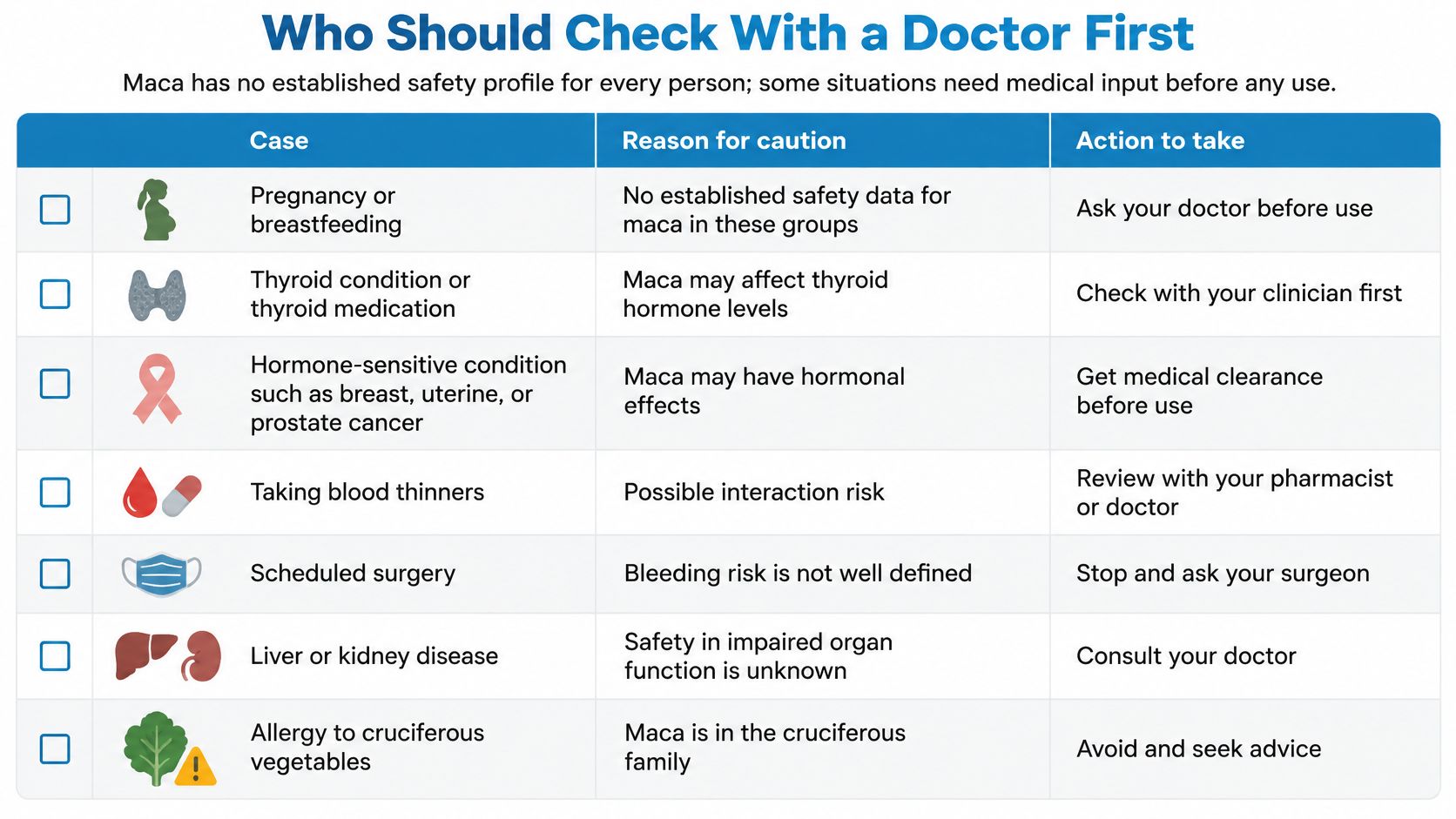
Hormone-sensitive conditions sit at the top of that list. Breast, uterine and prostate cancer histories all involve tissue that responds to hormones, and maca's endocrine activity is incompletely understood, so clearance comes before experimentation. The same caution applies to endocrine-active medicines, where an interaction is possible and a pharmacist can review the whole list in one conversation.
Symptoms That Need Assessment, Not a Supplement
Persistent or unexplained bleeding, and any symptom that is new, severe or worsening, should be evaluated rather than self-treated. A supplement can hide the timeline of a problem that needed a diagnosis months earlier.
Pregnancy and breastfeeding belong in the same bracket, because human safety data in those groups are limited. Nobody has run the trials that would let a label make a clean claim there.
| Situation | Reason for caution | What to do first |
|---|---|---|
| Taking hormone replacement therapy | Hormonal effects unclear; combination not assessed | Ask a clinician before combining |
| Hormone-sensitive condition | Endocrine activity incompletely understood | Get clinical advice before starting |
| Taking endocrine-active medicines | Possible interactions | Clinician review of full medication list |
| Persistent or unexplained bleeding | Needs medical assessment first | See a clinician before any supplement |
| Pregnant or breastfeeding | Limited human safety data | Avoid unless a clinician approves |
| New, severe or worsening symptoms | May have another cause | Seek evaluation instead of self-treating |
Bring three things to the appointment: the bottle or a photo of the label, the exact daily dose, and the date you started.
How to Choose and Track a Maca Product
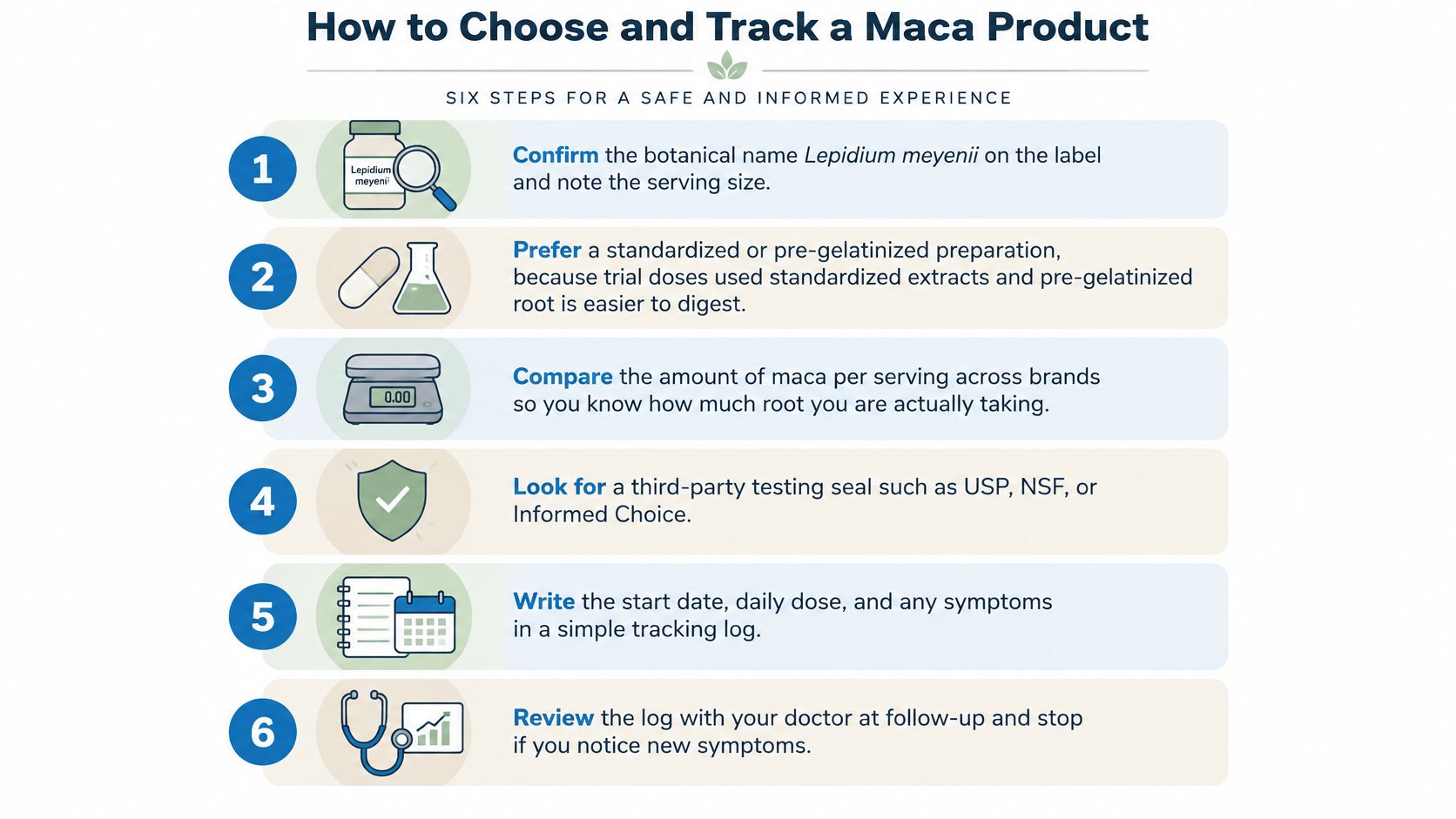
A maca label is the first piece of evidence, and it is often clearer about marketing than about dose. Read it as if you were checking a small trial: what was given, in what form, and for how long.
Work through these checks in order and keep the routine boring, because consistency is what the trials had and casual use often lacks.
- Confirm the botanical name and the serving size. The label should read Lepidium meyenii, and the serving size tells you what one dose means before you compare anything else.
- Favor a standardized or pre-gelatinized preparation. The trial results came from characterized preparations rather than generic powder, and gelatinized root is easier to digest.
- Match the daily amount to what trials tested. Powder measured in grams and a capsule extract measured in milligrams aren't interchangeable, and a product supplying a fraction of a studied dose gives you no reason to expect a studied result.
- Check the rest of the blend. Extra herbs can interact with your symptoms or your medicines, and a multi-ingredient formula makes it impossible to tell what helped.
- Run a baseline week before starting. Record hot flushes, night waking, mood and sleep for seven days with no supplement in the picture, so the comparison later has something to stand on.
- Keep the same log while you take it. Compare week by week against the baseline for several weeks, since a few days can't separate a real change from a bad week.
- Stop and call a clinician if things get worse. New bleeding, worsening symptoms or a new side effect ends the experiment rather than extending it.
Change one thing at a time. Adding maca, a new iron supplement and a sleep aid in the same week leaves you guessing which one moved the symptom, and stopping everything at once leaves you guessing whether any of them helped.
Keep the scorecard narrow. A daily line for flushes, sleep and mood can show whether you report relief; it cannot prove the root caused the change, and it does not show estrogen-like action. That distinction keeps a useful self-test from becoming an overclaim.
If you'd rather watch than read labels, this short overview covers the basics of the root before you start comparing products.
A label is a claim, not proof. Comparing brands is its own exercise, and our guide to choosing a maca supplement covers how the products differ and what the wording on the front commits the maker to.
Decide Whether Maca Fits Your Plan
Severity decides this, not enthusiasm. If your symptoms are mild and steady, trying maca as an adjunct is a reasonable move once a clinician has looked over your history and medicines. Go in with expectations sized to the evidence: some people report less discomfort, and nobody has proven it works for everyone.
If symptoms are severe, new, worsening or unexplained, the next step is evaluation, not a supplement. Bleeding after menopause, night waking that ruins your week, or a sudden change in a pattern you've lived with for years all point to a conversation with a clinician before anything goes into the cart.
Five Questions Worth the Appointment
- Does my medical history or medication list rule out maca?
- Am I on hormone replacement therapy or any endocrine-active medicine?
- Which symptom should I track, and what change would count as a result?
- How long should I try before we review it together?
- Which symptoms mean I should call you sooner?
If you'd rather start with a formula built for this stage than experiment with a single root, our NOW Menopause Support, 90 veg capsules at $27.39, is designed for the perimenopause and menopause phases and can be taken while you're still having periods. The label advises consulting your doctor before taking it together with hormone replacement therapy, which is the same rule that applies to maca. For non-hormonal options aimed at flushing and mood, our guide to herbal relief for hot flashes and hormonal balance sets out what each botanical is supported to do.
Maca may ease some hot flushes and night sweats for some people, the evidence behind that is preliminary, and it doesn't replace evaluation or prescribed treatment.
CalVitamin carries maca blends and menopause-support formulas alongside vitamins, minerals, proteins, probiotics and a toll-free support line if you want a second pair of eyes on a label before you buy. Take the question you have, whether that's hot flushes, energy or libido, and compare the preparations and serving sizes at your own pace at CalVitamin. Your symptom log and your clinician's view are the two pieces of evidence that matter most here, and both are yours to bring.