In a 16-week trial of 50 infertile men, the placebo group's sperm concentration rose 76% and its sperm count rose 102%, while the yellow-maca group rose 40% and 15%, and free testosterone in the maca group fell 27%, according to a 2024 trial summary table published in Nutrients. Read that again with the marketing filter removed: the men taking nothing did better on both counts, and the hormone the label promised to boost went down.
That single comparison explains most of the confusion around maca root men benefits. The trials measured questionnaire scores (sexual desire, erectile function) and semen parameters. Labels sell testosterone, stamina and virility, which are different outcomes, often unmeasured ones.
Table of Contents
- Maca Root Benefits for Men at a Glance
- Sexual Desire and Erectile Function Trials
- Does Maca Raise Testosterone?
- Fertility and Semen Quality Research
- Safety Limits and Who Should Check With a Doctor
- How to Check a Maca Supplement Label
- Decide Whether a Maca Trial Is Worth It
Maca Root Benefits for Men at a Glance
Maca has its most credible human data for sexual desire and erectile-function scores, and that data is small, short and inconsistent.
| Benefit claim | Evidence strength | Verdict for men |
|---|---|---|
| Sexual desire (libido) | Limited, small randomized trials | Possible modest benefit; supported by one healthy-male trial |
| Erectile function scores | Limited, one trial of 50 men | Not a treatment for erectile dysfunction |
| Testosterone boost | Weak, hormone levels often unchanged | Don't expect a reliable testosterone increase |
| Semen quality and fertility | Mixed, pooled analysis found no significant gain | Not a proven fertility product |
| Energy and vitality | Anecdotal and self-reported | No firm trial evidence |
| Long-term safety | Poorly studied, short trials only | Unknown beyond a few months of use |
Limited means a handful of small trials found a possible effect that hasn't been confirmed at scale. Weak means trials looked for the effect and didn't find it reliably, which is a different and worse position than "not yet studied enough."
How to use this table
Match the row to the reason you're buying. If your goal is desire, you're buying into the strongest row, and it's still only a maybe. If your goal is a higher testosterone number on a lab report, you're buying into the weakest row, and no amount of dosage escalation fixes that mismatch.
Energy and vitality sit in the anecdotal row for a plain reason: it's self-reported, and no trial discussed here measured it as an outcome. Men who feel better on maca aren't lying, but feeling better and demonstrating a physiological change are separate claims.
Buying rule: judge maca by the specific outcome it claims to improve, not by a general men's health banner on the front of the bottle.
The practical consequence is that a "men's wellness" label tells you nothing about which of these six rows the product is built on. Check the row before you check the price.
Sexual Desire and Erectile Function Trials
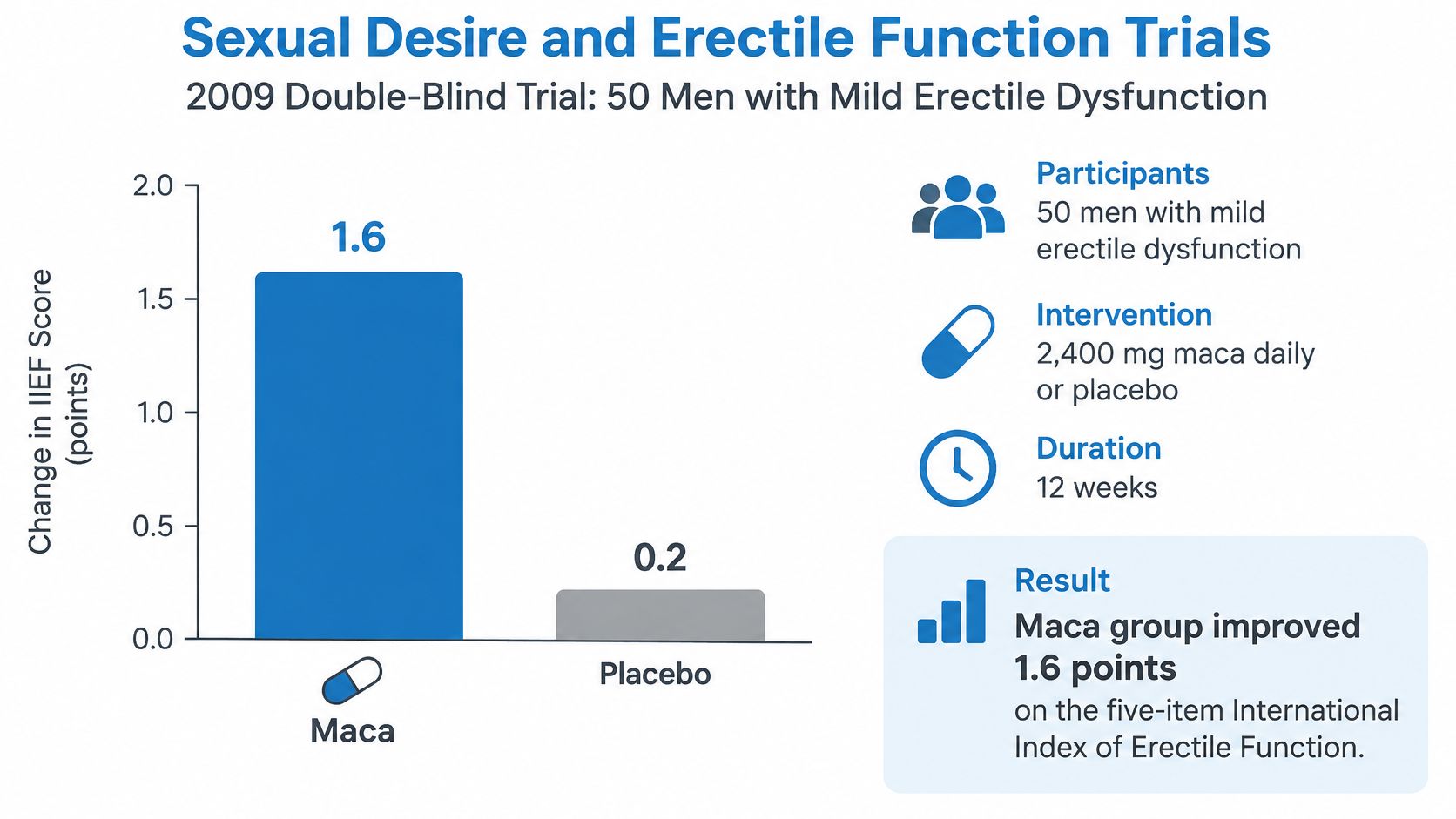
The headline trial here is easy to describe and easy to oversell. A 2009 double-blind trial gave 50 men with mild erectile dysfunction either 2,400 mg of maca extract daily or placebo for 12 weeks; both groups improved on the five-item International Index of Erectile Function, with the maca group gaining an average of 1.6 points against 0.5 points for placebo, a between-group difference reported as significant at p < 0.001, per the clinical review of maca trials hosted on NCBI Bookshelf.
What a 1.6-point gain actually means
The IIEF-5 is a questionnaire. Men rate confidence, erection firmness, penetration ability, maintenance and satisfaction, and the answers are summed. It measures a man's report of his function, not blood flow, not hormone status, not a clinical cure.
So the honest reading is narrow: on a five-question self-report scale, men taking maca improved about one point more than men taking placebo, and both groups improved. A statistically significant difference in 50 men with mild symptoms doesn't establish a treatment for erectile dysfunction, and it says nothing about men with moderate or severe symptoms, who weren't the population studied.
The desire signal and the null result
A separate randomized dose-finding study enrolled healthy men aged 21 to 56 and compared placebo with 1.5 g or 3.0 g of maca daily for 12 weeks; the pooled maca groups improved on sexual-desire measures by the study endpoint, with no corresponding changes in serum testosterone or estradiol, as described in the same NCBI clinical review.
| Study | Population | Dose and duration | Main result |
|---|---|---|---|
| 2009 double-blind trial | 50 men with mild erectile dysfunction | 2,400 mg daily for 12 weeks versus placebo | IIEF gain of 1.6 points versus 0.5 for placebo (p < 0.001) |
| Dose-finding randomized trial | Healthy men aged 21 to 56 | 1.5 g or 3.0 g daily for 12 weeks versus placebo | Sexual-desire measures improved; testosterone and estradiol unchanged |
| 2010 systematic review | Four randomized trials on sexual function | Trials lasting up to 12 weeks | Two of four showed significant benefit; evidence judged too limited for firm conclusions |
| Trial in healthy cyclists | Healthy adult cyclists | Not specified in the review | No benefit found |
That last row matters more than most buyers assume. A null result in healthy cyclists shows the effect isn't a universal male response, and the 2010 systematic review counted only four randomized trials, of which two reported significant benefit, concluding the trial count, participant total and methodological quality were too limited for firm conclusions.
Small human studies have reported possible improvements in sexual desire and erectile-function scores. That's the ceiling of the claim, and it's why "may support sexual desire" is defensible while "treats ED" isn't.
If you're comparing ingredients for desire specifically, our comparison of male libido supplements puts maca alongside the other options men usually shortlist.
Does Maca Raise Testosterone?
Many labels imply maca is a natural testosterone booster. The human record doesn't support that as a dependable mechanism, and the one piece of evidence pointing the other way is the weakest study design in medicine.
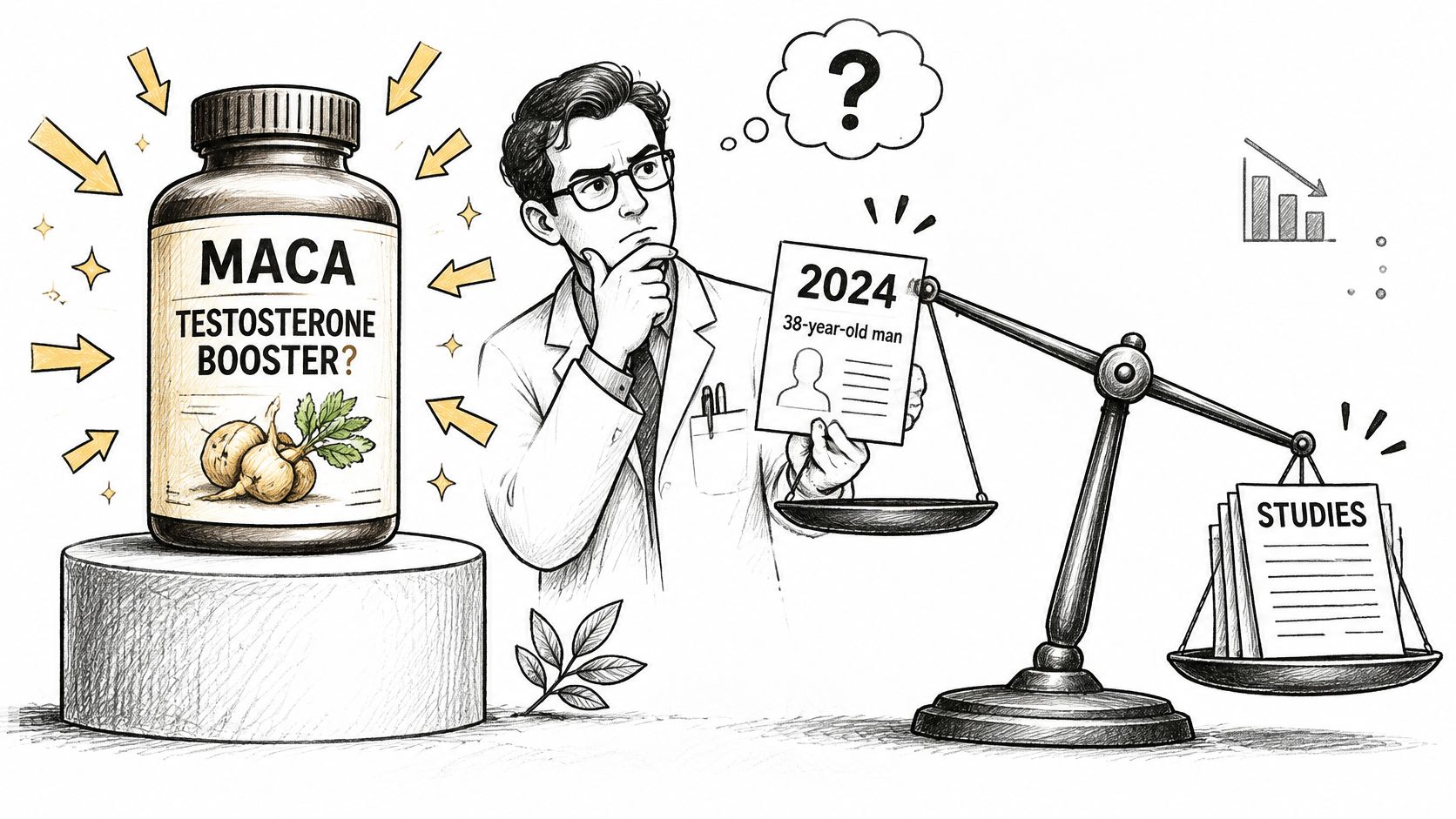
In 2024, a case report described one 38-year-old man whose use of a concentrated maca preparation was associated with increases in total testosterone, sperm concentration, total motile sperm, motility, morphology and libido, according to the Journal of Men's Health case report. One man, no control group, no randomization, and a concentrated preparation that may not match the powder in your cart. A case report generates a hypothesis. It cannot generalize to you.
Symptoms improved, hormones didn't
Set the case report beside controlled work. In a randomized pilot of healthy men, sperm concentration and motility trended upward after 12 weeks while hormone levels didn't change significantly, and in an infertile-patient trial free testosterone decreased in the maca group, as documented in a review of maca's hormonal and sexual effects.
The most interesting counterexample is an 80-participant randomized trial in eugonadal men with late-onset hypogonadal symptoms, which reported improvements in symptom and sexual-function measures, including IIEF scores, without severe treatment-related adverse events, per that same hormonal-effects review. Men felt better. That still doesn't demonstrate higher testosterone, and it doesn't prove maca treats medically defined hypogonadism.
Three outcomes get conflated constantly:
- Serum testosterone: a lab value, measured in blood, unchanged in the controlled trials.
- Sexual desire and IIEF scores: self-reported, and the outcomes that moved.
- Subjective energy: felt and described, not assayed, and not a hormone proxy.
If you're asking whether maca can replace testosterone therapy, the answer runs through a needle, not a capsule. Get baseline blood levels, let a clinician interpret them alongside your symptoms, and don't assume a herb corrects androgen deficiency.
Fertility and Semen Quality Research
Start with the pooled result, because it outranks any single trial. A 2022 systematic review and meta-analysis of 5 randomized controlled trials of maca and semen quality found no statistically significant improvement in sperm concentration versus placebo: weighted mean difference 2.22, 95% confidence interval −2.94 to 7.37, p = 0.40, reported in the meta-analysis published in Frontiers in Pharmacology.
A confidence interval that crosses zero in both directions means the data are compatible with a small harm and a small benefit. That's not a fertility product.
Why individual trials disagree
The same semen-quality meta-analysis describes a 2020 double-blind pilot that assigned 69 infertile men with mild asthenozoospermia or mild oligozoospermia to 2 g of maca daily (35 participants) or placebo (34 participants) for 12 weeks. Sperm concentration differed significantly between groups, with reported means of 15.04 ± 5.61 versus 10.16 ± 3.59 and p = 0.011, while another semen measure wasn't significantly different (p = 0.801).
A separate randomized trial of 50 infertile patients, with 25 participants per group after accounting for expected dropouts, reported a statistically non-significant maca-related improvement in sperm concentration.
Three reasons those results diverge, none of which flatters the supplement:
- Population drift. Healthy volunteers, men with mild abnormalities and men in a fertility clinic aren't interchangeable, and a man with normal baseline values has less room to improve.
- Preparation differences. Doses and formulations varied across trials, so a positive result with one extract doesn't transfer to a different product on a shelf.
- Small samples. With groups in the twenties and thirties, one or two outliers can flip a p-value, which is exactly why pooling exists.
Percentage gains mean nothing without the placebo arm printed beside them. A label quoting a rise in sperm count is quoting half a result.
What this means if you're trying to conceive
Maca isn't a fertility treatment, and treating it as one costs time, which is the resource that matters most in conception. Get a semen analysis and clinician guidance first, so you know whether the issue is count, motility, morphology, hormones or something outside the semen picture entirely.
If you and your clinician decide to trial a supplement anyway, judge it over at least one full spermatogenic cycle with a repeat analysis, not after a few days of feeling optimistic. A single pre-and-post comparison in one man, without a control, can't distinguish a real effect from normal biological variation.
Safety Limits and Who Should Check With a Doctor
Long-term safety is the least studied part of this ingredient. The available trials are small and short, and a clinical review of randomized maca trials notes that the included trials didn't adequately assess adverse effects. "No serious adverse events reported" in a 12-week study of a few dozen men is a statement about the study's ability to detect problems, not a guarantee about years of daily use.
That gap changes what a cautious buyer does. It doesn't mean maca is dangerous. It means you can't outsource your risk assessment to a trial literature that never looked properly.
Cases that need medical input first
| Situation | Why it matters | Action |
|---|---|---|
| Erectile symptoms that persist | Vascular, metabolic, medication-related or psychological causes may need treatment | See a clinician for evaluation |
| Suspected low testosterone | A supplement can't be assumed to correct androgen deficiency | Get baseline blood testing first |
| Trying to conceive | Fertility effects are mixed and unproven | Get a semen analysis and clinician advice |
| Pregnant, nursing or on medication | Safety data are thin | Ask a healthcare provider before use |
| History of a hormone-sensitive condition | Hormonal effects aren't well studied in these groups | Discuss with the treating specialist |
Persistent erectile symptoms deserve the most urgency on that list. Erections are a vascular event, and difficulty that doesn't resolve can point to circulatory, metabolic or medication-related problems that a herb won't touch. Self-treating for months delays the evaluation that would identify the cause.
Anyone with a hormone-sensitive condition, or a history of one, should raise maca with the specialist managing that condition rather than a general practitioner who may not know the treatment plan. The hormonal question is unresolved in healthy men, which makes it more unresolved in a group whose treatment depends on hormone control.
Before your appointment: photograph the supplement facts panel and write down the exact daily dose you're taking or considering. A clinician can't assess "a maca blend" without the milligrams and the other ingredients.
We build that caution into our own product pages: where safety data are thin, our labels direct you to consult a healthcare provider before use if you're pregnant, nursing or taking medication. That's not boilerplate. It's the honest response to a short-trial evidence base.
How to Check a Maca Supplement Label
A label is a testable document. Run these seven checks in order and most bad buys eliminate themselves.
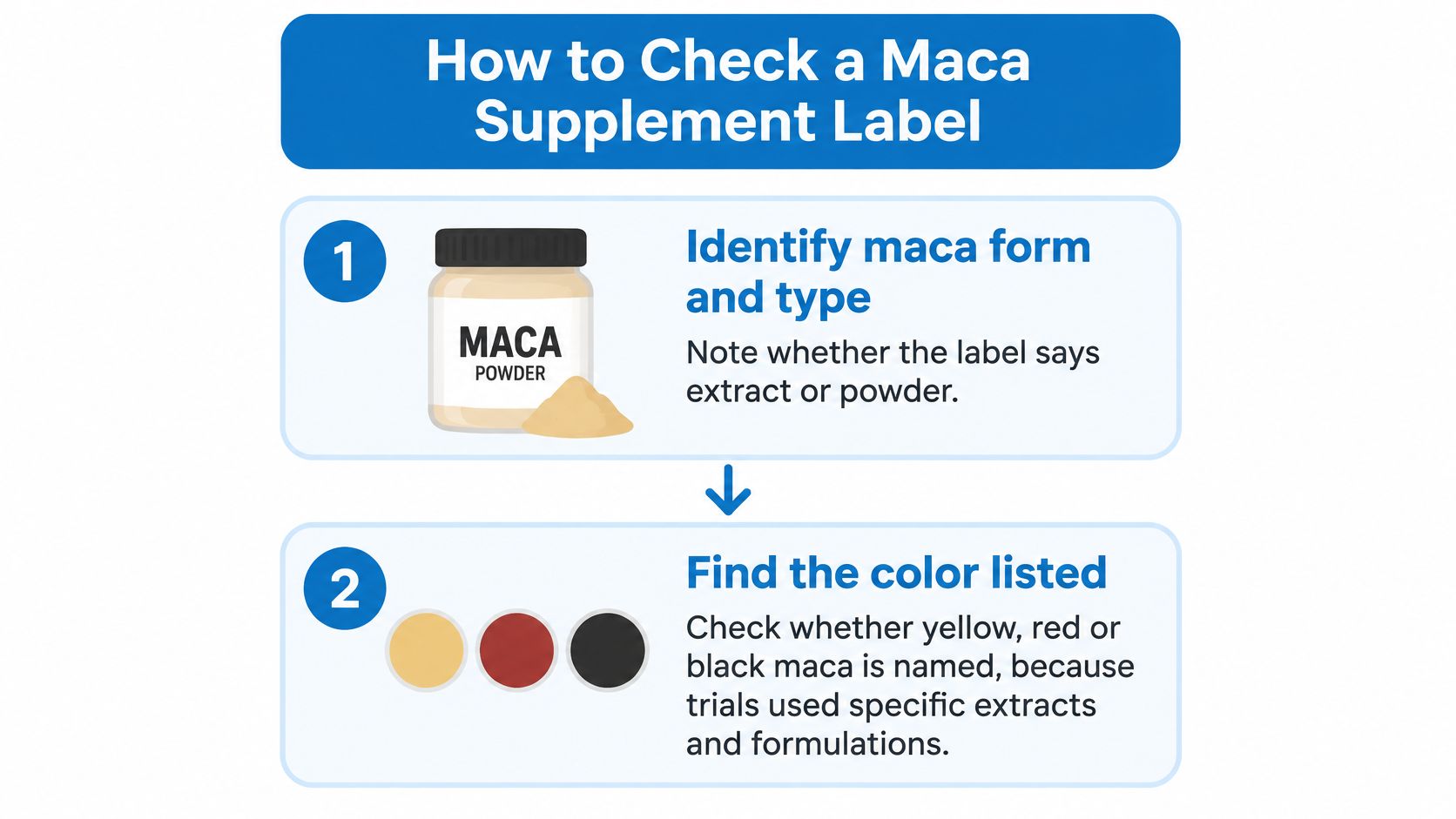
Identify the form. Note whether the panel says extract or powder, and whether it names a concentration ratio. Trials used specific preparations, so an unspecified "maca root" gives you nothing to compare against the research you're hoping to borrow.
Find the colour. Yellow, red and black maca are sold as distinct products, and the fertility trial that produced the placebo comparison used yellow maca specifically. If the front of the bottle advertises a colour the supplement facts panel never confirms, you can't verify what you're swallowing.
Read the dose per serving, in grams or milligrams. The sexual-function trials used 1.5 g to 3.0 g daily, 2,400 mg daily and 2 g daily, so a serving measured in the low hundreds of milligrams isn't reproducing any of them. Multiply by the number of capsules in a serving before you decide, because "per capsule" and "per serving" are often different numbers.
Audit the claim wording. "May support sexual desire" matches what small trials reported. "Boosts testosterone" or "treats erectile dysfunction" claims outcomes the controlled work didn't demonstrate, and that mismatch tells you how the company reads evidence.
Count the other ingredients. A blend of six herbs makes any effect you notice unattributable, and it usually means each ingredient is dosed below what was studied. Single-ingredient products are easier to judge and easier to stop.
Look for third-party testing and a traceable manufacturer. A full ingredient list, a batch test result and a real contact route let you verify potency and contaminants. Our guide to reading a supplement label walks through where each of those details should appear on the panel.
Compare price per serving and set a 12-week horizon. Discount tiers reward buying more, not buying better, so divide the price by servings at your intended daily dose. Most trials ran 12 weeks, which is the minimum honest window for judging a result.
One more check worth the seconds: a label that tells pregnant or nursing users and people on medication to consult a provider is following safe practice, and its absence is a small red flag about the rest of the copy.
Decide Whether a Maca Trial Is Worth It
Three men, three different answers.
If your goal is libido and you accept modest evidence, a 12-week trial at a dose inside the studied range is a reasonable experiment, provided the label passed the checks above. If your erectile symptoms persist, see a clinician before adding anything. If you're trying to conceive, get the semen analysis first, because a supplement chosen before diagnosis is a guess with a price tag.
Set the rules before the first capsule:
- A check date: twelve weeks out, written in your calendar, not "when I notice something."
- A simple log: score sexual desire and energy from 1 to 5 each day, so you're comparing numbers rather than moods.
- A stop rule: any new side effect ends the trial, no tapering, no waiting it out.
- A handoff: bring the log to your next appointment, where it becomes clinical information instead of a supplement anecdote.
For dose specifics and timing, our maca root dosage guide covers how to translate a studied daily amount into a serving size on a real bottle.
This week, write down your goal in one sentence, pick the single outcome you'll track, and book baseline blood work if you suspect low testosterone. A supplement supports a plan that already exists. It doesn't replace testing or treatment.
We stock maca products alongside the rest of our herbal and sexual wellness range, with supplement facts panels showing form, strength and serving size so you can compare a label against the trial doses discussed here. If you're building a libido-focused routine rather than chasing a testosterone claim, browse the maca and men's wellness selections at CalVitamin and check the milligrams per serving before you add anything to your cart.