
A 2023 ClinicalTrials.gov study registration investigated maca for male sexual dysfunction and planned to enroll just 60 men, assigning 30 to 2.25 g of maca extract twice daily and 30 to placebo for 12 weeks. That scale is common in botanical research, and it explains why the label "generally well tolerated" leaves gaps when you assess maca root side effects for men. Short trials can identify common, visible complaints. They are weaker at catching uncommon signals, subtle lab changes, or effects that need longer follow-up.
Product pages often treat the absence of dramatic emergencies in short human trials as proof of blanket safety. The clinical record supports a narrower conclusion. Short-term use at standard oral doses rarely causes serious harm, yet two findings deserve attention before a man buys a bottle. One controlled infertility trial recorded a statistically significant drop in free testosterone (2021 PubMed Central trial). A 90-day study reported an association with raised ALT (a liver enzyme) and higher diastolic blood pressure (MedlinePlus maca page). Those results do not prove predictable harm for every user, but they show what "well tolerated" can leave out.
The practical point is scope. Trial size, duration, dose, and what investigators measured all shape the safety picture. Knowing which symptoms warrant stopping, and which outcomes were tracked in the studies, lets you weigh maca against marketing claims with cleaner expectations and fewer assumptions.
Table of Contents
- Documented Side Effects and How Often They Occur
- When to Stop Maca and Call a Doctor
- What Maca Does and Does Not Do to Male Hormones
- Interactions, Blends and Who Should Be Cautious
- How Long Maca Stays Safe at Studied Doses
- Your Next Step Before You Buy Maca
Documented Side Effects and How Often They Occur
In men, the most consistently recorded adverse effects from maca root are mild, short-lived gastrointestinal symptoms and headaches. Short trials have rarely recorded hormonal or organ-related changes, though the less frequent signals discussed elsewhere in this article deserve attention. According to the NIH LiverTox review, small clinical trials generally found maca well tolerated, while one dose-finding study logged gastrointestinal upset in 5 of 16 participants and headache in 2 of 16, alongside single cases of irritability, sleep disruption, increased sweating, urinary frequency, and blurred vision.
Every one of those symptoms was transient. None prompted a participant to drop out. The breakdown below organizes the full symptom profile from that 16-man dose-finding study so you can see both the frequency and the clinical course at a glance.
| Side effect | Reported in | Share of 16 men | Severity and course |
|---|---|---|---|
| Gastrointestinal upset | 5 of 16 | 31% | Mild, transient, no discontinuation |
| Headache | 2 of 16 | 13% | Mild, transient, no discontinuation |
| Irritability | 1 of 16 | 6% | Transient |
| Sleep disruption | 1 of 16 | 6% | Transient |
| Increased sweating | 1 of 16 | 6% | Transient |
| Urinary frequency | 1 of 16 | 6% | Transient |
| Blurred vision | 1 of 16 | 6% | Transient, see a doctor if it persists |
A clinical review archived on PubMed Central adds two important pieces of context to those numbers. First, across the same dose-finding trial of men experiencing SSRI-associated sexual dysfunction, 11 of 16 participants (approximately 69%) reported at least one adverse event, and less frequent complaints also included panic symptoms. Second, that picture looks very different alongside a larger randomized, double-blind pilot trial of 56 men taking 1.5 g or 3.0 g daily for up to 12 weeks, which reported no adverse events and no shifts in sex or pituitary hormones.
Why Small Denominators Distort Side Effect Rates
A percentage means nothing until you know what sits beneath it. When a trial includes only 16 men, a single person reporting a restless night immediately registers as a 6% incidence rate, and one upset stomach moves the figure by more than six points. Reading "31%" or "69%" without that check leads straight to the wrong conclusion in both directions.
That group also wasn't a random cross-section of healthy buyers. Men already taking selective serotonin reuptake inhibitors (SSRIs) face higher baseline rates of sleep disruption, sweating, irritability, and digestive sensitivity, so some share of the recorded events may reflect the medication or the underlying condition rather than the maca. Treating their event rate as the expected rate for every man taking a scoop of maca powder overstates the risk.
The denominator problem: A zero-event result in 56 men doesn't rule out uncommon side effects, and a 69% event rate in 16 men on antidepressants doesn't predict what a healthy man will experience.
What This Means in Daily Use
Even with those statistical limits, gastrointestinal complaints and headaches surface most often across the broader maca research, which is why they sit at the top of the table. Maca root is a dense, starchy cruciferous vegetable, so taking raw powder or concentrated capsules on an empty stomach can easily trigger cramping, bloating, or mild nausea.
If you're healthy and decide to test maca, expect mild digestive friction or a brief headache if you notice anything at all. Start with the lowest dose listed on the label, take it alongside a meal rather than on an empty stomach, and give minor adjustment symptoms a couple of days before judging tolerability. The rarer hormonal and cardiovascular findings carry a different weight than these everyday complaints, precisely because they appeared in controlled settings rather than as passing discomfort.
When to Stop Maca and Call a Doctor
Mild stomach rumbling after your first dose is a dosing adjustment problem. Severe, persistent, or systemic symptoms are a different category altogether and require stopping the supplement immediately.
Before you take your first capsule, keep this quick visual reference on hand to distinguish ordinary adjustment discomfort from urgent warning signs.

Your 30-Second Triage Checklist
Stop taking maca and seek medical advice right away if you develop any of the following red flags:
- Persistent abdominal pain or vomiting that doesn't settle after stopping the supplement or taking it with food.
- Severe or worsening headache, especially if it feels sharper or lasts longer than your usual tension headaches.
- Any visual change, such as blurred vision, that fails to clear promptly.
- Marked mood changes, panic symptoms, or new sleep disruption that interfere with work, focus, or overnight rest.
- Swelling, hives, or breathing difficulty, which point toward a possible allergic reaction and call for urgent care.
- Yellowing of the eyes or skin, or noticeably dark urine, both classic warning signs that warrant prompt liver evaluation.
If you don't have any of those red flags and only notice mild nausea or bloating that starts to fade within a few days, you can take the slower route. Pair your capsule with a full meal, step down to the lowest labeled serving, and check whether the discomfort clears. Stop anyway if the irritation lingers instead of improving.
Hormone Labs and What to Bring to Your Appointment
One overlooked pitfall has nothing to do with how you feel day to day. Because controlled trial evidence flagged a drop in free testosterone in one male group, taking maca right before routine blood work can muddy the interpretation of a hormone panel. Tell your clinician you're using maca before scheduling testosterone or fertility labs, and never add it without disclosure while starting or adjusting prescription testosterone therapy.
Don't guess whether a symptom is "just the supplement." Stop the product first, document what happened, and let your doctor rule out an underlying issue.
For a quick walkthrough of how doctors and supplement reviewers evaluate maca's safety signals in practice, watch the video breakdown below.
When you do contact a healthcare provider about a reaction, walk in prepared so the visit stays productive. Bring the exact product bottle (or a photo of its Supplement Facts panel showing the product name and extract strength), along with your daily dose, how long you took it, and a dated timeline showing when you started maca and when each symptom appeared or eased.
What Maca Does and Does Not Do to Male Hormones
Supplement labels routinely pitch maca as a natural testosterone booster, inviting men to assume that higher libido must mean higher androgen levels. Controlled human trials don't back up that chain of logic.
In a 12-week randomized trial of healthy men taking 1.5 g or 3 g per day, an Examine.com research review reports that maca did not increase circulating testosterone or other reproductive hormones, even though some participants reported greater sexual desire. Desire rose without moving the endocrine needle. That distinction matters because men searching for a low-testosterone fix often delay proper lab testing while waiting for an herbal powder to raise a hormone it hasn't been shown to raise.
The Free-Testosterone Finding You Should Weigh
A closer look at fertility research introduces an unexpected wrinkle. A 2021 randomized, double-blind, placebo-controlled trial evaluated infertile men over 8 to 16 weeks and found no statistically significant changes across male reproductive hormones except a statistically significant decrease in free testosterone.
The fertility results in that same study were equally sobering:
- Sperm concentration gains trailed placebo: Sperm concentration increased by 40% in the maca group compared with 76% in the placebo group, a difference that was not statistically significant.
- Two men stopped treatment early: Both discontinuations were linked to possible treatment-related issues, one involving starch intolerance and the other a diagnosis of ulcerative colitis.
- Investigators stayed cautious: The study authors concluded that the available evidence was insufficient to determine whether maca improves male fertility.
Earlier research paints a similarly modest picture. In a 2015 pilot study summarized in that same PubMed Central paper, 20 healthy men aged 20 to 40 took 1.75 grams per day of maca or placebo for 12 weeks; sperm concentration and motility showed upward trends, yet hormone levels didn't change significantly.
Separating Libido Effects from Androgen Suppression
Does one trial prove maca crashes male testosterone? No. A single small study in infertile men can't establish clinically meaningful androgen suppression across the general male population, and variations in maca preparation make it hard to generalize from one extract to another.
Hormone reality check: Maca hasn't been proven to raise testosterone, and one controlled trial saw free testosterone dip. Treat it as a libido-focused botanical, never as a stand-in for medical hormone management.
Still, that signal is strong enough to retire the "hormonally neutral" assumption. Men monitoring hypogonadism, undergoing fertility workups, living with hormone-sensitive conditions, or adjusting testosterone therapy shouldn't self-treat with maca. If your goal is fixing low energy, poor recovery, or erectile trouble tied to low testosterone, start with a morning blood panel through a physician instead of an over-the-counter root powder.
Interactions, Blends and Who Should Be Cautious
Controlled human drug-interaction trials for maca barely exist. Rather than pretending there's a complete interaction chart, the responsible move is framing risk around physiological overlap and product complexity.

Five Groups of Men Who Should Clear Maca First
Certain medical histories raise the stakes if a supplement shifts blood markers, liver enzymes, blood pressure, or mood. Speak with a healthcare professional before buying maca if you fall into any of these categories:
- Men on testosterone therapy or hormone replacement: Adding an unmonitored botanical alongside prescription hormones makes it much harder for your doctor to tell whether shifting symptoms or lab numbers come from your dose or the supplement.
- Men with hormone-sensitive conditions: Because human trials haven't established long-term endocrine neutrality in high-risk patients, any condition influenced by reproductive hormones warrants medical sign-off first.
- Men with liver issues: A recorded liver-enzyme signal in short-term research means anyone managing fatty liver disease, hepatitis, or high baseline liver lab results should clear maca before starting.
- Men taking SSRIs: Antidepressants already carry overlapping side effects like sweating, sleep disruption, and stomach upset, and clinicians need to know about every active botanical when evaluating sexual side effects.
- Men already under fertility treatment: Introducing maca mid-protocol can complicate semen analysis tracking and hormone interpretation without delivering proven fertility gains.
Say a man starts prescription clomiphene or testosterone cypionate for fertility or hypogonadism and adds a maca capsule the same month. When his follow-up blood panel comes back slightly off target, neither he nor his urologist can isolate which variable caused the swing. Keeping your prescriber in the loop eliminates that blind spot.
Why Multi-Ingredient Blends Complicate Safety
Walk down any supplement aisle or browse herbal supplements for sexual health, and you'll notice maca rarely travels alone. Male vitality blends frequently combine maca with ashwagandha, shilajit, fenugreek, yohimbe, zinc, or proprietary plant complexes packed into a single capsule.
Mixing five or six active compounds creates an attribution nightmare. If you develop a pounding headache, racing pulse, or persistent heartburn after starting a stacked formula, you have no way to know whether maca, another herb, or a concentrated stimulant triggered the reaction.
Apply one simple rule whenever you add a supplement: introduce one single-ingredient product at a time. Read the Supplement Facts panel carefully so you know both the extract strength (for instance, whether a label lists actual capsule weight or a dried-root equivalent from a 10:1 extract) and every inactive filler or secondary herb. Bring that full list, including over-the-counter products, to your pharmacist before combining maca with daily prescriptions.
Serious drug interactions with maca haven't been clearly documented in clinical trials. Remember what that means statistically: an absence of reports across small, short-term studies isn't proof that a combination is safe for you.
How Long Maca Stays Safe at Studied Doses
Four months is the outer edge of medicinal use that the clinical summaries support. MedlinePlus states that maca doses of up to 3 grams per day appear safe for as long as four months, while larger medicinal amounts have not been fully evaluated.
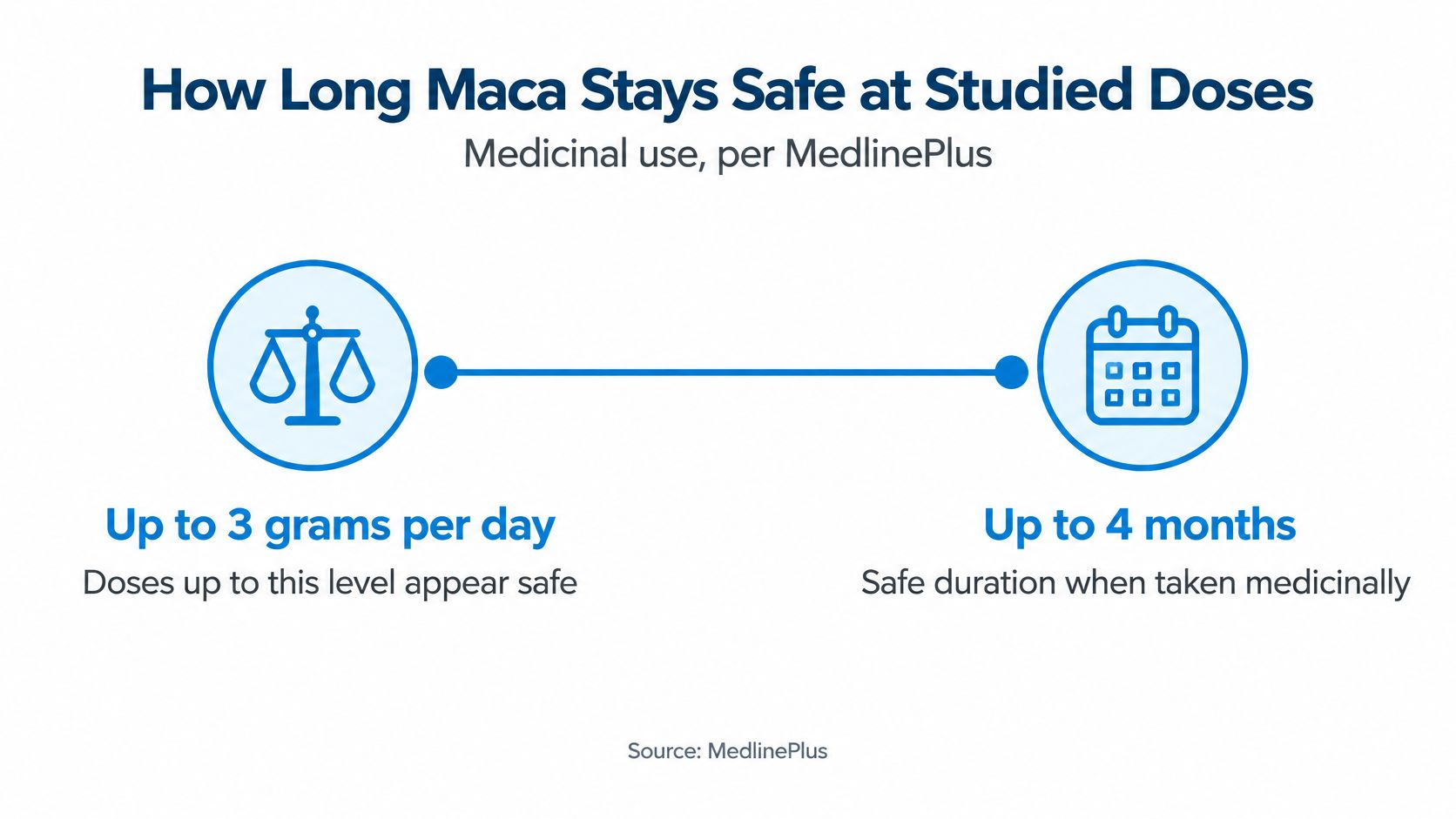
Short trials often get folded into one label, "generally well tolerated." That label records what those studies measured. It leaves out the two findings men most need to weigh: a decrease in free testosterone, and a signal of higher ALT and diastolic blood pressure. The benchmarks below show how narrow the tested window is.
| Source | Dose | Duration | Reported finding |
|---|---|---|---|
| MedlinePlus | Up to 3 g/day | Up to 4 months | Appears safe; larger medicinal amounts not comprehensively evaluated |
| Randomized pilot, 56 men | 1.5 or 3.0 g/day | Up to 12 weeks | No adverse events; no sex or pituitary hormone changes |
| Healthy men trial | 1.5 or 3 g/day | 12 weeks | No rise in testosterone or reproductive hormones; some reported higher desire |
| Infertility trial, 2021 | Oral maca | 8 to 16 weeks | Free testosterone decreased; two participants discontinued |
| ALT and blood pressure study | 0.6 g/day | 90 days | ALT and diastolic blood pressure increased; causation not established |
The Overlooked Liver and Blood Pressure Signal
The last row is the clearest break with a "food root, so no footprint" assumption. At 0.6 g per day for 90 days, one study noted in the MedlinePlus evidence summary was associated with increased ALT and higher diastolic blood pressure. That same summary also points to a review of mild gastrointestinal complaints in two maca-treated participants, a meta-analysis of five randomized trials with mixed semen-quality results and samples too small for firm conclusions, and a 2024 case series of just two men that cannot establish broader safety or efficacy.
An association in one 90-day trial does not prove maca causes liver injury or hypertension. It does show why men who already manage blood pressure or liver disease should put maca on the list at routine checkups. The free-testosterone decrease in the 2021 infertility trial belongs in the same conversation: over 8 to 16 weeks of oral maca, free testosterone fell and two participants stopped. Desire reports in the healthy-men trial moved the other way, with no rise in testosterone. Those are different endpoints, not one reassuring hormone story.
What Sits on the Untested Side of Four Months
A 12-week report of no serious adverse events covers those 12 weeks. Small participant counts, brief follow-up, and wide differences in how roots are dried, gelatinized, or extracted mean one trial's safety record does not transfer to every bottle.
Three patterns sit outside that record. Doses above 3 grams per day, taken as ongoing medicine rather than traditional cooked food, have not been fully evaluated. Concentrated extracts can carry alkaloid or glucosinolate ratios that differ sharply from plain root powder. Continuous use past about four months is where systematic safety monitoring drops off.
Before setting a daily amount, compare practical ranges in a guide to maca root dosage. Use the four-month mark as a checkpoint: pause and review results and health markers with a clinician rather than refilling on autopilot for the rest of the year.
Your Next Step Before You Buy Maca
Good supplement decisions happen before you click checkout, not after an unexpected reaction. Use these four steps to test maca methodically without guessing.

- Run a quick personal clearance check. Look at your current prescriptions and medical history first. As we advise across our catalog, consult a healthcare professional before use if you take medications, have a hormone-sensitive condition, or have liver issues. That single check protects you from preventable lab confusion or symptom overlap.
- Audit the label before opening your wallet. Pick a transparent formula that clearly lists its extract strength and every single ingredient instead of hiding behind proprietary blends. Comparing single-ingredient powders and capsules in a buyer's breakdown of the best maca supplement helps you match the form to your goal, whether you're shopping for plain maca or an active men's vitality formula designed for athletes and men seeking to maintain healthy testosterone, strength, and vitality as they age. Begin at the lowest labeled dose, and always take it with food since products in this category are generally well-tolerated, though mild digestive changes can occur.
- Keep a two-week symptom log. Jot down brief notes each evening on stomach comfort, headaches, sleep quality, and mood during your first 14 days. Writing it down makes it obvious whether a minor gripe fades in three days or lingers long enough to stop.
- Set two calendar checkpoints. Review whether maca is helping at 12 weeks, and schedule a firm stop-and-reassess check by the four-month mark. If any red-flag warning sign appears earlier, quit immediately and contact your doctor.
Maca is a low-risk option for most healthy men at studied doses, not a hormone treatment and never a substitute for diagnosing a hormonal or fertility problem.
Keep expectations grounded in what trials support, pay attention to how your body responds, and loop your clinician in whenever blood work, prescriptions, or persistent symptoms enter the picture.
When you're ready to compare clearly labeled single-ingredient maca capsules, powders, and men's herbal wellness formulas with transparent extract details, explore our curated selection at CalVitamin. Every product page lists full Supplement Facts alongside customer reviews, and our Jacksonville-based support team is available by phone or email if you have questions about product formats before you order.