
Of the 353 sexual-enhancement supplements the U.S. Food and Drug Administration flagged as adulterated between 2007 and 2016, 287 of them, or 81.3%, contained sildenafil, a sildenafil analogue, or both, according to a JAMA Network Open analysis of FDA warning data.
That number changes what a side effect means. When most flagged products in a category carry a prescription-drug compound, a headache, a flush, or a blood pressure drop isn't necessarily a reaction to the ginseng or the maca printed on the front of the box. It may be a reaction to something nobody disclosed.
This guide runs in the order you need: the symptom you're feeling, then the action it calls for. You'll get the reactions that usually settle, the ones that need a same-day call, the ones that need an emergency department, and a record-keeping routine that turns a bad night into a report a regulator can act on.
Table of Contents
- Side Effects to Expect and Which Need Urgent Care
- Why a Natural Label Does Not Guarantee Drug-Free Contents
- Nitrate Medicines and the Risk of a Sudden Blood Pressure Drop
- Hidden Drug Ingredients in Pills, Gummies, Shots and Chocolates
- How to Document and Report a Bad Reaction
- Who Needs Medical Review Before a First Dose
Side Effects to Expect and Which Need Urgent Care
Sort the symptom before you sort the cause. That order matters in this category, because the label rarely tells you what you swallowed. Use the list below as a speed filter: it tells you how quickly to act, not what caused the reaction.
| Symptom | Typical Pattern | Action |
|---|---|---|
| Headache, flushing or mild stomach upset | Listed among possible reactions; often temporary | Stop the product and monitor; ask a pharmacist if it persists |
| Nasal congestion or mild digestive complaints | Reported across product formats; usually mild | Stop the product and monitor for changes |
| Dizziness or palpitations (rapid heartbeat) | Reported; may reflect a blood pressure change | Stop the product and contact a clinician the same day |
| Chest pain | Serious warning sign | Seek urgent medical attention now |
| Fainting or severe dizziness | Serious warning sign | Seek urgent medical attention now |
| Sudden vision loss | Serious warning sign | Seek urgent medical attention now |
| Erection lasting more than four hours | Medical emergency | Seek urgent medical attention now |
| Any symptom after taking a nitrate medicine | Dangerous interaction risk | Seek urgent medical evaluation now |
The mild rows still deserve a note. A published review of sexual-enhancement product safety found that 17.6% of users reported adverse events, and around half of those affected consulted no one and reported nothing, most often because the symptoms felt temporary or embarrassing.
That silence shapes the whole evidence base. Spontaneous safety reports capture a fraction of real-world reactions, so a tidy product page tells you very little. A mild symptom isn't proof that a product is gentle. It's proof that nobody wrote it down.
You usually can't name the culprit. Two products sold for the same purpose can differ completely in formulation, and the compound behind your reaction may never appear on the ingredient panel at all. Guessing burns time you could spend getting assessed.
Practical rule: stop at the first symptom and write down the time it started. A timeline is the most useful thing you can hand a clinician.
Some ingredients do carry documented effects of their own. Yohimbine, which appears in this category, has a distinctive side-effect profile worth reading on its own, so start with this explainer on yohimbe bark extract before you stack it with anything else.
Whatever the severity, keep a written record: product name, dose, time, and what happened. You'll want it if the symptoms return, and a clinician will want it to rule other causes out.
Why a Natural Label Does Not Guarantee Drug-Free Contents
A natural label describes a marketing decision, not a test result. That's the central confusion in this category, and the historical record is blunt about it.
What the Warning Data Shows
Researchers reviewed FDA warning data from 2007 through 2016 and identified 776 adulterated dietary supplements tied to 146 companies. Sexual-enhancement products accounted for 353 of those cases, or 45.5% of all identified adulterated supplements, so nearly half of everything flagged in that window sat in the category most shoppers browse casually.
| Measure | Count | Share |
|---|---|---|
| Adulterated dietary supplements identified | 776 | From 146 companies |
| Sexual-enhancement products among them | 353 | 45.5% of all adulterated supplements |
| Contained sildenafil, an analogue, or both | 287 | 81.3% of sexual-enhancement products |
| Contained sildenafil | 166 | 47.0% of sexual-enhancement products |
| Contained at least one sildenafil analogue | 134 | 38.0% of sexual-enhancement products |
| Contained more than one unapproved ingredient | 157 | 20.2% of all 776 supplements |
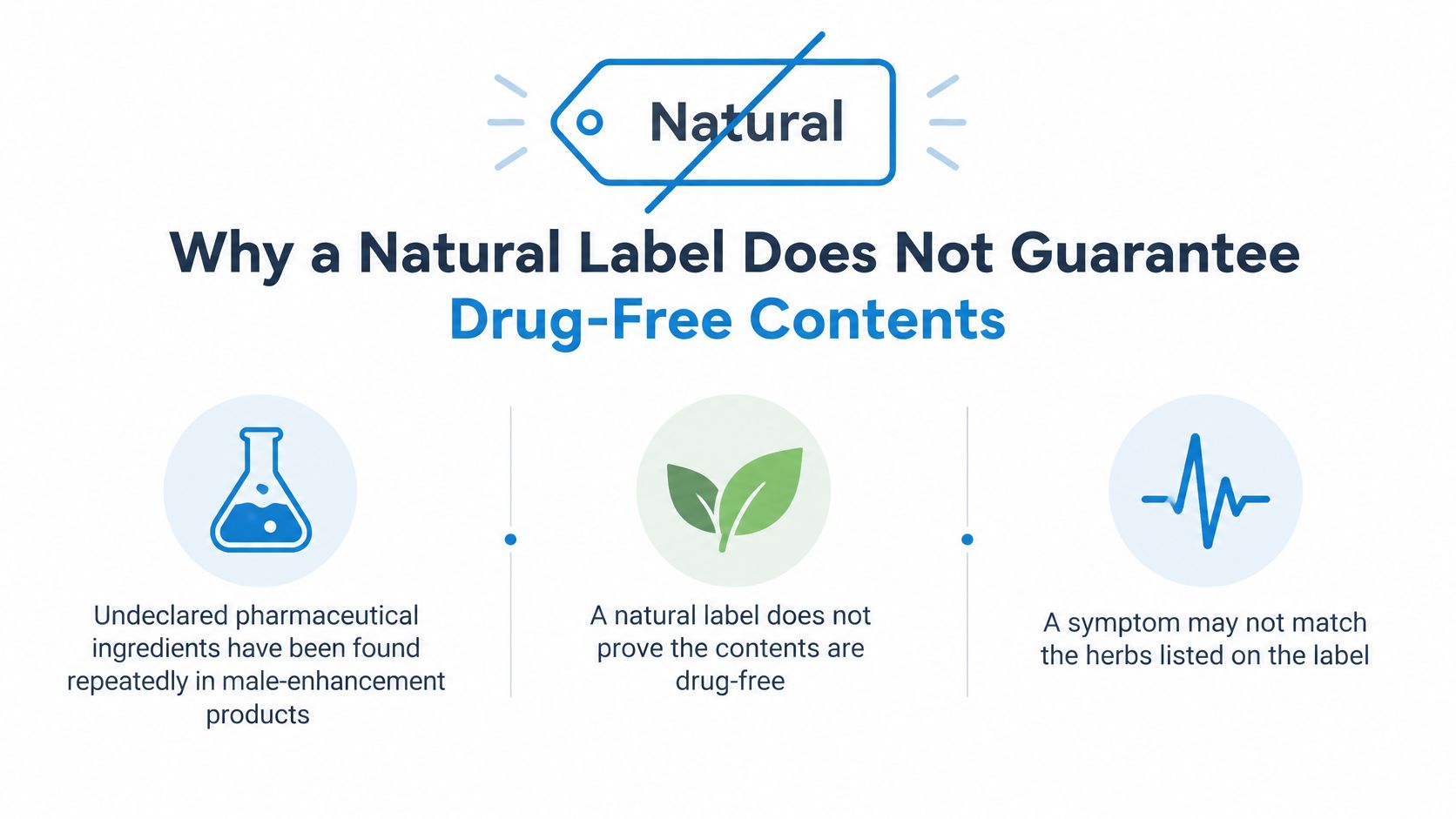
What the figures mean for one capsule. Sildenafil and its analogues relax blood vessels and lower blood pressure. A user who doesn't know the compound is present can't judge their own exposure, can't tell a cardiologist what they took, and can't predict what happens when a prescription joins the mix.
One symptom can reflect several drugs. The review found that 157 adulterated supplements, or 20.2% of the full 776-product sample, contained more than one unapproved pharmaceutical ingredient. A racing heart and a headache arriving together may come from two different undisclosed compounds rather than one, which is why matching your symptoms against an herb list usually fails.
The question that matters after a bad reaction isn't which botanical caused it. It's what to do next, given that the contents may be unreliable.
The label still deserves a read, just not unquestioning trust. A panel that names every ingredient with a stated amount is a better starting point than a proprietary blend, and this walkthrough of herbal supplements for sexual health shows the difference on a real label.
The practical lesson is narrow and useful. The word natural has not reliably meant pharmaceutical-free here, so check a product against regulatory warnings before you buy it, and treat any unexplained effect after taking it as possibly drug-related until a clinician says otherwise.
Nitrate Medicines and the Risk of a Sudden Blood Pressure Drop
One combination produces the most dangerous reaction in this entire category: an enhancement product taken alongside a nitrate medicine.
How the interaction works. PDE5 inhibitors such as sildenafil and tadalafil block the breakdown of cyclic guanosine monophosphate (cGMP), the molecule that keeps blood vessel walls relaxed. Nitrates such as nitroglycerin and isosorbide push the same pathway from the other direction by increasing nitric oxide signalling and cGMP formation. Run both at once and the vessels widen well past the intended range, which can drop blood pressure suddenly and severely.
The National Center for Complementary and Integrative Health warns directly that hidden drug ingredients in sexual-enhancement supplements may interact with nitrates, and its guidance on erectile dysfunction and sexual enhancement notes that FDA notifications describe products containing undeclared sildenafil or tadalafil. A nitrate user therefore can't rely on the label to reveal the risk.
| Combination | Risk | Action |
|---|---|---|
| Nitroglycerin with a product containing hidden sildenafil | Excessive vasodilation and a sudden fall in blood pressure | Do not combine; seek urgent medical evaluation |
| Isosorbide with a product containing hidden tadalafil | Excessive vasodilation and a sudden fall in blood pressure | Do not combine; seek urgent medical evaluation |
| Any nitrate with a product of unknown contents | Interaction risk cannot be assessed | Do not combine; review with a pharmacist first |
| Any nitrate with chest pain or fainting after a pill | Possible serious cardiovascular event | Seek urgent medical attention now |
The people at highest risk are easy to describe. Nitrates are prescribed for angina, which often occurs alongside the same conditions that drive erectile dysfunction: coronary disease, hypertension, diabetes, and high blood lipids. The man carrying a nitroglycerin spray is often the same man browsing this category.
Never combine an enhancement product with a nitrate, and never treat chest pain with a supplement. Those two rules cover most of the danger on this page.
Since the label can't confirm whether sildenafil is present, treat the possibility as real. Ask a pharmacist to review your full medication list before a first dose, and if you've already combined the two and you feel faint, severely dizzy, or you have chest pain, call emergency services instead of lying down to see whether it passes.
Hidden Drug Ingredients in Pills, Gummies, Shots and Chocolates
Capsules aren't the only delivery format any more, and the newer ones are harder to recognize as an exposure.
In a February 2026 consumer warning, the FDA reported that several chocolates marketed for sexual enhancement contained hidden drug ingredients that weren't listed on their labels. The agency also described a product containing undeclared sildenafil and acetaminophen, with a warning that sildenafil may interact dangerously with nitrates.
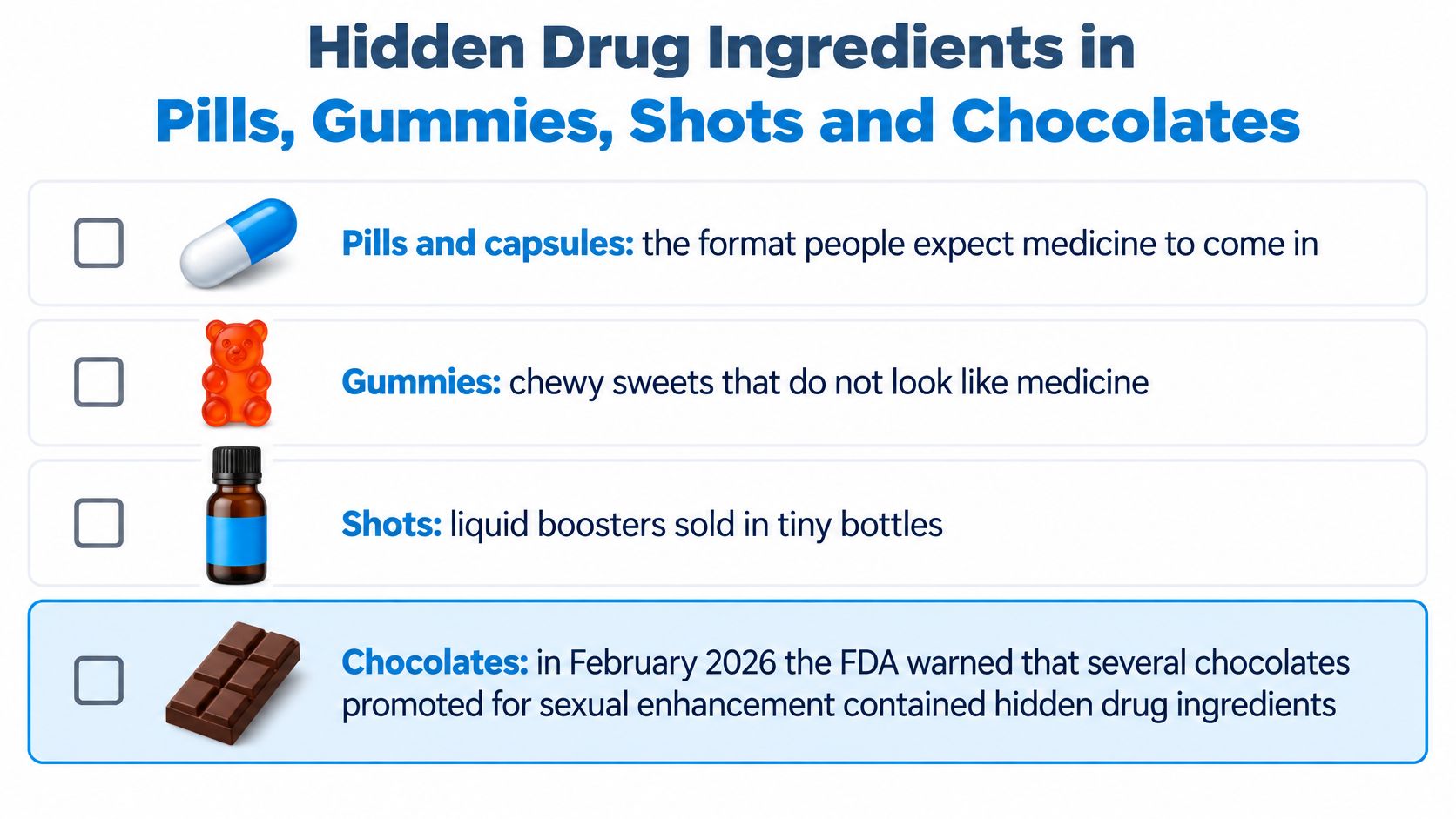
Why the format changes the risk. A chocolate square, a honey sachet, a gummy, or a small liquid shot doesn't read as medicine. People take it with alcohol, take a second because it tasted like dessert, and lose track of how much they've had. The food-like package does none of the work a pill bottle's label does.
Watch for these signals before you open anything:
- Effects that arrive unusually fast. A reaction closer to a prescription drug's onset than to a botanical's slow build is a mismatch worth noticing.
- Prescription-style claims. Language about acting like a drug, or promising prescription-strength results from a sweet, is a category error, not a bargain.
- No manufacturer name or address. A pack with no company, no contact details, and no lot code can't be traced if something goes wrong.
- A wall of ingredients with no amounts. Long blends hide whether any ingredient appears at a meaningful dose.
- No full ingredient list at all. If the packaging won't state everything it contains, there's nothing for you to check.
- Informal channels. Social media sellers, market stalls, and unfamiliar sites leave you with no recourse after a bad batch.
A product marketed for sexual enhancement is a drug exposure until proven otherwise, whatever the packaging looks like.
Multiple substances in one product show up often. FDA notifications have listed combinations involving tadalafil, yohimbine, and flibanserin, so a single reaction can reflect more than one compound acting at once.
Before you buy or use anything in this category, run one check. Search the product name and brand in FDA warning notices and the agency's tainted-products listings for supplements. A match means don't use it. No match isn't a clean bill of health, because undeclared ingredients are common enough here that silence proves very little.
The label itself deserves a close read too, and this guide to how to read a supplement label covers the panel details worth checking.
How to Document and Report a Bad Reaction
A reaction nobody documents is a reaction nobody can investigate. The sequence below takes a few minutes and produces something a clinician, a regulator, and a batch tracer can all use.
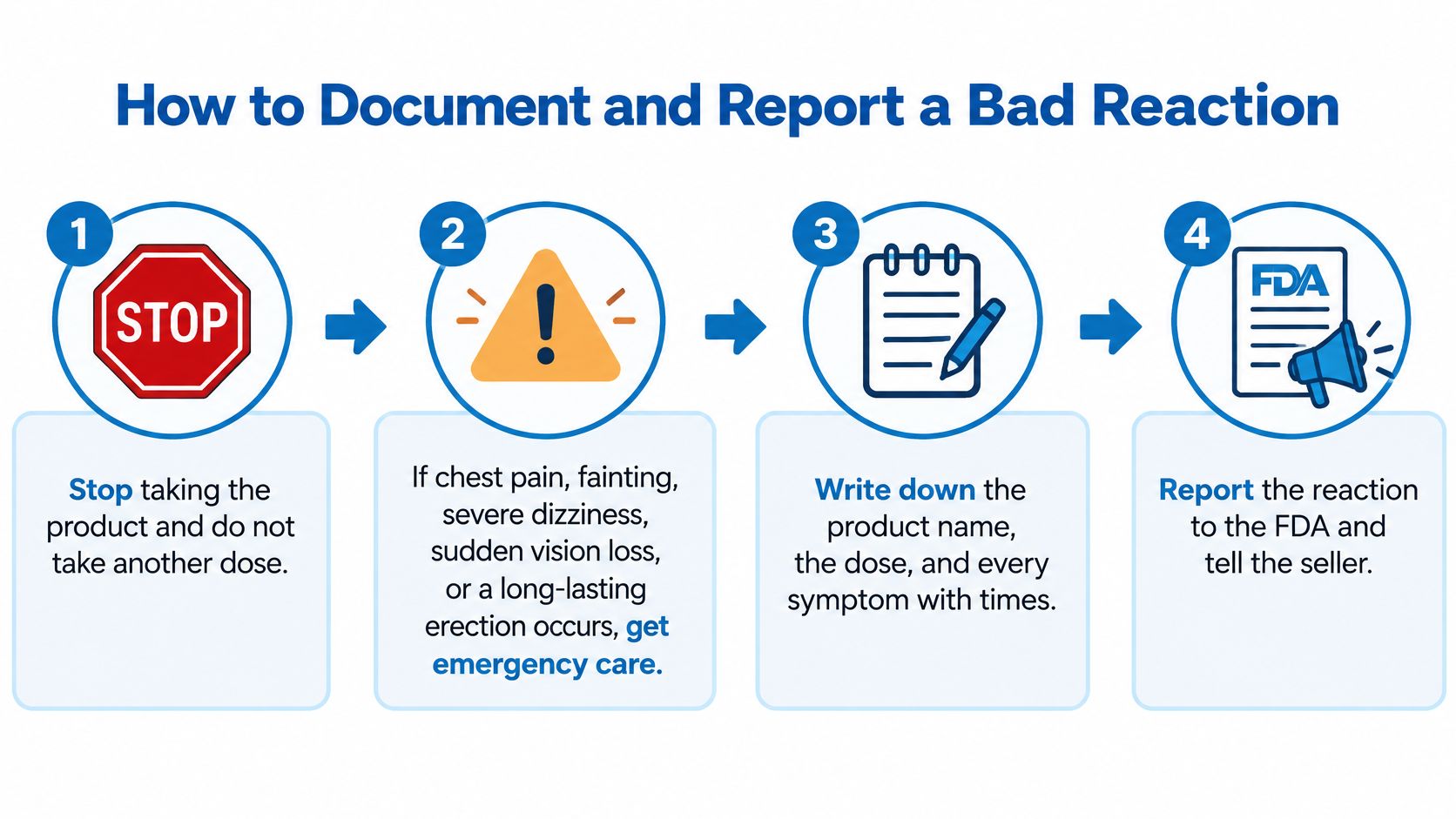
- Stop taking the product and don't take another dose. A second dose scrambles the timeline and can double an exposure you still can't identify.
- Get emergency care first if an urgent row applies. Chest pain, fainting, severe dizziness, sudden vision loss, or an erection lasting more than four hours all jump the queue. Complete the rest of these steps afterward.
- Keep the packaging, including the lot number. That code is the only practical way to trace a batch, and losing it removes the one link between your reaction and everyone else who took the same run.
- Write down what you took. Product name, format, amount, and the time, plus every other medicine, supplement, or drink you had that day. Interactions are dose and timing questions before they're anything else.
- Track each symptom on its own line. Start time, duration, severity, and whether it came back. A pattern points to a cause faster than a paragraph of description.
- Report it to the FDA through its MedWatch safety reporting program. MedWatch accepts reports directly from consumers, not only from clinicians.
- Tell every treating clinician about the product. Say plainly that its contents can't be verified. A clinician can't diagnose an interaction they don't know exists.
A report without a lot number is a dead end. Staff handling your case can't pull a product from a shelf, or warn the next buyer, if they can't identify which run it came from. A useful report carries three things: a clear timeline, the packaging itself, and a complete list of the other medicines you were taking.
This short walkthrough shows how a reported reaction moves from a consumer form into a public safety alert.
Who Needs Medical Review Before a First Dose
Feeling fine on a previous pack says less than you'd think, because batch contents change between runs. The groups below should get a review before a first dose, not after a bad night.
Groups Who Should Get a Review First
Anyone taking a prescription medicine. Heart, blood pressure, diabetes, and cholesterol drugs matter most here, because undeclared PDE5 inhibitors act on the same system those drugs are managing. Bring the actual bottles rather than a mental list.
Men with coronary disease, high blood pressure, diabetes, or high cholesterol. These conditions tie erectile dysfunction to nitrate prescribing, which places this group squarely in the highest-risk category for a blood pressure emergency.
A short medication review is the single most useful appointment in this category.
People with hormone-sensitive conditions or liver problems. Products here sometimes lean on hormonal pathways, and the liver processes whatever arrives in the capsule. A clinician who knows your history can say whether the product belongs in your routine at all.
Pregnant or nursing people, anyone below adult age, and women. Most products marketed this way are built and labelled for adult men, and the safety data don't cover other groups. That isn't a cautious technicality. It means nobody can tell you the risk with any confidence.
Anyone stacking supplements, alcohol, or stimulants. Each addition widens the range of possible interactions and blurs which substance caused what. If you're already taking three things, the fourth deserves a conversation before it deserves a purchase.
Five Questions to Bring to the Appointment
- The product itself and a photo of the label. Names get copied wrong, and a photo settles what you're taking.
- Every medicine, including over-the-counter drugs and supplements. A review only works with the full list.
- Whether a nitrate or an erectile-dysfunction medicine is part of your care. Ask directly. These are the combinations that matter most.
- Which symptoms should trigger a phone call and which should trigger an emergency visit. Get the answer while you're calm, not while you're worried.
- Whether a medication review or lab work is warranted first. Liver and kidney function change how any active compound behaves.
Clinicians can only assess what they're told, and an undeclared ingredient is invisible on a label. We ask anyone using hormone replacement therapy to consult their doctor before taking our products alongside it, and we recommend speaking with a healthcare professional before use if you take medications, have a hormone-sensitive condition, or have liver issues. That guidance exists for the same reason the questions above do.
If you're unsure what to say: give the clinician the product name, what's printed on the label, and the fact that you can't verify the contents. Honesty about uncertainty gets you a better assessment than a confident guess.
A clean record today isn't a guarantee of anything. Batch contents vary between runs, so the fact that last month's pack felt fine says nothing about the one in your hand. If the answer you get is unclear, don't start the product until a clinician confirms it's appropriate for you.
If you're shopping in this category, CalVitamin carries men's wellness formulas in capsules, liquid shots, and gummies, with ingredient panels and serving details on each product page so you can see what you're buying before it arrives. Read the panel first, then bring the questions above to your clinician before your first dose. Browse the men's wellness range at CalVitamin.