Most supplement blogs sort red maca vs black maca into neat, effortless boxes. Pick black maca for men, muscle, and libido; pick red maca for women, hormones, and mood. That shorthand sells jars, yet it collapses the moment you inspect what human and animal trials measured.
Root color isn't a standardized potency grade, and buying by color alone leaves out the details that control what ends up in your capsule. Growing altitude, drying practices, extraction solvents, and actual dose weight shift a product's chemistry just as much as the color of the hypocotyl. Looking at the controlled trials, chemical analyses, and label disclosures side by side gives you a far more reliable way to choose between red and black maca.
Table of Contents
- Red and Black Maca Labels and Side-by-Side Comparison
- What Animal Studies Show About Black Maca
- What the 12-Week Human Trial Found
- How Growing and Processing Change the Profile
- Label Checks Before You Buy Either Color
- Choosing Red or Black Maca for Your Goal
Red and Black Maca Labels and Side-by-Side Comparison
Neither red nor black maca outranks the other as a universally "stronger" root. In a 12-week human trial of 175 adults taking 3 g/day of spray-dried extract, summarized in a 2024 Nutrients review, red maca produced stronger reported improvements in mood, energy, and chronic mountain-sickness scores, while black maca carried higher levels of fatty acids and macamides. Meanwhile, black maca holds the strongest preclinical signal for sperm production in rat experiments, whereas neither color has reliably improved testosterone, libido, or athletic performance in human testing.
Maca (Lepidium meyenii) is a hardy root vegetable grown in the high Andes and sold commercially as raw powder, gelatinized powder, capsules, and concentrated extracts. If you're new to the plant itself, our overview of what maca root is and its potential benefits breaks down its traditional food use alongside modern supplement forms. Red, black, and yellow maca aren't separate species; they're ecotypes of the same plant distinguished by the skin color of the hypocotyl, which is why supplement marketers adopted color as quick shorthand for targeted formulas.
Why Root Color Does Not Equal Potency
Treating color as a potency rating creates three predictable blind spots when you compare bottles online:
- Chemistry shifts don't guarantee clinical outcomes: Analytical tests show gamma-aminobutyric acid (GABA) predominating in red maca extracts and higher lipid-based macamides in black maca extracts, yet a higher concentration of one plant compound doesn't automatically translate into a proven human health effect.
- Preclinical results hinge on the endpoint: Rodent experiments comparing ecotypes produce different winners depending on whether researchers measure daily sperm production, organ weight, or another biological marker.
- Human comparative evidence remains sparse: Only a small pool of controlled human trials tests specific maca colors head to head, and results from spray-dried extracts may not carry over to raw powders, gelatinized powders, or lower-dose capsules.
The comparison table below organizes what controlled analyses and trials have documented for each ecotype, separating verified signals from gaps in the evidence.
| Attribute | Red maca | Black maca |
|---|---|---|
| Ecotype of Lepidium meyenii | Red ecotype | Black ecotype |
| Main phytochemical emphasis | GABA predominant | Fatty acids and macamides higher |
| Glucosinolates in Peruvian samples | Consistently higher | Lower than red |
| Rat sperm production at 7 and 42 days | Not significantly enhanced at 42 days | Significantly enhanced at 42 days |
| Mood, energy and mountain-sickness scores (12 weeks, 3 g/day) | Stronger improvements reported | Weaker improvements reported |
| Sexual desire in 12-week trial | No color-specific figure reported | No color-specific figure reported |
| Testosterone, libido or athletic performance | Not reliably shown | Not reliably shown |
| Strength of human evidence | Preliminary, small trial | Preliminary, few human semen trials |
Reading the Research Profile Table
Four rows in that table do most of the practical work when you evaluate a label. First, the phytochemical emphasis row explains why formulators position red maca around perceived vitality and mood while describing black maca as a lipid- and macamide-oriented extract. Second, the glucosinolates row reflects agricultural comparisons from Peru where red maca consistently tested higher, a difference heavily shaped by cultivation environment.
Third, the rat sperm production row is the main origin of black maca's reputation in male reproductive marketing, even though animal reproductive physiology doesn't map directly onto human fertility. Fourth, look closely at the rows with no color-specific winner. For sexual desire, the human trial reported a combined increase across participants rather than splitting rates between red and black, and for testosterone or athletic output, neither color clears the bar.
Treat this table as a map of published research profiles, never as a guarantee of what a specific jar contains. Two brands can print the exact same ecotype on the front label and deliver entirely different compound levels per serving.
What Animal Studies Show About Black Maca
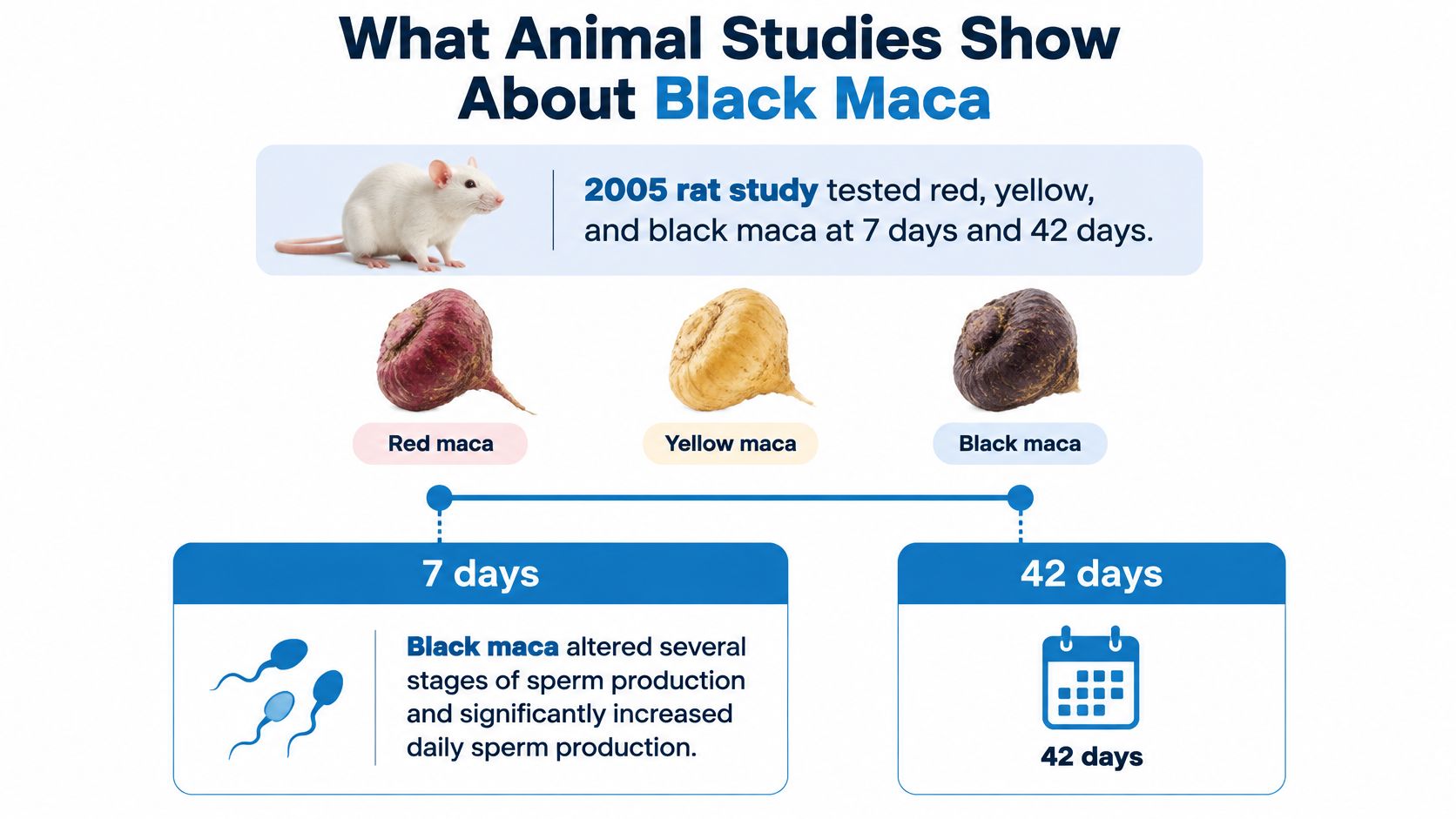
Controlled rodent research created the clearest quantitative split between red and black maca, which is why marketers cite it so often. The experiment, published in 2005, compared red, yellow, and black maca in rats across two treatment windows: a short-term run lasting 7 days and a longer run lasting 42 days. After 7 days, black maca altered several stages of the sperm-production cycle and significantly increased daily sperm production compared with control animals.
By the 42-day mark, black maca stood out even more sharply. It was the only one of the three tested ecotypes that significantly enhanced daily sperm production over the longer window. That experiment gave researchers concrete biological grounds to stop treating all maca colors as chemically or functionally identical, and it remains the single strongest preclinical result attached to any maca color.
The graphic below summarizes how those two time points separated black maca from red and yellow roots in the 2005 experiment.
Why the 84-Day Chronic Study Complicates the Picture
A single short-to-medium trial rarely tells the whole story in pharmacology. In a later chronic rat experiment, investigators administered aqueous extracts equivalent to 1 gram of maca hypocotyl per kilogram of body weight every day for 84 days. Under that longer dosing protocol, the sharp single-color advantage blurred.
Both yellow and black maca increased epididymal sperm count, rather than black acting alone. Meanwhile, all three ecotypes increased seminal-vesicle and coagulating-gland weight without changing daily sperm production at all. Changing the treatment length, extract preparation, and measured endpoint changed which colors looked active. Read carefully, this means the black-maca advantage depends on how you measure it: daily sperm production favors black in shorter protocols, while epididymal count over a chronic window does not.
Rodent sperm data can guide what researchers test next, not guarantee fertility results in men.
Taken together, these experiments confirm that black maca holds the strongest preclinical signal for sperm-related markers. They also highlight a boundary that product pages routinely erase: animal findings depend heavily on the animal model, extract type, dose per kilogram, and specific endpoint tracked. They do not prove that black maca improves human fertility, and they do not show that red maca lacks biological activity in other areas. Color is a shorthand for these results at best, since the measured outcome, not the pigment on the label, is what separated one root from another.
What the 12-Week Human Trial Found
A color on the label is a weak stand-in for what a human trial measured. The centerpiece comparative study, published in 2016 in Pharmaceuticals, used a randomized, double-blind, placebo-controlled design enrolling 175 adults living at either low or high altitude. Participants took 3 grams per day of spray-dried red maca extract, black maca extract, or placebo for 12 weeks. Researchers tracked acceptability, safety, sexual desire, mood, energy, and quality of life.
That endpoint list is what the result can support. Sexual desire scores are not semen analyses, and a mood rating is not a fertility outcome. Clinicians still weigh this setup more heavily than customer anecdotes because the comparison is controlled. The diagram below outlines how the participants were assigned across the three daily arms.

A placebo arm, one fixed extract dose, and a set 12-week schedule remove much of the guesswork in informal product comparisons. The 2024 Nutrients review summary table reports that about 50% of participants experienced increased sexual desire during the trial. Mood and energy scores leaned toward red maca. Red therefore had the clearer signal on those subjective daily measures, not a general potency advantage over black.
Trial Strengths, Limits, and Short-Term Safety
Enrolling 175 adults for 12 weeks beats a tiny uncontrolled pilot.
Twelve weeks is still a short window. The protocol was not built as a large fertility trial, and it did not report semen-quality results that would let either color claim a reproductive effect. Both extracts were judged on the same subjective scores, at the same daily dose of spray-dried material. On that shared ground, red looked stronger where mood and energy moved, while the desire finding is a cohort-level result rather than a guarantee for one person. Dose, extract form, and the endpoint chosen decide what a bottle can claim. Skin color does not.
For a quick visual breakdown of how practitioners interpret these comparative findings in everyday supplement choices, watch the short overview below.
Safety data need the same narrow reading. The 2016 trial tracked acceptability and safety, and that record covers 12 weeks of one spray-dried extract. People taking daily prescription medications, managing hormone-sensitive conditions, or who are pregnant should consult a clinician before starting maca. Color-specific promises stay preliminary next to a stated dose, a named endpoint, and that short safety window.
How Growing and Processing Change the Profile
Even if you pick an ecotype based on published trials, farm and factory conditions can redraw its chemical fingerprint before the powder ever hits a bottle. Compositional analyses of Peruvian samples harvested at approximately 3,800, 4,000, and 4,200 meters, detailed in a 2024 Nutrients review, showed that red maca generally held statistically higher crude protein at certain matched elevations and consistently higher glucosinolate concentrations than black maca. Review data also indicate that black maca tends to contain more macamides and fatty acids, while red maca leans higher in GABA, making color a rough tendency rather than a fixed chemical rule.
Four Variables That Shift Potency Independently of Color
Several agricultural and manufacturing steps move metabolite concentrations up or down regardless of whether the root skin looks crimson or charcoal:
- Altitude and growing region: High-elevation UV exposure, soil minerals, and temperature swings alter how Lepidium meyenii synthesizes secondary metabolites, meaning a red root grown in one Andean valley won't automatically match a red root from another elevation.
- Harvest timing: Pulling roots earlier or later in the growing cycle shifts starch, protein, and sulfur-compound levels before drying even begins.
- Processing method: Drying and milling raw powder preserves native starches, whereas gelatinized powder uses heat and pressure to break down starch for easier mixing, altering heat-sensitive compounds along the way.
- Extraction solvent and ratio: Water extracts pull polar compounds like glucosinolates efficiently, while alcohol or hydroalcoholic solvents capture fat-soluble macamides differently, and concentrating an extract changes how much active material fits in a single gram.
Consider a simple shelf comparison. Say two tubs are both labeled "Black Maca," yet one holds a 1:1 raw root powder and the other contains a 4:1 concentrated extract. If you scoop the exact same gram weight from each jar, you're taking different amounts of concentrated plant compounds despite buying the exact same color.
Quality-control benchmark: Two bottles carrying the same root color can deliver completely different compound levels if their harvest altitude, drying method, or extract ratio differs.
Because color isn't a standardized potency grade, your buying decision shouldn't stop at the front label. Prioritizing dose equivalence and third-party marker-compound assay data tells you far more about what you're swallowing than red-versus-black marketing copy ever will.
Label Checks Before You Buy Either Color
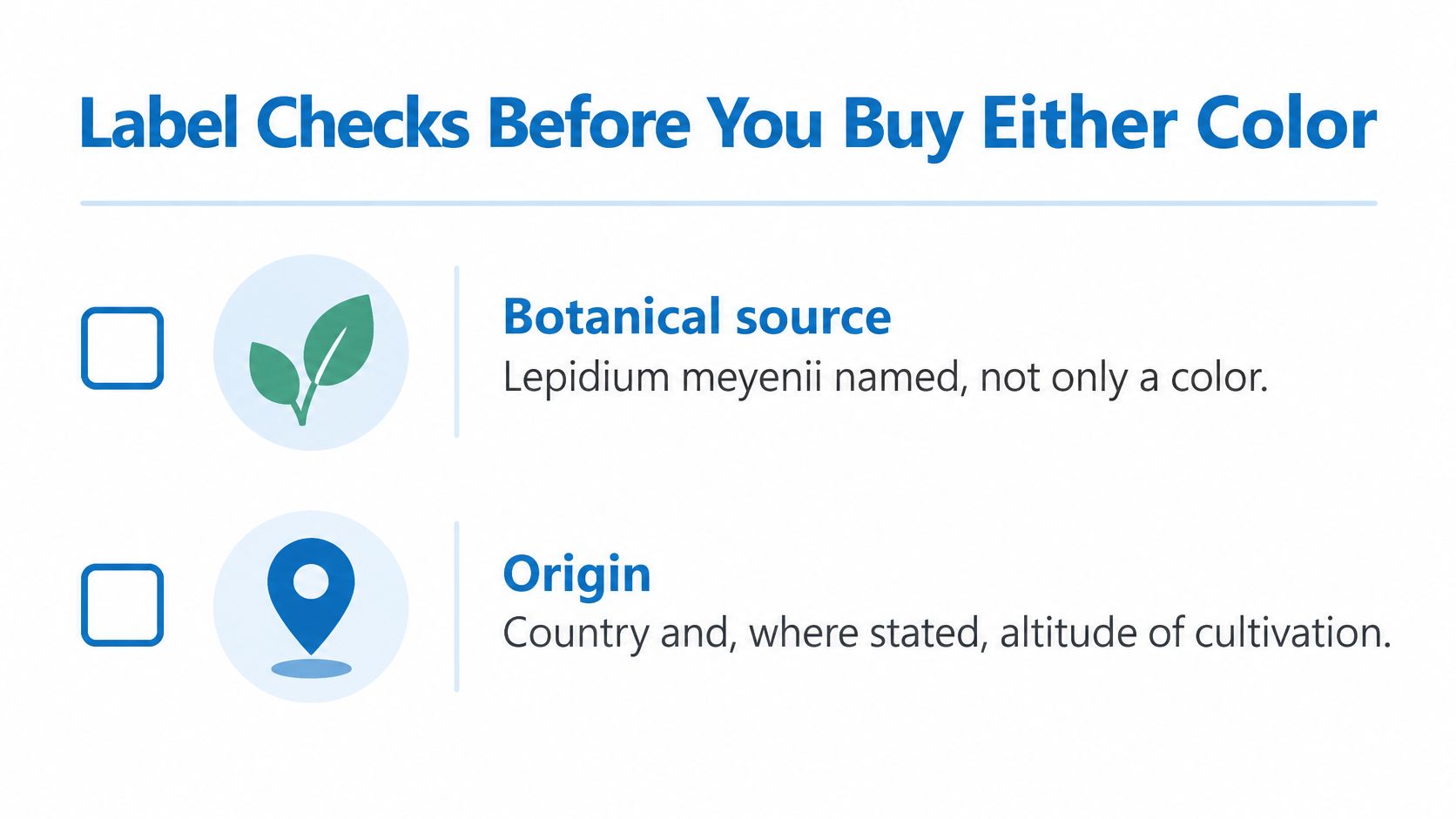
Shopping for maca gets much faster once you stop reading front-of-bottle slogans and go straight to the Supplement Facts panel. The infographic below highlights the first two foundational items every trustworthy label should state clearly.
Run any red or black maca bottle through these seven checks before adding it to your cart:
- Botanical source: Look for Lepidium meyenii printed explicitly on the label, not just "red maca" or "black maca." This check prevents buying vague herbal blends that omit species verification.
- Origin and elevation: Confirm the country of cultivation and, when disclosed, the growing altitude. Knowing where the crop was harvested helps you avoid undocumented supply chains where metabolite profiles swing wildly.
- Processing format: Verify whether the jar contains raw root powder, gelatinized powder, or a spray-dried or solvent extract. Skipping this detail can leave you comparing a starchy whole powder directly against a concentrated extract as if gram weights were interchangeable.
- Extract ratio: On any extract product, check for a stated concentration ratio, such as a hypothetical 4:1 or 10:1 label. Without an extract ratio, comparing effective doses across two competing brands becomes guesswork.
- Dose per serving: Check the actual milligram or gram weight per serving and compare it against the spray-dried extract dose used in the human trial, adjusting carefully when converting between plain root powder and concentrated extract. This prevents paying for "dusting" formulas that pack a tiny fraction of a meaningful serving into a single capsule.
- Third-party marker testing: Search the label or product page for verified assay results measuring macamides, GABA, or glucosinolates. When assay data are missing, the root color name carries the entire weight of the product's quality claim.
- Intended use claims: Walk away from any label promising guaranteed fertility outcomes, testosterone spikes, or athletic breakthroughs based on color alone. Flagging overblown claims keeps you from buying products built on marketing hype rather than verified human evidence.
The One-Minute Label Test
You don't need a chemistry degree to screen out weak supplements in under a minute. Flip the bottle over (or scroll down the product page) and hunt for just two concrete details: an extract ratio (or clearly specified powder form) and third-party marker testing.
If a supplement label lists neither an extract ratio nor third-party marker testing, you're paying for a color name rather than a verifiable dose.
If neither detail appears anywhere on the packaging or listing, skip it and keep looking. When you want a structured breakdown of quality standards across capsules, powders, and concentrated formulas, check our guide to choosing the best maca supplement for your routine.
Choosing Red or Black Maca for Your Goal
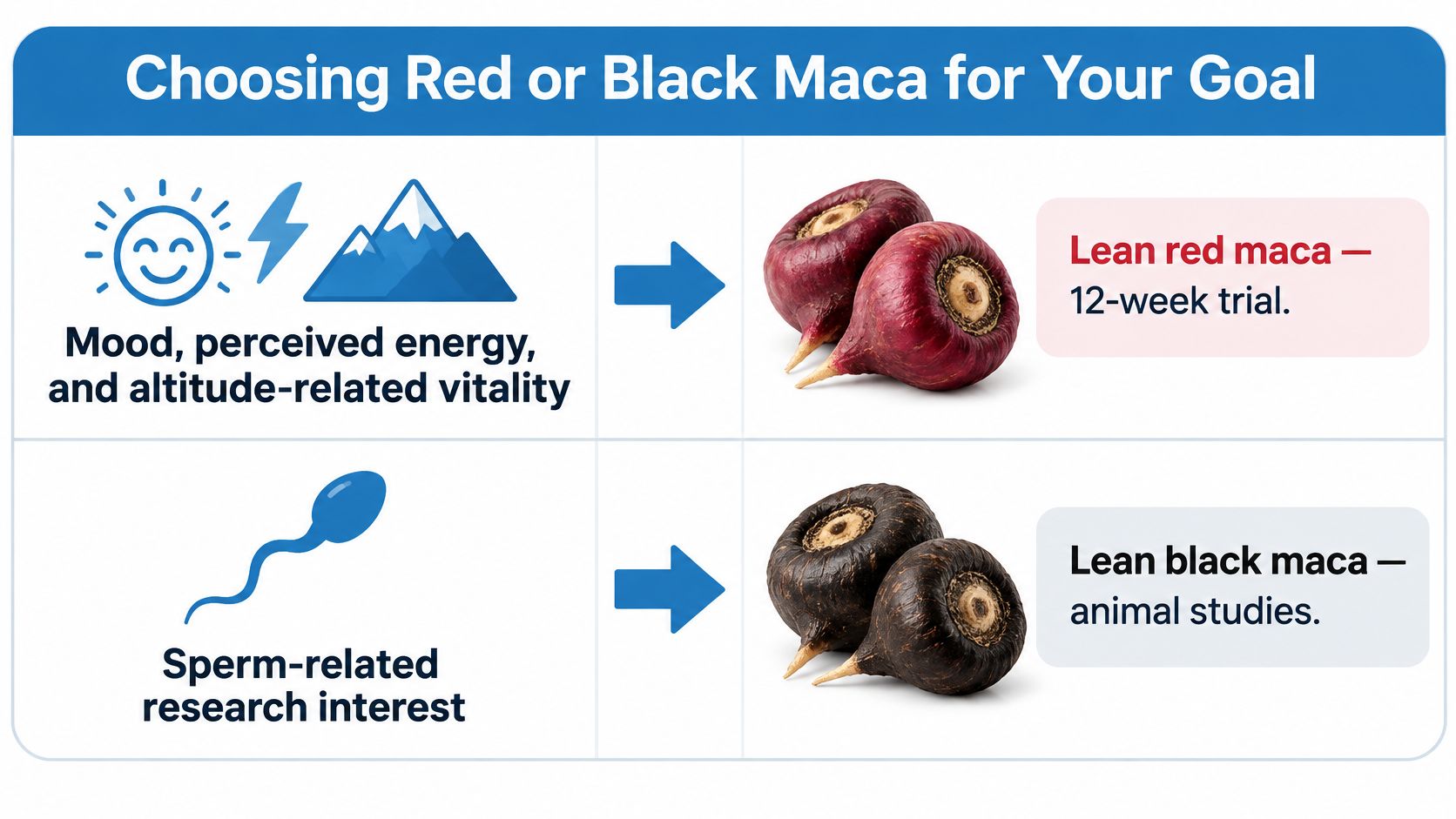
Color is a weak shorthand for potency. Use it only as a starting signal, then match the product to the outcome you care about and the dose details that can support that claim.
| Your goal | Leaning | Evidence behind it | Check before buying |
|---|---|---|---|
| Mood, perceived energy, altitude-related vitality | Red maca | Stronger mood and energy scores in 12-week trial | 3 g/day equivalent dose and extract type |
| Sperm-related research interest | Black maca | Strongest preclinical sperm signal in rats | Animal data only; no proven human fertility effect |
| Macamide or fatty-acid-focused extract | Black maca | Higher macamides and fatty acids in analysis | Third-party marker assay |
| Athletic performance or testosterone | Neither color established | Neither color reliably shown to help | Clinical advice before use |
The practical conclusion is narrow. Red maca has the better human signal for mood and perceived energy, while black maca's appeal rests more on compositional findings and animal research. That means a black label may be rational for someone comparing extracts by markers, but it should not be treated as a proven fertility product. A red label may fit an everyday vitality goal, but only when the serving lines up with the trial benchmark.
Four Steps Before Adding Maca to Your Routine
Pick the ecotype whose reported signal fits your priority: Lean toward red maca if mood, perceived daily energy, or altitude vitality is the target. Lean toward black maca if you are specifically interested in a higher-macamide extract or following preclinical sperm research, while keeping the human evidence gap in view. CalVitamin carries maca blends among its herbal supplements. Apply the same label and dose checks to those blends before buying them, because a multi-color formula still needs a disclosed serving and usable product details.
Audit the label before trusting the color: Confirm Lepidium meyenii botanical identity, country of origin, raw versus gelatinized or extract processing, extract ratio, and third-party marker assays. These details separate a defined product from a pigment name. They also show whether the formula is built around root powder, a concentrated extract, or a blend whose individual ecotype amounts are unclear.
Verify dose equivalence for your chosen format: Convert capsule counts, raw powders, and concentrated extracts carefully so your daily serving lines up sensibly with the human trial benchmark. Our breakdown of maca root dosage walks through practical serving conversions across formats. This step matters because two bottles with the same root color can deliver very different daily amounts.
Loop in a clinician when health conditions overlap: Before starting any maca formula, talk with a qualified healthcare provider if you are addressing fertility concerns, managing hormone-sensitive conditions, taking regular medications, or hoping for testosterone or athletic outcomes that neither maca color has reliably demonstrated.
CalVitamin is an online retailer of dietary supplements and wellness products based in Jacksonville, Florida. Its catalog includes vitamins, minerals, proteins, probiotics and prebiotics, herbal formulas, sexual wellness enhancers, and beauty and personal care items. Browse product labels, compare serving strengths, and choose formulas that fit your goals.