Taking zinc every day to “boost immunity” isn't automatically a good health decision. A mineral your body needs can still be a poor addition to your routine when you already get enough, choose an unsuitable dose, or take it alongside a medicine that interacts with it. Understanding zinc supplements effects starts with a more useful question: what problem are you trying to solve?
Table of Contents
- Why Zinc Is a Precision Tool, Not a Daily Booster
- How Zinc Works in the Body
- Forms of Zinc and Why the Label Matters
- What Zinc Can and Cannot Change in Your Body
- When Supplementation Actually Helps
- Dosage, Timing, and How to Avoid Interactions
- Too Little, Too Much, and the Copper Problem
Why Zinc Is a Precision Tool, Not a Daily Booster
More zinc isn't necessarily better. The sensible goal is adequate zinc availability, not the highest intake you can tolerate. Think of supplementation as correcting a missing input rather than upgrading every system in an already well-nourished body.
This distinction changes how you shop. A person with clinician-identified inadequacy has a specific reason to consider supplementation. Someone buying a bottle because its packaging promises immune support still needs to establish whether additional zinc is appropriate.
Start with the reason, not the bottle
Before comparing products, write down what you want zinc to accomplish. Correcting inadequate intake, managing a confirmed deficiency, and trying something during a cold are different decisions. They shouldn't automatically lead to the same product or schedule.
A practical starting point is to separate these questions:
- Need: Is there a credible reason to suspect inadequate intake or status?
- Purpose: Are you addressing nutrition, considering a short-term intervention, or responding to an unexplained symptom?
- Suitability: Can the product fit safely around your existing supplements and medicines?
These questions also help you evaluate marketing. A label describing a nutrient's normal biological role doesn't establish that taking more improves that function in you. “Supports” shouldn't be read as “will produce a noticeable benefit.”
Buying principle: Choose a reason for supplementation before choosing a zinc formulation.
Decide what success would mean
For a nutrition-related problem, success might mean following an agreed plan and reassessing whether supplementation remains necessary. It shouldn't mean continually increasing the dose because you haven't felt an immediate change.
Don't use a subjective feeling of wellness as your only safety check, either. Your purchasing decision should account for dose, duration, and medication timing even when you feel fine.
Zinc is a precision mineral, not a general-purpose wellness upgrade. Treating it with medication-like care doesn't mean everyone needs a prescription. It means the reason, amount, and schedule deserve more attention than the promise on the front of the bottle.
How Zinc Works in the Body
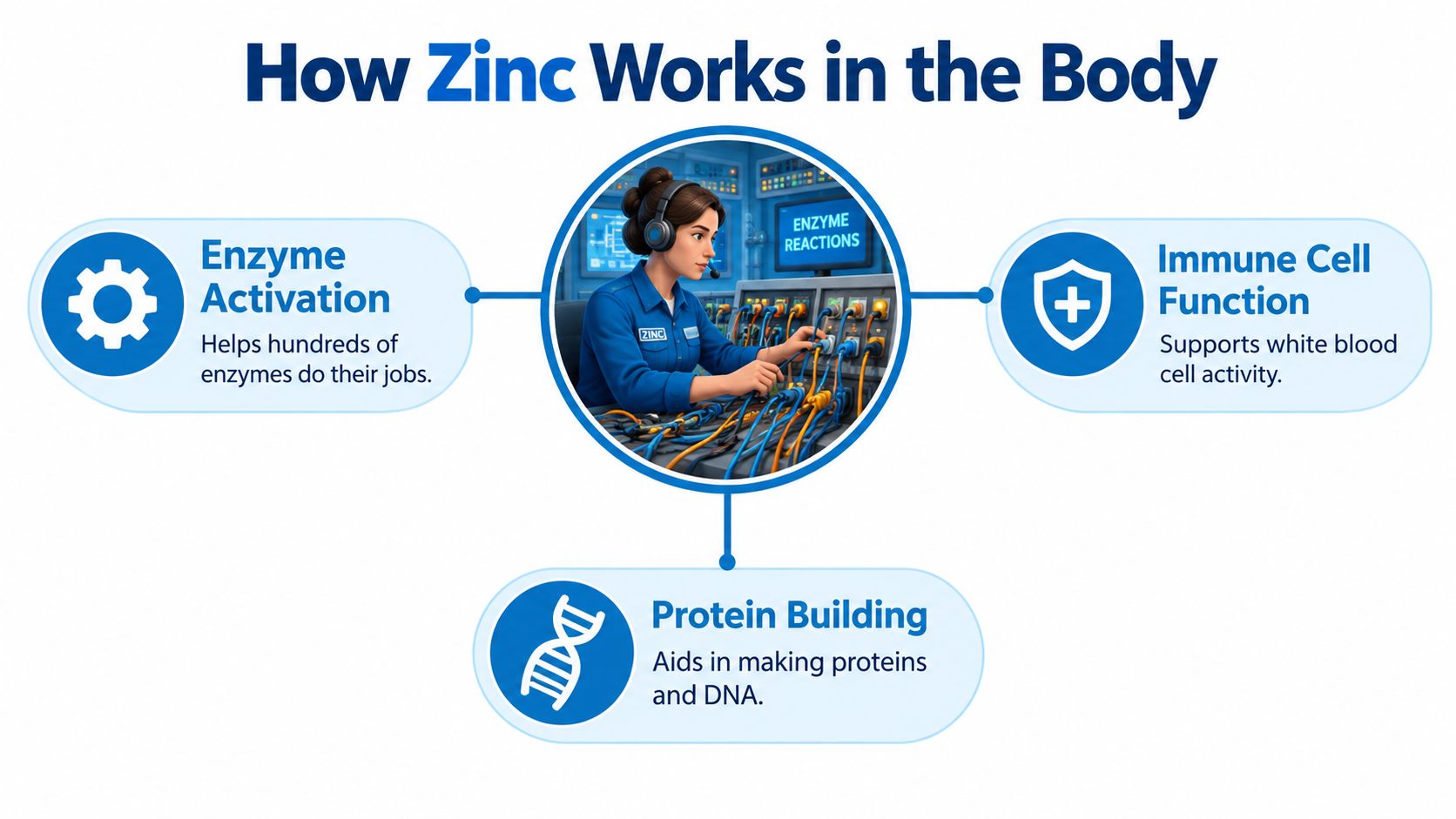
Think of zinc as a switchboard operator helping cellular processes connect correctly. The analogy isn't literal, but it captures something important: zinc participates in a network of functions rather than acting as a single-purpose immune ingredient.
The NIH Office of Dietary Supplements zinc fact sheet describes zinc's involvement in hundreds of enzymes and transcription factors supporting DNA synthesis, immune signaling, antioxidant defense, and protein metabolism. It also identifies serum zinc below 70 mcg/dL in women and 74 mcg/dL in men as indicative of inadequate status, while cautioning that inflammation, infection, fasting status, and collection timing can influence the result.
From cellular instructions to everyday function
Enzymes help chemical reactions occur. Transcription factors help regulate how cells use genetic instructions. Zinc's involvement in both explains why inadequate availability can affect more than an isolated laboratory measurement.
Protein metabolism and DNA synthesis matter because cells need to maintain their structures and carry out their instructions. Immune signaling matters because an immune response requires coordination, not more activity. Antioxidant defense concerns how the body manages reactive molecules, not a promise that supplements remove every source of cellular stress.
The concept map below connects those functions without turning them into separate treatment claims.
A mechanism isn't a diagnosis
It's tempting to reason that because zinc participates in protein building, taking it must improve skin recovery. The same leap appears in claims about testosterone: a nutrient's involvement in physiology isn't enough to establish a hormone-enhancing effect from supplementation.
Use biological mechanisms to understand why adequacy matters, not to predict a treatment result.
- For test results: Ask how the blood sample and your health at the time affect interpretation.
- For symptoms: Ask whether another explanation needs evaluation before assuming zinc inadequacy.
- For benefit claims: Look for evidence about the actual outcome, not just a diagram of a pathway.
A serum result belongs in a clinical context. It isn't a stand-alone instruction to buy a high-dose supplement, and a biological explanation isn't a substitute for evidence that a particular intervention helps.
Forms of Zinc and Why the Label Matters
Two bottles can display similar-looking amounts while describing different things. Elemental zinc is the zinc itself; the compound name describes the substance used to supply it. Confusing those terms can make a product comparison misleading.
As the NIH guidance noted earlier explains, compare elemental zinc rather than the compound's total weight. If the Supplement Facts panel identifies an amount of zinc followed by a form in parentheses, don't assume that amount represents the weight of the entire compound. If the wording is unclear, ask the retailer or pharmacist to clarify it.
Common Zinc Forms Compared
The useful comparison below focuses on what to verify. It doesn't assign absorption rankings or fixed elemental amounts that can't be established from the product's actual label.
| Form | Typical elemental zinc | Common use | Notes |
|---|---|---|---|
| Zinc picolinate | Product-specific; check the zinc amount | A candidate for dietary supplementation | The form name alone doesn't establish a better outcome |
| Zinc gluconate | Product-specific; check the zinc amount | Considered in supplements and lozenges | Distinguish nutritional use from a cold-treatment question |
| Zinc citrate | Product-specific; check the zinc amount | A candidate for dietary supplementation | Compare dose and directions, not just the compound name |
| Zinc oxide | Product-specific; check the zinc amount | An alternative formulation to evaluate | Don't infer absorbed zinc from compound weight |
| Zinc sulfate | Product-specific; check the zinc amount | Another option for an appropriate supplementation plan | Review the complete formulation and your experience with it |
| Zinc chelates | Product-specific; check the zinc amount | Options marketed with a particular binding form | “Chelated” doesn't establish suitability for your situation |
Compare products without guessing
Start with the panel, then review serving size and directions. A serving may involve more than the single tablet or capsule you were planning to take. CalVitamin's guide to reading a supplement label is a useful companion when you're checking those distinctions.
Consider format separately from mineral form. A lozenge and a capsule aren't interchangeable evidence-wise: the clinical question, timing, dose, and exposure duration may differ. Cold-lozenge findings don't automatically justify indefinite capsule or gummy use.
A more technical ingredient name isn't a reason to accept a less suitable dose.
Absorption and tolerability are legitimate questions, but don't fill gaps with assumptions. Ask what evidence supports the specific comparison being advertised, and prioritize a clearly labeled product that fits an appropriate plan over an unsupported claim of superior delivery.
What Zinc Can and Cannot Change in Your Body
Zinc can shift a laboratory result without changing how a person feels. Keeping those outcomes separate helps prevent a change in a marker from being mistaken for proof that a supplement treats a disease.
A meta-analysis of inflammation and oxidative-stress trials included 25 randomized controlled trials involving 1,428 adults. It reported weighted mean changes of −0.03 mg/L in C-reactive protein, −3.81 pg/mL in interleukin-6, −0.78 micromol/L in malondialdehyde, and +95.96 mmol/L in total antioxidant capacity.
C-reactive protein and interleukin-6 are related to inflammation. Malondialdehyde is used to assess lipid-peroxidation burden, while total antioxidant capacity summarizes aspects of antioxidant activity. These measurements offer clues about biological processes, much as a dashboard reading can show that a system has changed without revealing whether the change improved the whole journey.
The results support possible effects on inflammation-related and redox measurements. They do not show that zinc treats every inflammatory condition. The trials differed substantially, and the analysis found no significant changes in nitric oxide or glutathione. A statistically significant average shift also does not tell you whether one person will feel better.
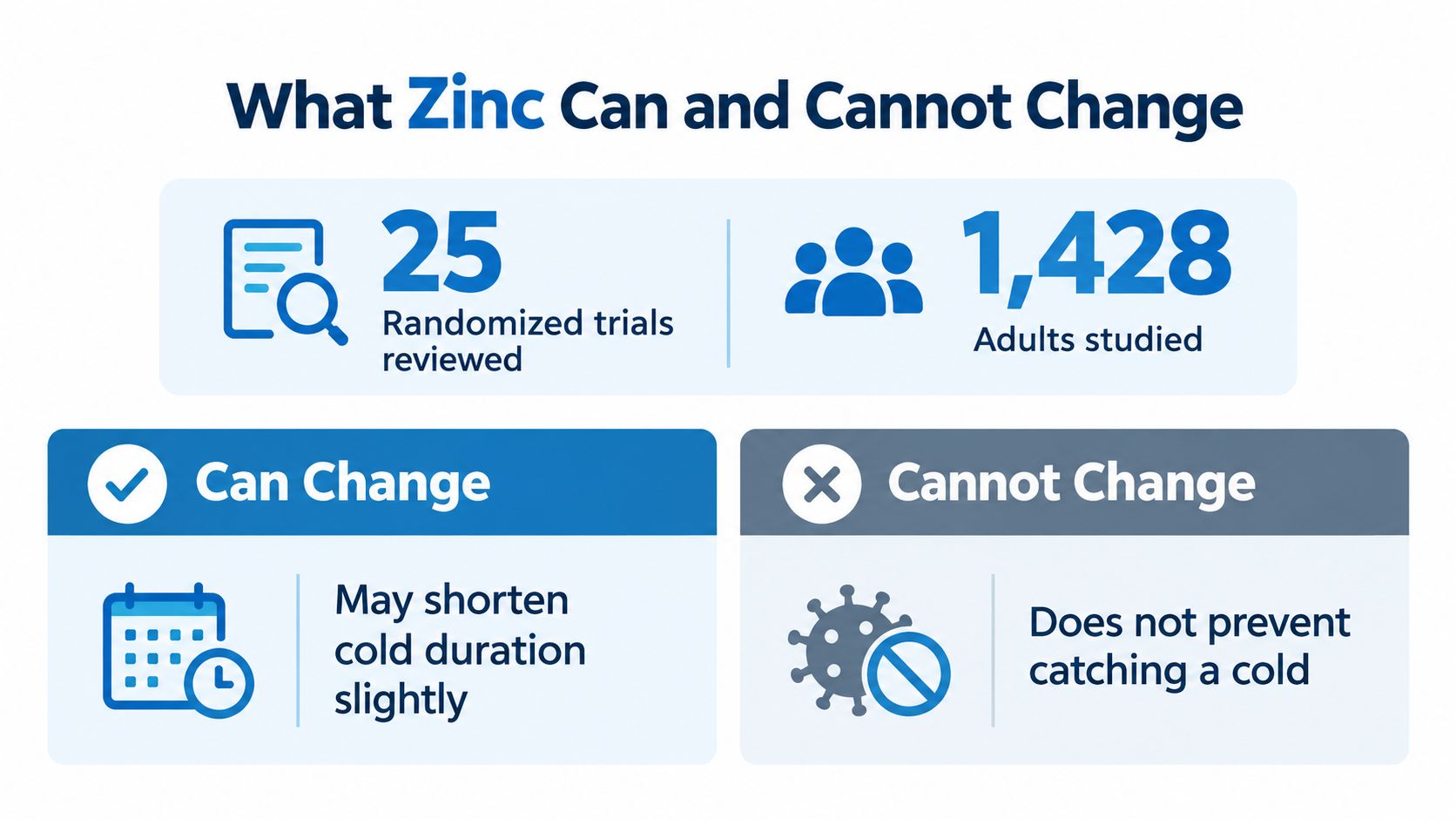
The infographic's cold-related message should be read with care: a possible effect on illness duration is different from preventing infection. Those are separate outcomes, and evidence for one does not establish the other.
Match claims to outcomes
A biological role can make a benefit plausible, but it cannot prove that extra zinc will produce that benefit:
- Inflammation markers: A biomarker shift may support a mechanism, but it does not establish treatment of a disease.
- Wound healing: Zinc's role in cellular maintenance does not show that supplementation speeds every wound's recovery.
- Acne: Antioxidant findings do not establish that a zinc supplement will clear skin.
- Hormonal concerns: Changes in the markers above do not demonstrate improved testosterone or sexual performance.
For persistent acne, a wound that is not healing, or a hormonal concern, seek an assessment focused on that problem. The key question is whether zinc is limiting the process, not whether the body uses zinc.
The evidence supports a narrower conclusion than a product claim: supplementation can affect certain measurements under the conditions studied. That is not evidence of a universal anti-inflammatory remedy.
When Supplementation Actually Helps
Zinc makes sense when it addresses a specific need. A pill organizer can turn a supplement into a daily habit, but convenience alone does not show that the habit is useful.
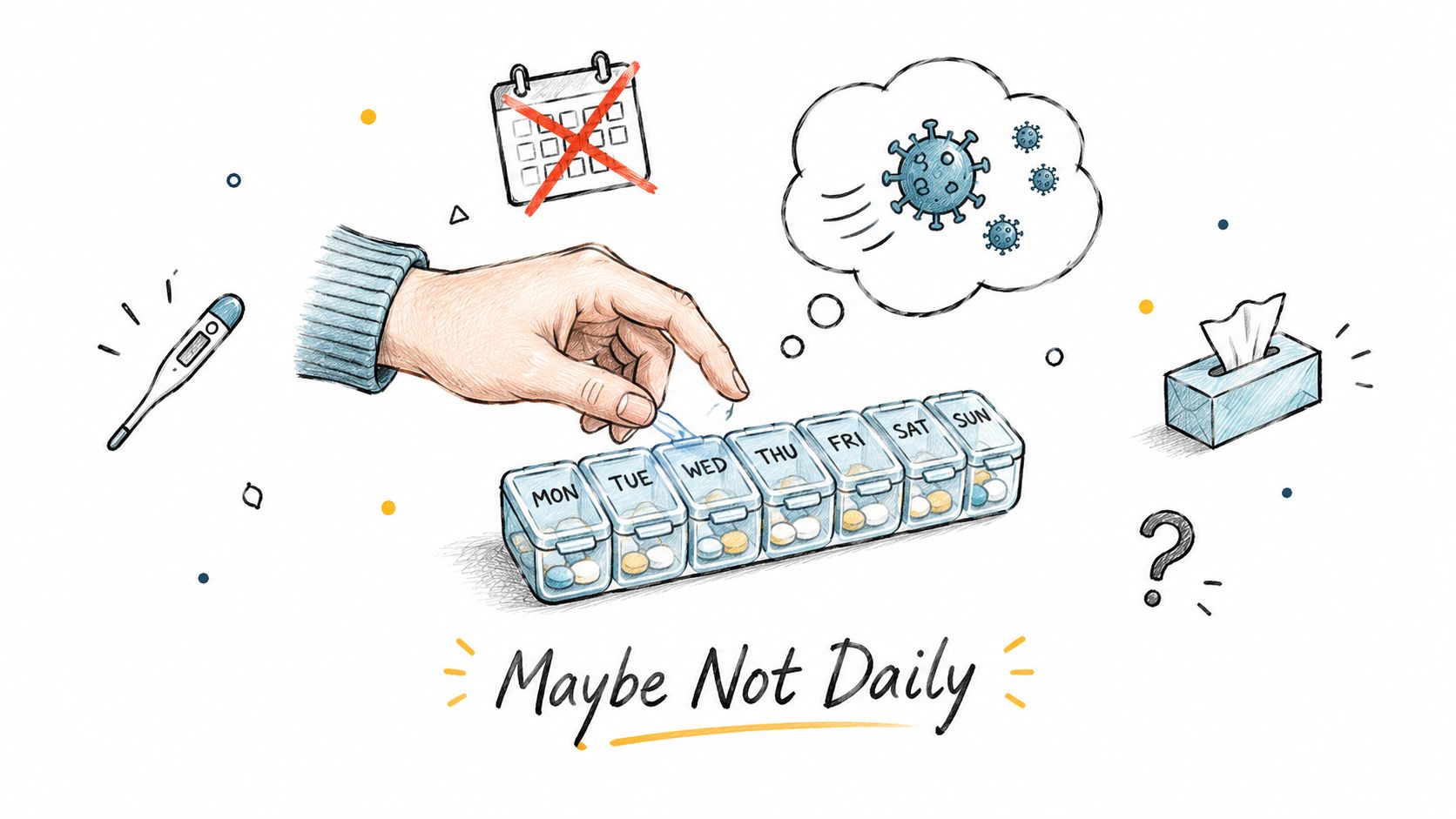
For colds, the distinction is between preventing an illness and changing its course after symptoms start. The Cochrane review of zinc for the common cold found that zinc probably has little or no effect on preventing colds, while it may modestly shorten an illness that has already begun. The review also found more non-serious adverse effects with zinc use.
These findings describe different outcomes, not a contradiction. A tool that may affect the length of an existing cold is not necessarily useful for avoiding infection. And “may modestly shorten” describes a possible effect, not a promise about your next cold or every zinc product.
If year-round cold prevention is your main reason for buying zinc, the evidence does not support treating it as a dependable shield. A broader guide to vitamins for immune support can help put supplement claims in context, without implying that every ingredient associated with immunity belongs in a daily routine.
A clearer reason to supplement is a deficiency identified by a clinician. If your diet may not provide enough zinc, review your usual foods and any supplements you already take rather than guessing from a broad risk category.
The details matter. Explain what foods you avoid and what you eat instead; describe digestive symptoms and any diagnosed condition; and ask for advice suited to you if you are pregnant, breastfeeding, or older. These circumstances can guide an individualized review, but none proves by itself that you need a supplement.
A useful decision has a purpose and a point for reassessment. If you cannot say what need zinc is meant to address, a daily habit may be running ahead of the evidence.
Dosage, Timing, and How to Avoid Interactions
Zinc's schedule depends on what else you take. A supplement can be reasonable in amount yet interfere with a medicine if the two are taken too close together. Timing is part of the dose decision, not a minor detail to sort out later.
For adults, the tolerable upper intake level is 40 mg daily from all sources combined. This is a ceiling, not a target or a supplement-only allowance: zinc from food, fortified products, supplements, and zinc-containing medicines all counts. The NIH consumer zinc guidance advises taking tetracycline or quinolone antibiotics at least 2 hours before zinc or 4–6 hours after zinc, and separating penicillamine from zinc by at least 1 hour.
Choose a schedule with your pharmacist, and keep the prescribed antibiotic timing unchanged unless your prescriber advises otherwise. The gap works in either direction: the antibiotic can come first with the shorter interval before zinc, or zinc can come first with the longer interval before the antibiotic.
Thiazide diuretics can increase urinary zinc losses when used long term. That may be relevant during a medication review, but it does not tell you to raise your dose. Ask a clinician or pharmacist to consider your medicines and overall intake together.
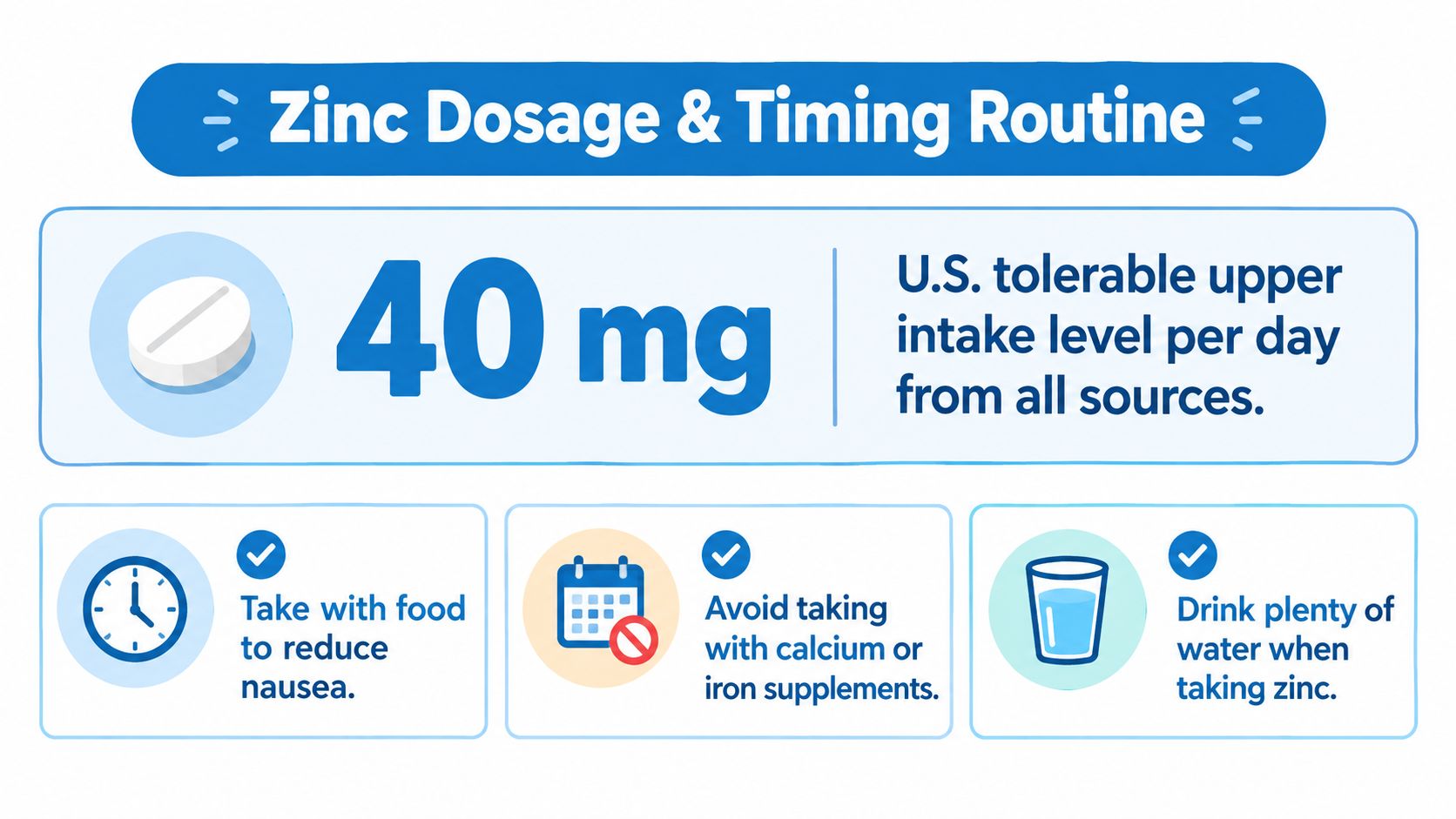
Use the graphic as a prompt to check timing and total intake, not as a personalized schedule. Its general meal and mineral suggestions should not replace medicine-specific advice.
Before buying a product, lay out your complete routine. Include multivitamins, mineral supplements, immune formulas, fortified products, and medicines, then check their labels for overlapping zinc. Share the ingredient panels and full medicine list with your pharmacist. If you have kidney-related conditions or other treatment concerns, ask before adding zinc. Set a point to review the routine rather than continuing a high-dose product indefinitely without clinical supervision.
A combination formula still needs an ingredient-by-ingredient check. This guide to zinc and vitamin D can help you review a product containing both, but combining nutrients does not remove the need to check doses and timing. If nausea occurs, review the amount, schedule, and possible interactions before continuing; do not increase the dose or assume the brand is at fault.
Too Little, Too Much, and the Copper Problem
The difficult part of self-assessing zinc is that symptoms don't reliably tell you which direction to adjust. A concern about nutrition can be real without identifying the nutrient responsible. A supplement-related problem can also develop without an obvious immediate warning.
The safest response isn't to decide that every unexplained symptom means you need more zinc. It's to put symptoms, diet, supplement exposure, and medical history together.
Symptoms are reasons to investigate
Slow wound healing, frequent infections, changes in taste or smell, hair thinning, and skin concerns may prompt someone to consider zinc. Don't treat that list as a diagnostic checklist. These concerns alone don't establish inadequate zinc status or demonstrate that supplementation will improve them.
A more useful clinical conversation includes what changed, when it started, and what you were taking at the time. Bring product labels rather than relying on a description such as “just a mineral supplement.” Include products you use intermittently, too.
For example, someone concerned about hair thinning might already be taking both a beauty supplement and an immune formula. Before adding standalone zinc, the useful next step is to examine those labels and seek an assessment of the hair concern. That approach avoids turning an unconfirmed explanation into additional exposure.
Safety signal: Unexplained symptoms deserve assessment, not an automatic increase in zinc.
Why copper deserves attention
As the NIH safety guidance explains, excessive long-term zinc intake can impair copper absorption. The consequences can extend beyond nausea or stomach discomfort to copper deficiency, anemia, neutropenia, and neurological complications.
Anemia involves a problem with red blood cells or their oxygen-carrying capacity. Neutropenia means a reduced level of neutrophils, a type of white blood cell. These are medical findings, not conditions you can reliably identify by how a supplement makes you feel.
Severe copper deficiency can involve numbness, weakness, or coordination problems. Don't dismiss those symptoms as an ordinary supplement adjustment, and don't try to solve them by adding copper without assessment. Tell a clinician about prolonged zinc use and bring the full ingredient list.
Avoid treating one supplement problem with another
The copper issue can tempt shoppers into a shortcut: buy a zinc-and-copper combination and assume the risk is covered. That isn't a substitute for establishing whether the zinc dose is appropriate or whether a deficiency already exists.
- If inadequacy is suspected: Seek a nutrition and medical review before selecting a treatment dose.
- If excess is possible: Review the complete intake history rather than focusing only on the newest bottle.
- If neurological symptoms appear: Seek medical assessment instead of experimenting with another mineral.
Balanced supplementation means resisting both assumptions: that zinc is unnecessary for everyone, and that more is beneficial for everyone. The sound decision is the one matched to your needs, with a clear dose, medication-compatible schedule, and reason to reassess.
CalVitamin offers dietary supplements, minerals, and wellness products alongside educational guides to help you examine labels and compare options. Visit CalVitamin to review available products, then bring your chosen zinc label and current medication list to a pharmacist or clinician before starting a routine.